- RRT timing:Deferred 優於 early/pre-emptive(1C)— AKIKI、IDEAL-ICU、STARRT-AKI 三大 RCT 共識:early RRT 不改善存活,反增 RRT 暴露。
- RRT modality(不穩定 AKI):CRRT 或 acute PD 優於 conventional IRRT(2C);acute brain injury 一律 CRRT。
- RRT dose:CRRT 20–25 ml/kg/h effluent、IRRT Kt/V 3.9/週(1B);反對高劑量 hemofiltration(HVHF)對 sepsis(1B)。
- Anticoagulation:Regional citrate 優於 heparin(CRRT,無 citrate 禁忌;1B)— RICH trial 共識。
- Post-AKI/AKD coordinated follow-up(1B)— 把「出院就消失」改為「結構化追蹤」。
- RASi 後重啟:除非禁忌,AKI 後依 evidence-based 適應症 start 或 restart(成人 1B、兒童 1D)。
- 3 個月複查 kidney function 與 damage markers,評估 resolution 與新發/進展 CKD。
5.1 RRT Timing — 何時啟動
Conceptual:RRT continuum(Figure 14)
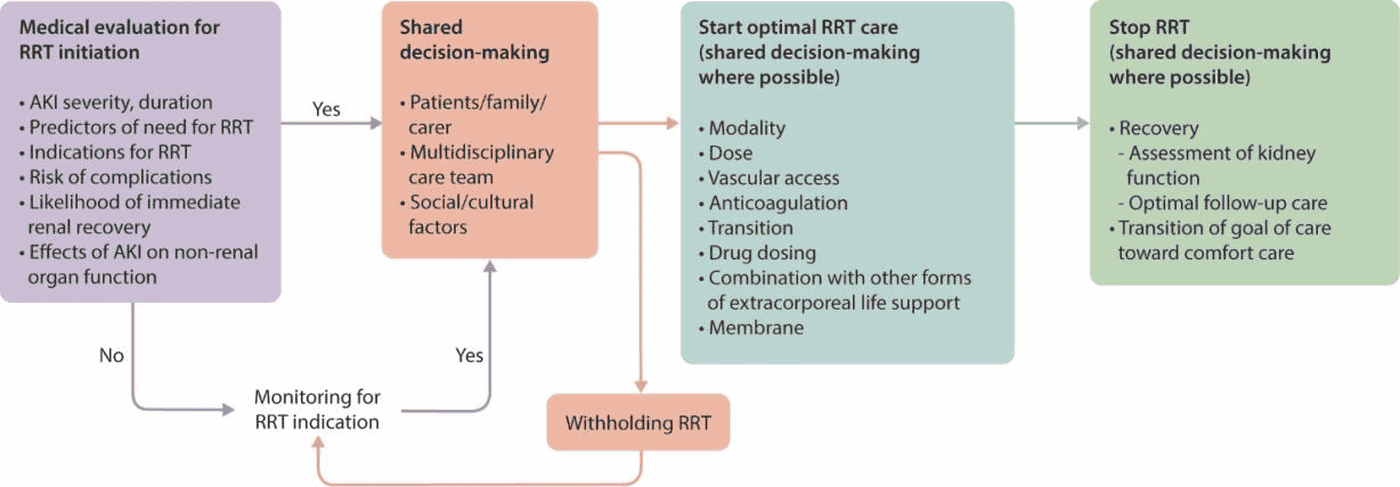
來源:KDIGO 2026 Clinical Practice Guideline for AKI and AKD (Public Review Draft, March 2026) — 個人教學使用,原始版權屬 KDIGO。
Figure 14 把 RRT 過程分成 4 個階段 — Medical evaluation → Shared decision-making → Start optimal RRT care → Stop RRT。整章 Chapter 5 就是針對這 4 階段給出具體 recommendation。注意「shared decision-making」貫穿全程(這條也適用於 withholding RRT 的決定)。
Deferred vs Early — Recommendation 5.1.1
Recommendation 5.1.1(1C):成人 AKI Deferred timing of RRT initiation 優於 early (pre-emptive) initiation。
支撐證據:
- AKIKI(NEJM 2016):early vs delayed → 60-day mortality 48.5% vs 49.7%(no diff),但 49% 的 delayed 組從未需要 RRT
- IDEAL-ICU(NEJM 2018):septic shock + AKI early vs late → 90-day mortality 沒差
- STARRT-AKI(NEJM 2020):accelerated vs standard → 90-day mortality 43.9% vs 43.7%;accelerated 增加 RRT 依賴度
共識:「early」不等於「safer」;deferred 是把「絕對緊急適應症」當決策觸發點,避免不必要的 RRT。
絕對緊急 vs 相對適應症(Table 41 改寫)
| 絕對緊急(urgent / refractory)— 立即啟動 | 相對(可以 watch & wait)— 觀察再決定 |
|---|---|
|
• Refractory hyperkalemia(K>6.5 + ECG 變化或不反應藥物) • Refractory pulmonary edema / fluid overload(IV diuretic 失敗) • Severe metabolic acidosis(pH<7.15 + 不反應 bicarbonate / 有 multi-organ) • Uremic complications(pericarditis、bleeding、encephalopathy) • Severe sodium derangement • Hepatic encephalopathy ≥grade 2 due to acute/acute-on-chronic liver failure + 高 ammonia(PP 5.1.4) • Time-limited trial for awakening from coma(PP 5.1.5) |
• Stage 2-3 AKI 無上述急性 complications • 預期 24–48h 內可能恢復 • 仍有 UO >200 ml/2hr in FST • Persistent AKI >72h 但 metabolic 控制良好 → 持續監測(Fig 15 lower decision node) |
RRT Initiation Algorithm(Figure 15)
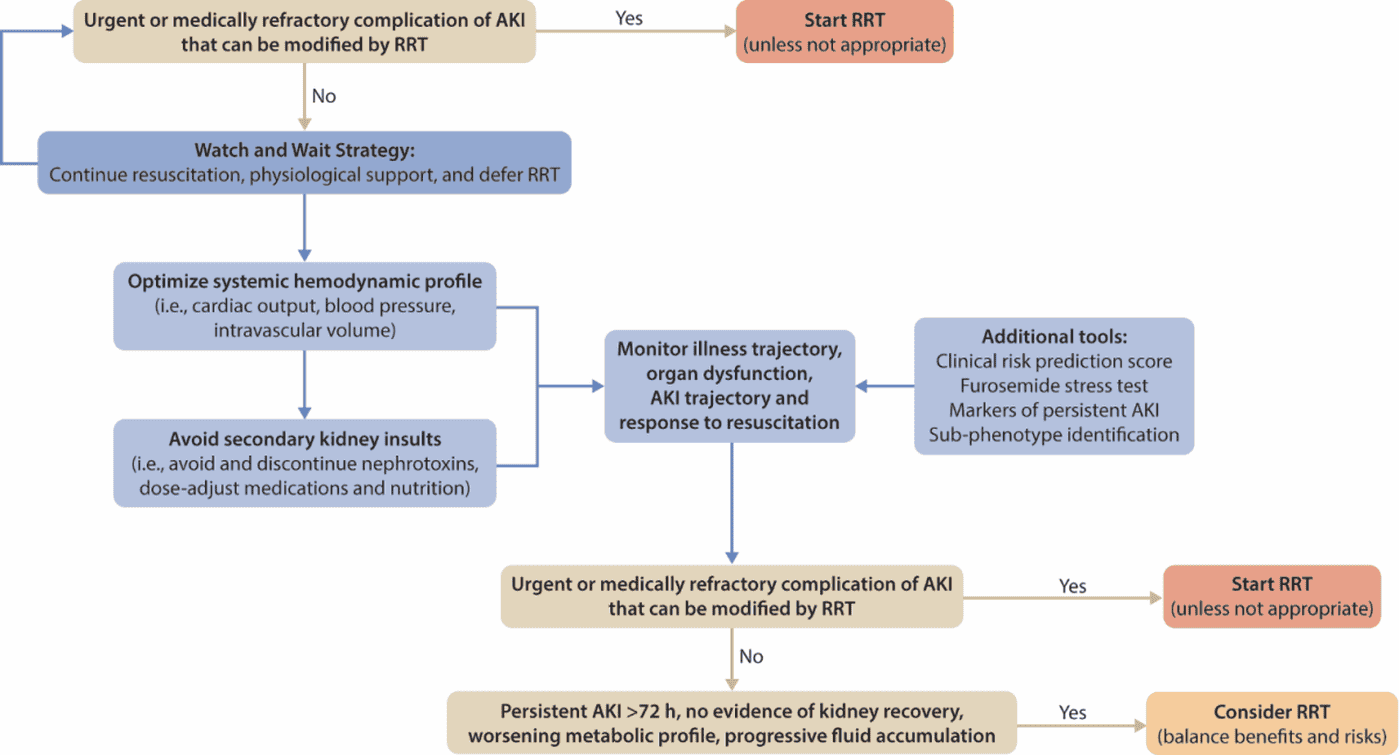
來源:KDIGO 2026 Clinical Practice Guideline for AKI and AKD (Public Review Draft, March 2026) — 個人教學使用,原始版權屬 KDIGO。
🧭 圖表逐步解析:Figure 15(RRT initiation 決策流程)
這張圖在回答什麼問題:具體把「deferred RRT」這個原則翻譯成可執行的決策步驟。
逐步走完:
- Yes → Start RRT immediately(unless not appropriate — goals of care、futility)
- No → 進入 Watch and Wait
- Yes → Start RRT
- No → 第三個 decision node
- Yes → Consider RRT(balance benefits / risks — 不是 mandatory,而是 informed decision)
- No → continue monitoring
容易踩雷的地方:
- 把「watch and wait」當「不做事」:圖的精髓是主動 optimization(hemodynamic + 避免 secondary insult + monitoring tools),不是被動觀察。
- 第二、三個 decision node 沒重複問:很多臨床醫師只在 Stage 3 一次決定,沒有持續每天評估。圖的設計就是要重複問。
- 用 FST 結果單獨決定:FST 陰性是 supporting 證據,不是 standalone trigger。要 cluster 多個 marker。
- 忽略 modifiable hemodynamic factors:很多病人在 vasopressor 上時 BP 看起來夠,但實際 perfusion 不夠(POCUS、lactate trend)。PP 5.1.6 特別強調 RRT 啟動時 modifiable factor 要處理。
- 沒做 shared decision-making:Practice Point 5.1.1 強調 SDM;很多 RRT 啟動沒和病人/家屬充分討論。
5.2 RRT Modality
Practice Point 5.2.1:CRRT / IRRT / acute PD 的選擇要整合 patient characteristics、clinical context、local expertise、resource availability — 沒有一個「universally best」modality。
Recommendation 5.2.1(2C):重症成人 AKI + hemodynamic instability → CRRT 或 acute PD 優於 conventional IRRT。
Practice Point 5.2.2:Acute brain injury 或 ICP/cerebral edema 風險 → 一律 CRRT(IRRT 急性 osmotic shift 可加重 edema)。
Practice Point 5.2.4:PIRRT(prolonged IRRT、SLED) 是 CRRT 的可接受替代,特別在資源受限的地區。
Practice Point 5.2.5:CRRT → IRRT 轉換 — 病人 hemodynamic & metabolic 穩定 + ICP 風險解除即可。
Modality 比較(Table 42 簡化)
| Modality | 主要適應 | 優點 | 缺點 |
|---|---|---|---|
| CRRT(CVVH/CVVHD/CVVHDF) | 不穩定、ICP 風險、liver failure 高 ammonia | Hemodynamic 友善、可連續控 fluid、ammonia 清除佳 | 需 24h 護理、抗凝、設備密集 |
| IRRT (IHD) | 穩定 AKI、long-term 預期 | 快速 K+ 與 toxin 清除、不需連續抗凝 | Hemodynamic 不穩、osmotic shift |
| PIRRT (SLED) | CRRT 的替代,資源受限地區 | 結合 CRRT + IRRT 優點;6–12h sessions | 需 protocol、培訓 |
| Acute PD | 資源受限地區、小兒、無 vascular access | 無 vascular access、簡易設備、低抗凝 | 清除較慢、不適合 hypercatabolic、需 PD catheter |
Acute PD Algorithm(Figure 16)
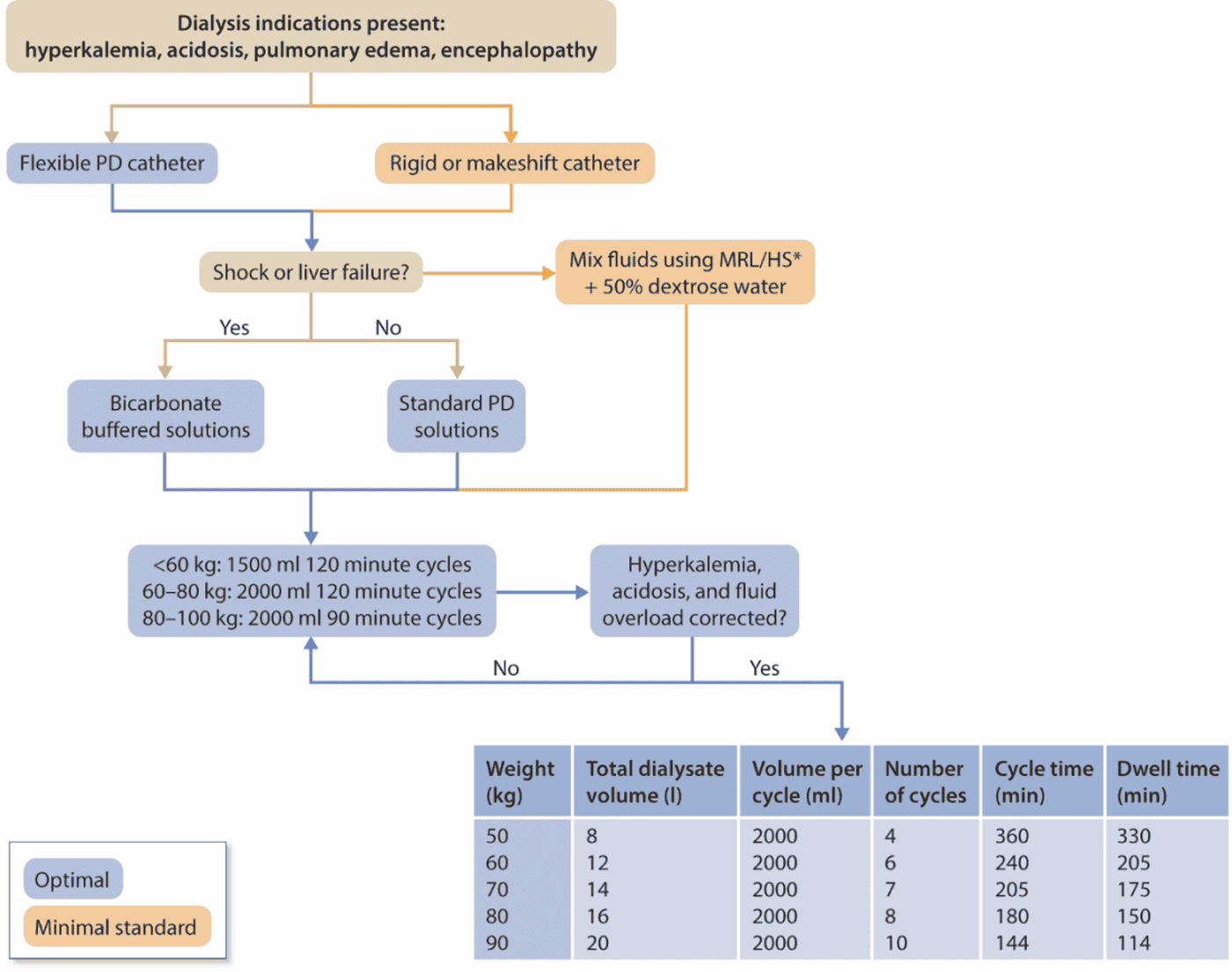
來源:KDIGO 2026 Clinical Practice Guideline for AKI and AKD (Public Review Draft, March 2026) — 個人教學使用,原始版權屬 KDIGO。
Figure 16 是 acute PD 流程(成人 AKI)— 從「有 dialysis indications」開始,分流為 flexible catheter(理想)或 rigid/makeshift(資源極受限),選 PD fluid(normal vs HRS/liver failure 用 bicarbonate),然後依體重設定 fill volume 與 cycle time。表格給出標準 prescription:50 kg = 1500ml/120min × 8 cycles/day 等。
5.3 RRT Dose-intensity
Recommendation 5.3.1(1B):成人 CRRT effluent 20-25 ml/kg/h;IRRT/PIRRT Kt/V 3.9/week(不要更高)。
共識來源:RENAL trial(NEJM 2009)+ ATN trial(NEJM 2008)確立「more is not better」— 35-40 ml/kg/h CRRT 沒比 20-25 好,且抗生素 over-clearance。
Recommendation 5.3.2(1B):反對高劑量 hemofiltration(HVHF)對 sepsis / septic shock 成人。IVOIRE 與後續多項 RCT 一致無效。
Practice Point 5.3.1:BMI ≥30 病人 CRRT 劑量基於 ideal 或 adjusted body weight(不用 actual body weight)— 避免 over-dosing 與 over-clearance。
PP 5.3.3:成人 acute PD weekly Kt/V 2.2(18–24 l PD fluid/day)不要更高。
兒童(PP 5.12.3.1):CRRT 起始 25–30 ml/kg/h;hyperammonemia 可達 200 ml/kg/h。劑量 weight-based 不 BSA-based。
5.5 Anticoagulation — Citrate 首選
Recommendation 5.5.1(1B):CRRT 兒童與成人(無 citrate 禁忌)→ Regional citrate 優於 heparin。
支撐證據:RICH trial(JAMA 2020):1,450 名 ICU AKI 病人,citrate vs heparin → citrate 顯著改善 filter lifespan(46h vs 26h)、降低 bleeding(5.1% vs 16.9%)、降低 HIT 風險。死亡率沒差。
Citrate 禁忌:嚴重肝衰竭(lactate >5 + INR >2,citrate 累積風險)、嚴重 shock with 高 lactate、citrate allergy。
Anticoagulation Strategy Algorithm(Figure 17)
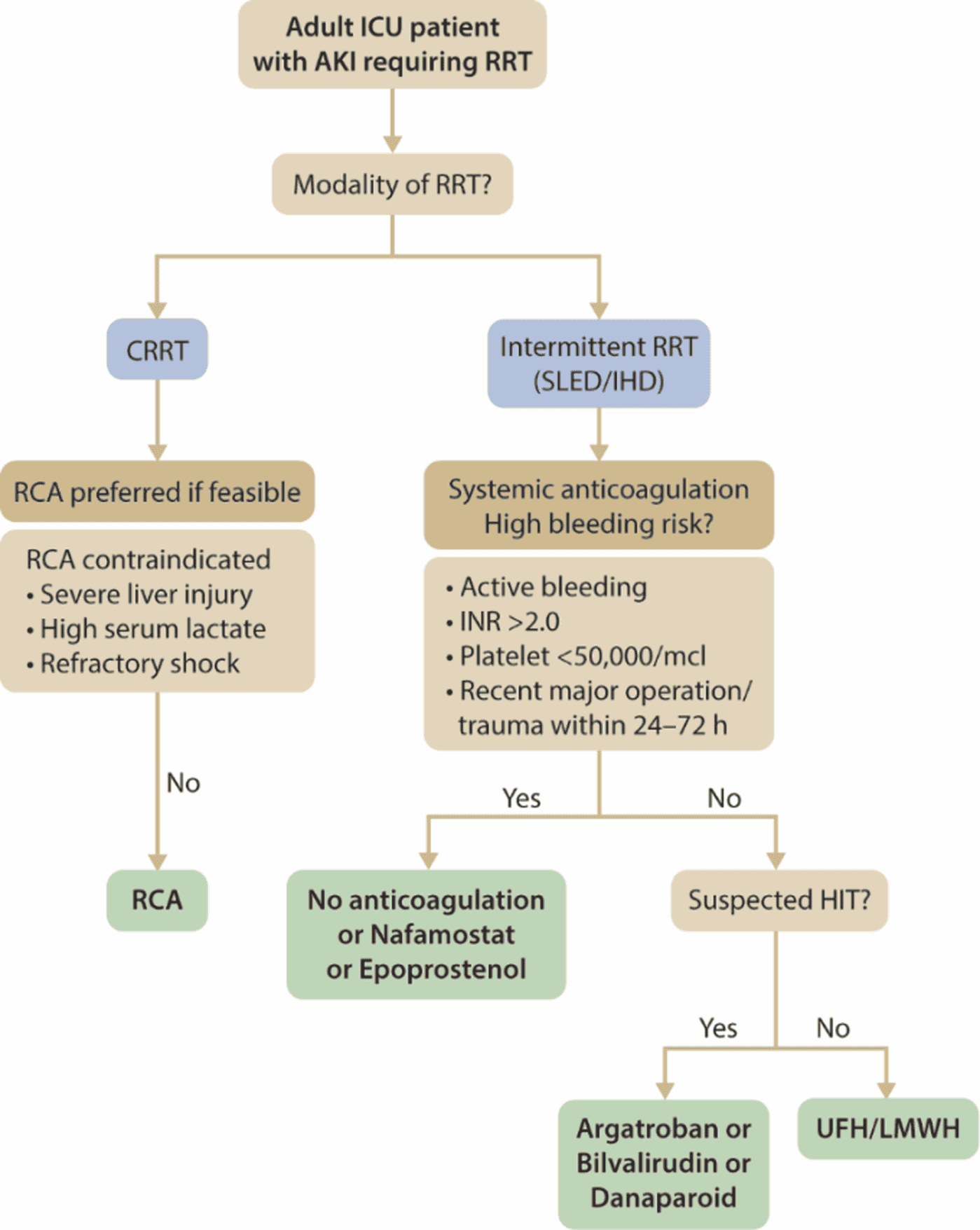
來源:KDIGO 2026 Clinical Practice Guideline for AKI and AKD (Public Review Draft, March 2026) — 個人教學使用,原始版權屬 KDIGO。
🧭 圖表逐步解析:Figure 17(RRT anticoagulation 決策)
這張圖在回答什麼問題:對需要 RRT 的 ICU 成人 AKI 病人,選哪種抗凝?
逐步走完:
RCA 禁忌:severe liver injury、high lactate、refractory shock → 改用 No anticoagulation 或 Nafamostat 或 Epoprostenol。
- Yes → Argatroban、Bivalirudin、或 Danaparoid
- No → UFH 或 LMWH
容易踩雷的地方:
- 對 severe liver failure 病人用 RCA:citrate 代謝路徑(liver gluconeogenesis)受損 → metabolic alkalosis、低 ionized Ca。要監測 ionized Ca、total Ca/iCa ratio >2.5 是警訊。
- 忽略 high lactate 是 citrate 警訊:lactate >3-5 + shock = citrate accumulation risk。改 nafamostat 或 no-anticoag。
- HIT 未排除前用 UFH/LMWH:4T score、HIT antibody。HIT 病人用 UFH → catastrophic thrombosis。
- Citrate 監測不足:每 6h 監測 ionized Ca(post-filter target 0.25-0.4,systemic target 1.1-1.3)。
- 對 Bleeding risk patient 仍用 systemic heparin:active bleeding 或 INR>2 是 anticoagulation 禁忌,no-anticoag 是合理選項。
5.4 Vascular Access
- Catheter size、length、site 依 patient size 與 weighing 風險(colonization vs bleeding vs patency)
- 標準化 care bundle(PP 5.4.2)降低併發症
- AV fistula/graft 可用於 IRRT(PP 5.4.3);不要用於 CRRT(PP 5.4.4 — 長期 cannulation 損傷)
- 不要常規定期換 catheter(PP 5.4.6)
- 長期預期 RRT → 考慮 cuffed tunneled catheter(PP 5.4.7 — 尤其 children)
5.7-5.8 Solutions & Ultrafiltration
PP 5.7.1:CRRT dialysate 用 bicarbonate(非 lactate)— circulatory shock、liver failure、lactic acidemia 病人。Lactate-buffered 在這些情境會加重 lactate burden。
PP 5.8.1-2:UF target 每日 prescribed,個人化 — 兒童 UFnet ≤2.5 ml/kg/h(PP 5.12.7.1)。
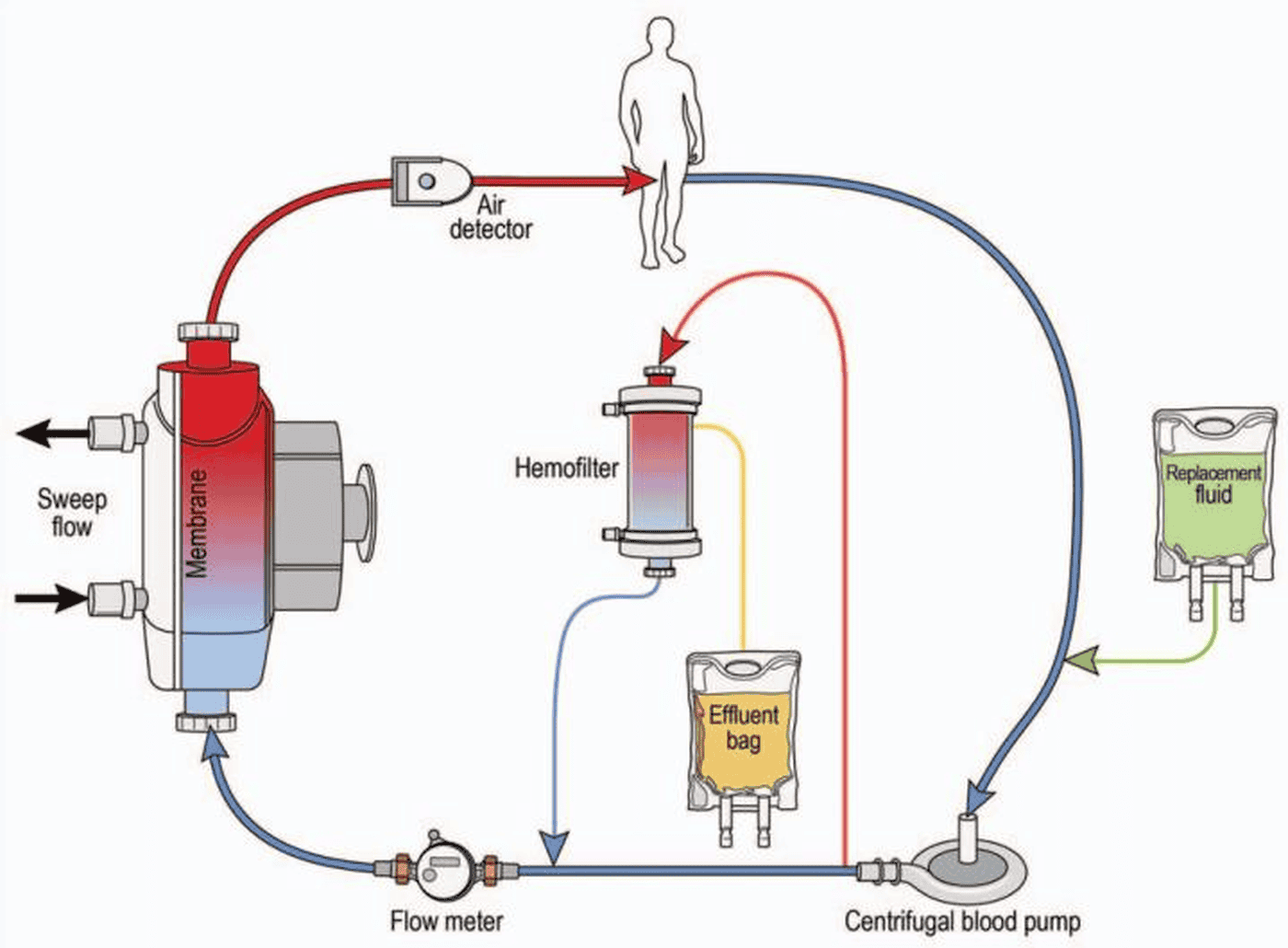
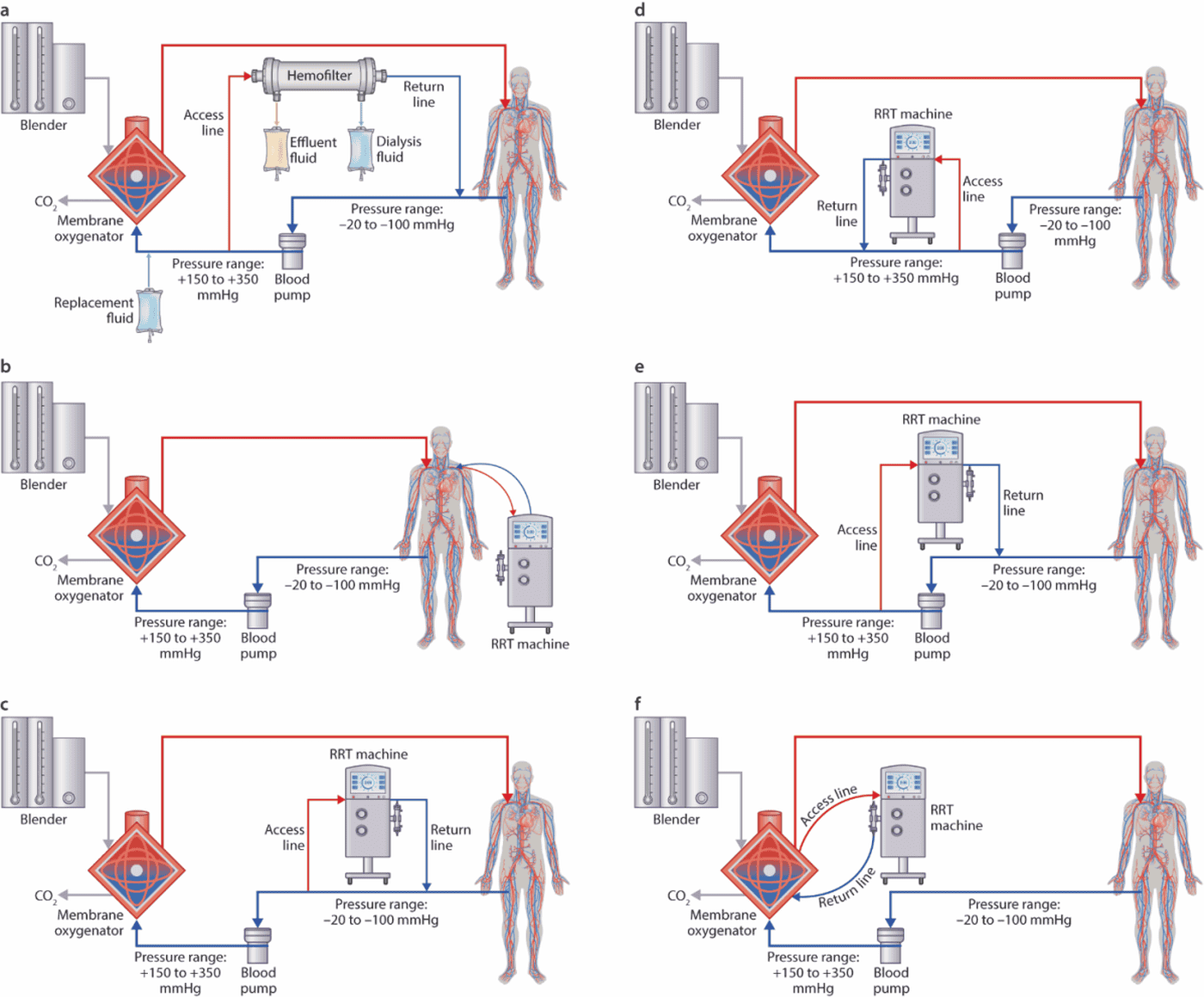
5.11 RRT 與 ECLS(ECMO)整合 — Figures 18, 19
來源:KDIGO 2026 Clinical Practice Guideline for AKI and AKD (Public Review Draft, March 2026) — 個人教學使用,原始版權屬 KDIGO。
來源:KDIGO 2026 Clinical Practice Guideline for AKI and AKD (Public Review Draft, March 2026) — 個人教學使用,原始版權屬 KDIGO。
ECMO + CRRT 兩種接法:
- Figure 18:In-line hemofilter 整合進 ECLS circuit(簡單但只有 hemofiltration,不能 hemodialysis;UF 控制靠流量)
- Figure 19:CRRT machine 平行接在 ECMO circuit(功能完整,但需要多人共管)
PP 5.11.1-3:選擇取決於 expertise + resources。Refractory fluid accumulation 即使 kidney function 還可以,也是 RRT 適應症。
📚 Chapter 6:Post-AKI/AKD Follow-up Care
6.1 Coordinated Follow-up — 升等為 1B 強制建議
Recommendation 6.1.1(1B):兒童與成人 AKI/AKD 後 coordinated follow-up,依 individual clinical context 與 vulnerability risks 個人化。
核心轉變:2012 版只是「轉介 nephrology」籠統建議;2026 版要求結構化追蹤系統。原因:多項 cohort 顯示有 follow-up clinic 的病人 1 年 CKD 進展 / 死亡率顯著較低(Silver 2019、Goldstein 2020)。
來源:KDIGO 2026 Clinical Practice Guideline for AKI and AKD (Public Review Draft, March 2026) — 個人教學使用,原始版權屬 KDIGO。
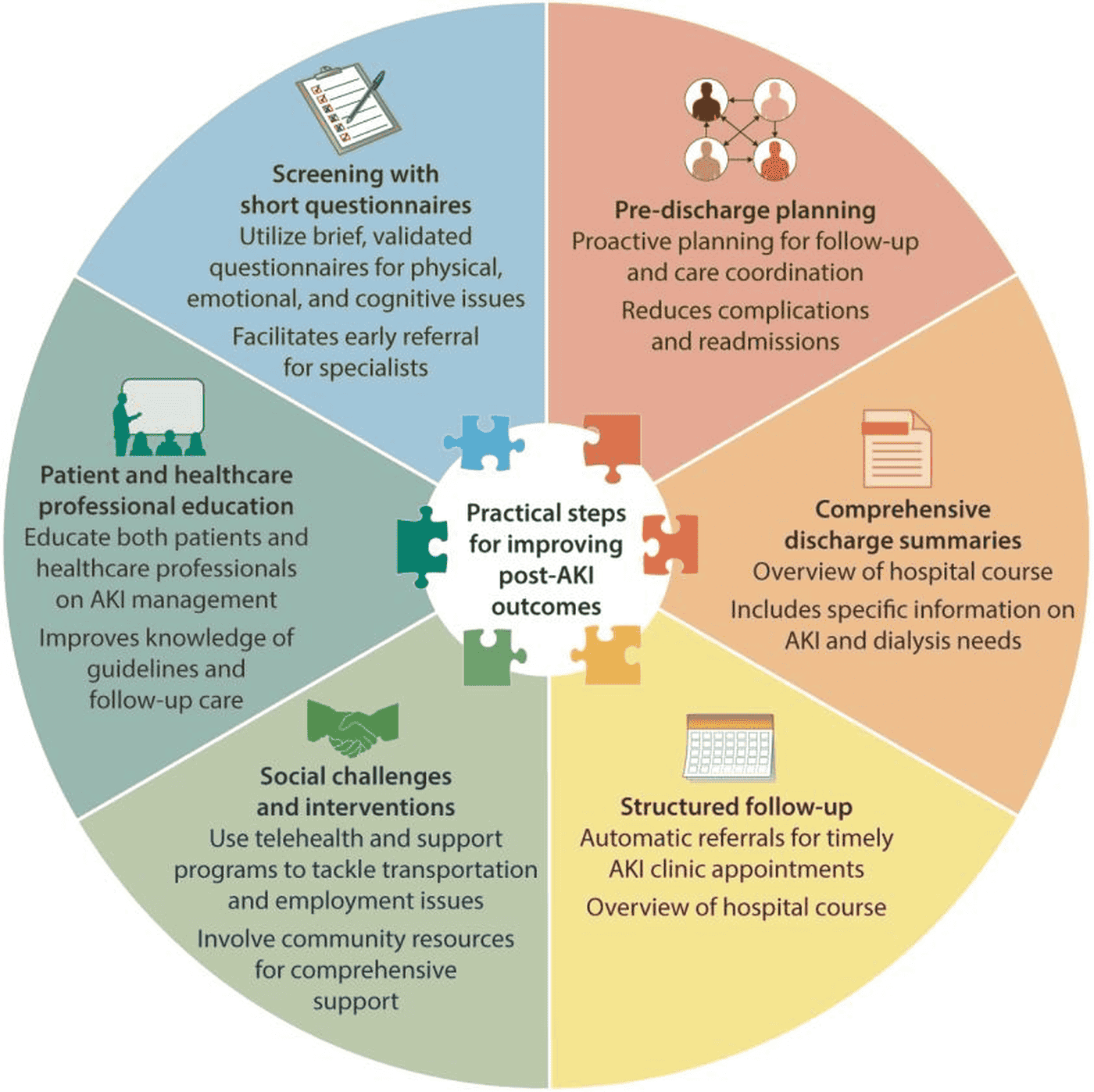
Figure 20 是 holistic follow-up 的 6 大要素(central illustration):
- Pre-discharge planning:proactive follow-up & care coordination → 減少 complications & readmissions
- Comprehensive discharge summaries:含 AKI 與 dialysis 細節、住院經過
- Structured follow-up:telehealth referrals、timely AKI clinic appointments、住院概覽
- Social challenges and interventions:employment support、transportation、community resources
- Patient and healthcare professional education:增進 guideline & follow-up care 知識
- Screening with short questionnaires:身體/情緒/認知;早期轉介專科
Practice Points 6.1.1-4:
- Hospital → home transition 要 clear communication + identified follow-up clinician + 病人衛教資源
- Discharge summary 包含:AKI episode 細節、resolution status、medication management、follow-up plan
- Follow-up assessment:BP、volume status、medication reconciliation、kidney function + albuminuria
- 提供病人(含 caregiver)kidney health education + sick day guidance + psychosocial support
Risk stratification at discharge — Figure 21
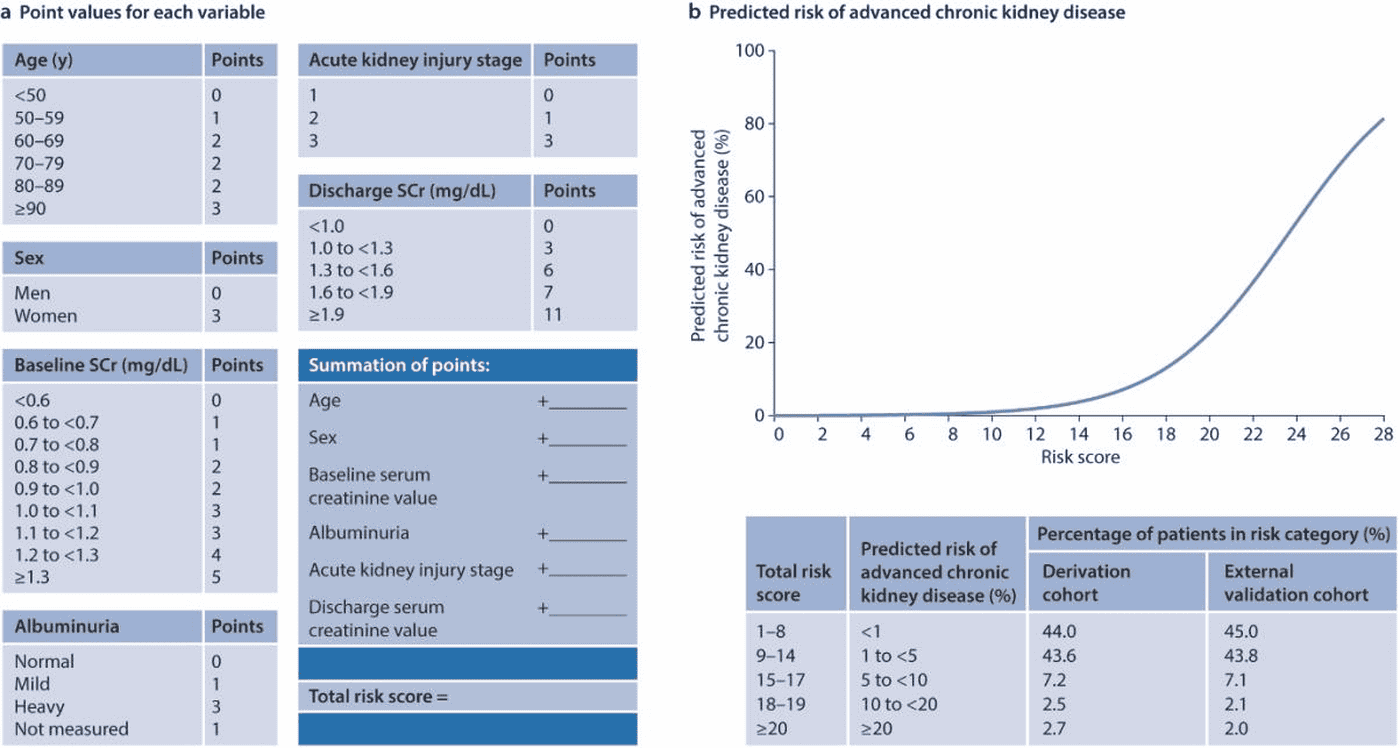
Recommendation 6.1.2(2D):AKI survivors at hospital discharge → 用 validated tool 做 risk stratification → 識別高 CKD 風險者,受益於 nephrology care。
來源:KDIGO 2026 Clinical Practice Guideline for AKI and AKD (Public Review Draft, March 2026) — 個人教學使用,原始版權屬 KDIGO。
Figure 21 是 6-variable risk score(James et al., Lancet 2019 改編)— predict transition to severe CKD (G4 或 G5):
- 變數:Age、Sex、Baseline SCr、AKI stage at peak、Discharge SCr、Albuminuria(categorical)
- 分數加總 → 預測 1 年內 advanced CKD risk
- 右側 nomogram 給總分對應的 advanced CKD 機率(%)
- 下方表格給臨床 stratification(low / moderate / high → 不同 follow-up frequency)
6.2 Medication Management — RASi 重啟
Recommendation 6.2.1(成人 1B / 兒童 1D):除非禁忌,AKI 後 start 或 resume RASi 依 evidence-based 適應症(HF、proteinuria、HTN)。
支撐:多項 cohort 顯示 AKI 後 RASi 重啟(vs 永久停)降 1 年 mortality 與 MACE,主要在 HF、CKD with proteinuria、post-MI 族群。「once-stopped, never-restarted」是 AKI 後最常見錯誤 — Coca 2018 cohort 顯示 30% 病人 1 年內未重啟。
PP 6.2.1:評估 SGLT2i、GLP-1 RA、MRA 是否該 start/resume — 這幾類藥都有 cardio-renal benefit(DAPA-CKD、EMPA-KIDNEY、FIDELIO、FLOW),AKI 後 deliberately 重新評估。
PP 6.2.2:在 discharge 與 3 個月兩個時間點評估 guideline-indicated 藥物的 start/resume。
6.3 Evaluation for CKD — 3 個月複查
PP 6.3.1:AKI / AKD 3 個月後評估 kidney function + damage markers → 評估 resolution、新發 CKD、preexisting CKD 是否惡化。
PP 6.3.2:SCr 失準時用 cystatin C-based eGFR。
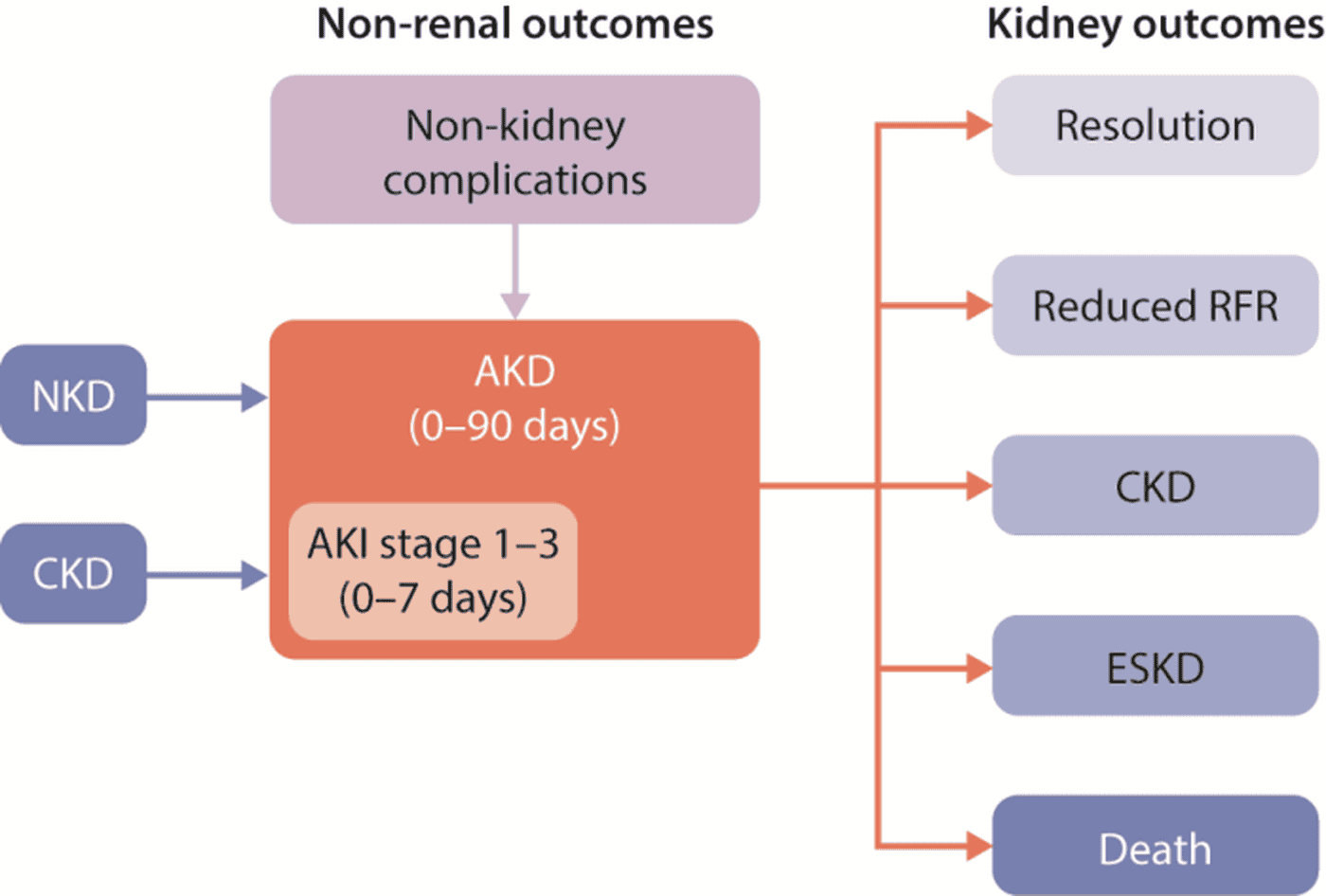
來源:KDIGO 2026 Clinical Practice Guideline for AKI and AKD (Public Review Draft, March 2026) — 個人教學使用,原始版權屬 KDIGO。
再次提醒 Figure 22 的 5 個 endpoint(resolution / reduced RFR / CKD / ESKD / death)— follow-up 的核心是把病人 trajectory 分流到對應路徑。
6.4 RRT 病人的後續
- PP 6.4.1:RRT program 應有 comprehensive dialysis care + communication plan,依 dialysis liberation 可能性 tailored
- PP 6.4.2-3:Engage patient、caregiver、outpatient dialysis team;定期 volume + medication + 教育 patient 識別腎功能恢復
- PP 6.4.4:Shared decision-making — 自我照護、長期 RRT 機率、QoL、目標
- PP 6.4.5:停 outpatient dialysis 後,nephrologist 7 天內完整評估 + 90 天追加 kidney function 評估
- CCU 病人何時 call nephrology consult:(a) Stage 2-3 AKI;(b) Persistent AKI >48h;(c) Refractory fluid overload;(d) Suspected HRS;(e) Cardiogenic shock + AKI 預期需要 CRRT。提早 consult 比 stage 3 才 consult 更能影響 outcome。
- HF + AKI 的 RRT timing:HF decompensation 即使 SCr 上升至 stage 2,先 maximize diuretic(Article III 階梯)+ inotropic support,再 consider RRT/UF — KDIGO 強調 diuretic 優於 UF。
- ECMO + CRRT 整合決策:cardiogenic shock 病人若已 ECMO,CRRT 通常以 separate machine 接(Fig 19)比較好控;簡易 in-line filter(Fig 18)功能受限。
- Cardiac surgery 後 AKI 病人出院:依 Figure 21 算 6-variable risk score;high risk → 6 週內 outpatient nephrology consult + 3 個月 SCr + UACR + cystatin C;low risk → 由 family physician + cardiologist 共同追蹤。
- HF GDMT 的「不要忘了 restart」:很多 cardiology 共識藥 — ACEi/ARB/ARNi、MRA、SGLT2i — 在 AKI 急性期暫停後常忘了重啟。出院 medication reconciliation 時逐項評估,最遲 90 天前要 restart 完成(除非絕對禁忌)。
- Post-AKI cardio-renal clinic:HF + AKI 史 + 殘餘 albuminuria → 是 cardio-nephrology integrated clinic 的核心族群;對應 KDIGO 強調的 coordinated follow-up。Women’s heart clinic / heart-kidney clinic 是新興 model。
- RRT 後 discharge 的 cardiology 角色:dialysis vintage >3 個月者 CV mortality 顯著上升;BP control、lipid management、阿斯匹靈、SGLT2i / GLP-1 RA 評估仍應由 cardiologist 共同管理。
📋 Chapters 5 + 6 關鍵 Recommendations 總表
| # | Recommendation | Grade |
|---|---|---|
| 5.1.1 | 成人 AKI → deferred RRT timing > early/pre-emptive | 1C |
| 5.2.1 | 重症成人 AKI + hemodynamic instability → CRRT 或 acute PD > conventional IRRT | 2C |
| 5.3.1 | CRRT effluent 20-25 ml/kg/h;IRRT/PIRRT Kt/V 3.9/week | 1B |
| 5.3.2 | 反對 高劑量 hemofiltration(sepsis 成人) | 1B |
| 5.5.1 | CRRT 用 regional citrate > heparin(無 citrate 禁忌) | 1B |
| 6.1.1 | AKI/AKD 後 coordinated follow-up | 1B |
| 6.1.2 | Discharge 時用 validated tool 做 risk stratification | 2D |
| 6.2.1 | 除非禁忌,AKI 後 start 或 resume RASi(成人) | 1B / 1D 兒童 |
- Deferred > early RRT:用 Figure 15 流程,watch & wait + 主動 optimization。
- CRRT 或 PD > IRRT(不穩定);acute brain injury 一律 CRRT。
- 劑量別衝高:CRRT 20-25 ml/kg/h、IRRT Kt/V 3.9/週;HVHF 對 sepsis 無效。
- Citrate 取代 heparin(CRRT 無禁忌)— RICH trial 確立。
- 結構化 follow-up:discharge planning + 6-variable risk score + 3 個月複查 + RASi 重啟 — 是 2026 版最大的概念升級之一。
🏁 系列總結
2026 KDIGO AKI/AKD(公開審查草案)是 14 年來最重要的腎臟急性傷害指引改版。對心臟科醫師而言,最關鍵的變動可以濃縮成 7 條:
- 標題擴張:AKI → AKI + AKD,提供管理 sub-AKI 病人的框架。
- Cystatin C + damage biomarker正式入診斷與分期。
- Multicomponent kidney protection bundle(Fig 9)對 cardiac surgery 與 cath 高風險族群應系統化部署。
- Cardiac surgery 兩個新介入:IV amino acid 與 RIPC(無 propofol 麻醉時)。
- RASi 不要常規 hold:CA-AKI 前、cardiac surgery 前、non-cardiac surgery 前 — 三條翻轉。
- Sick day rules正式入指引(Table 40),對 HF 病人 discharge 衛教重要。
- Coordinated post-AKI follow-up 1B,cardio-renal integrated clinic 在台灣值得推展。
整份指引仍在 public review 階段,正式發布的 final version 可能會在 2026 下半年問世。本系列文章將會在 final 發布後重新校對與更新。
📖 References(精選)
- KDIGO 2026 AKI/AKD Public Review Draft — Chapters 5–6.
- Gaudry S, Hajage D, Schortgen F, et al. Initiation Strategies for Renal-Replacement Therapy in the ICU (AKIKI). N Engl J Med 2016;375:122–133. PMID: 27181456.
- Barbar SD, Clere-Jehl R, Bourredjem A, et al. Timing of Renal-Replacement Therapy in Patients with Acute Kidney Injury and Sepsis (IDEAL-ICU). N Engl J Med 2018;379:1431–1442. PMID: 30304656.
- STARRT-AKI Investigators. Timing of Initiation of Renal-Replacement Therapy in Acute Kidney Injury. N Engl J Med 2020;383:240–251. PMID: 32668114.
- RENAL Replacement Therapy Study Investigators. Intensity of continuous renal-replacement therapy in critically ill patients. N Engl J Med 2009;361:1627–38. PMID: 19846848.
- Zarbock A, Kullmar M, Kindgen-Milles D, et al. Effect of Regional Citrate Anticoagulation vs Systemic Heparin Anticoagulation During CRRT on Dialysis Filter Life Span and Mortality (RICH). JAMA 2020;324:1629–1639. PMID: 33095849.
- James MT, Pannu N, Hemmelgarn BR, et al. Derivation and external validation of prediction models for advanced chronic kidney disease following acute kidney injury. JAMA 2017;318:1787–1797. PMID: 29136443.
- Silver SA, Adhikari NK, Bell CM, et al. Nephrologist Follow-Up versus Usual Care after an Acute Kidney Injury Hospitalization (FUSION). Clin J Am Soc Nephrol 2021;16:1005–1014. PMID: 34233920.
- Coca SG, Garg AX, Swaminathan M, et al. Preoperative angiotensin-converting enzyme inhibitors and acute kidney injury after cardiac surgery. Clin J Am Soc Nephrol 2013;8:1266–73. PMID: 23818440.
本文以教學為目的整理 KDIGO 2026 AKI/AKD Clinical Practice Guideline(Public Review Draft),所有原文 Figure 之版權屬 KDIGO;商業使用請洽 KDIGO 取得授權。最終版指引發布前,本文內容可能與 final guideline 有差異,臨床決策請以 KDIGO 屆時公告為準。