診斷上,Figure 7 的 outpatient pericarditis triage algorithm 把臨床決策標準化:依 high-risk features 分流到「outpatient treatment」、「admission with close follow-up」、「admission + aetiology workup + IL-1 antagonist」三條路徑。
治療上的第一線仍是 NSAID + colchicine,但 colchicine 從 IIa 升到 Class I(依 ICAP / CORP / CORE 系列 trial),且強調 colchicine 必須完整療程 3 個月(第一次發作)或 6 個月(recurrent)。Steroid 只用於 NSAID 禁忌、特定原因(autoimmune / connective tissue disease)、或對 NSAID+colchicine 無反應者。結核性心包膜炎是台灣 endemic 議題,2025 版有專屬章節(Fig 18 展示四階段)。
反覆性心包膜炎的核心不是「感染沒清乾淨」,而是自體發炎(autoinflammation):心包受刺激後,固有免疫的 NLRP3 發炎體被活化 → 釋放 IL-1β → 發炎、滲液、再發,形成IL-1 驅動的復發循環。理解這條軸,治療階梯就有邏輯:
- 第一線 NSAID+colchicine:colchicine 抑制微管 → 干擾 NLRP3 發炎體與嗜中性球 → 打斷 IL-1 循環。ICAP/COPE/CORP 系列證實它把復發率砍半,故升 Class I,且必須完整療程(首發 3 個月、復發 6 個月),太早停最常導致復發。
- 類固醇要「低–中劑量+慢慢減」:高劑量類固醇雖快速壓制,卻會養出steroid-dependent 的反覆復發(過去十年的痛苦教訓),故只用於 NSAID 禁忌/特定病因,且強調慢 taper。
- 第三線 anti-IL-1(rilonacept、anakinra)升 Class I:直接阻斷 IL-1 這個最上游的驅動子——RHAPSODY 顯示 rilonacept 把復發從 74% 降到 7%(HR 0.04),對 colchicine/steroid 難治、steroid 依賴者是突破。
🔍 心包膜炎臨床分期與表現
分期
| 分期 | 時間定義 | 備註 |
|---|---|---|
| Acute pericarditis (AP) | 首次發作,<4–6 週 | 典型 chest pain + pericardial rub + ECG + effusion |
| Incessant pericarditis | 持續 4–6 週但 <3 個月,沒有 remission 中斷 | 對 NSAID/colchicine 反應差 |
| Recurrent pericarditis (RP) | 第一次發作 → ≥4 週無症狀 → 再發作 | 復發率 15–30%(單靠 NSAID);用 colchicine 可降至 8–10% |
| Chronic pericarditis | >3 個月持續 | 常合併 constriction 或 effusion |
臨床表現(依 phenotype 分)
- Dry pericarditis:沒有 effusion,純 inflammation。診斷靠 4 條中 ≥2:pericardial chest pain、pericardial rub、ECG 改變(diffuse ST elevation 或 PR depression)、新/加重 pericardial effusion。
- Effusive pericarditis:有 effusion。需與 isolated pericardial effusion 區分(後者沒有 inflammation 證據)。
- Effusive-constrictive pericarditis (ECP):同時 effusion + constriction physiology。Pericardiocentesis 後仍 elevated RAP → 強烈暗示。
- Cardiac tamponade:effusion 累積到血行動力受影響(詳見篇 V)。
- Constrictive pericarditis:慢性纖維化/鈣化 pericardium(詳見篇 V)。
- Pericarditis with polyserositis:同時 pleural / peritoneal effusion,提示 autoimmune disease (SLE, RA, sarcoid)。
Inflammatory vs Non-inflammatory phenotype(2025 版新概念)
2025 版正式區分 inflammatory phenotype(CRP elevated, fever, response to anti-inflammatory therapy)與 non-inflammatory phenotype(CRP normal, no fever, often subacute/chronic course)。這個區分非常關鍵——non-inflammatory phenotype 對 NSAID / colchicine / steroid 都可能無反應,要找 underlying disease(heart failure, kidney disease, malignancy, post-radiation)。
🚦 Pericarditis triage algorithm(Figure 7)
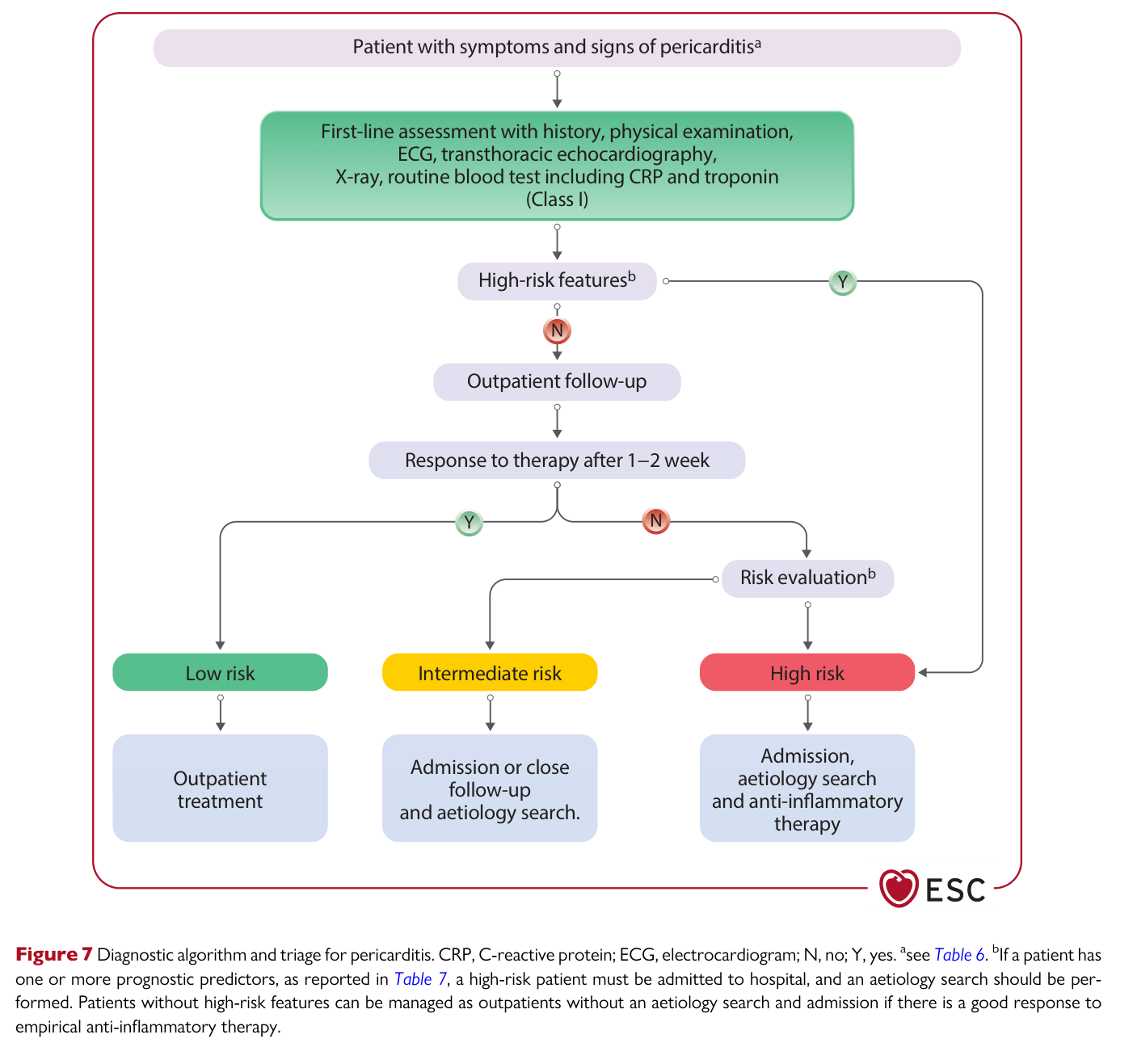
來源:2025 ESC Guidelines for the management of myocarditis and pericarditis (EHJ 2025;46:3952–4041, doi:10.1093/eurheartj/ehaf192) — 個人教學使用,原始版權屬 ESC。
🧭 圖表逐步解析:Figure 7 — Pericarditis triage
這張圖在回答什麼問題:一個典型急性心包膜炎病人來急診,要不要住院?什麼時候要找其他病因?什麼時候要用 anti-IL-1?
逐步走完:
Major:fever >38°C、subacute onset、large effusion (>20 mm)、cardiac tamponade、aspirin/NSAID 失敗 ≥1 週
Minor:myopericarditis、immunosuppression、trauma、anticoagulant therapy
無 high-risk feature → Outpatient treatment + outpatient follow-up(NSAID + colchicine 即可)
有 ≥1 high-risk feature → 需要更積極處理
Good response(症狀緩解、CRP 下降)→ Outpatient follow-up
Partial / poor response → 進入 risk evaluation
Low risk:outpatient treatment(單純 NSAID + colchicine)
Intermediate risk:admission or close follow-up + aetiology search
High risk:admission + aetiology search + early anti-inflammatory therapy(含考慮 anti-IL-1)
容易踩雷的地方:
- 「troponin 不高就 outpatient」是不足夠的判斷:fever >38°C 或 large effusion 仍是 high-risk,無論 troponin 高低。
- 不做 aetiology search 直接「idiopathic」:high-risk 病人應該主動找 viral PCR、autoimmune workup、TB workup、neoplasm workup。所謂「idiopathic」是排除後的標籤,不是預設。
- 對 NSAID + colchicine 反應差 → 直接上高劑量 steroid:這是 2015 → 2025 的核心改變。不要這樣做。應該先重新評估 aetiology,並考慮 anti-IL-1(Class I in 2025)。
- 把急診一次 CRP 當「無炎症」:CRP 在 acute pericarditis 的動態變化比單一值有意義。應該 baseline + 48–72 小時 + 出院前各測一次。
- 忽略 troponin 升 → 變 myopericarditis 的處置升級:troponin 高的病人應該住院監測並做 CMR。
🩺 診斷:心包膜炎的 4 條診斷標準
急性心包膜炎診斷需符合 4 條中至少 2 條:
- Pericarditic chest pain:sharp、pleuritic、躺下加重、坐起前傾減輕。
- Pericardial friction rub:聽診特徵性 scratching sound(最佳 LSB / xiphoid,吐氣末 + 前傾位置)。
- ECG changes:新發 diffuse ST elevation 或 PR depression。注意:aVR 反向(ST↓ + PR↑)是典型——區別與 STEMI 的關鍵之一。
- Pericardial effusion:新/加重的 effusion on TTE。
輔助評估:CRP、troponin、CMR
- CRP:~80% acute pericarditis CRP 升高。CRP 動態追蹤對判斷恢復很有用——CRP 正常化是停藥的關鍵 marker。
- Troponin:升高表示同時 myocardial involvement(myopericarditis)。預後通常與 troponin 無關,但處置強度要升級。
- CMR:not routine for typical pericarditis,但 high-risk / recurrent / suspected constriction 時很有價值(pericardial LGE、effusion 量、myocardial involvement)。
💊 心包膜炎藥物治療 algorithm(Figure 16)
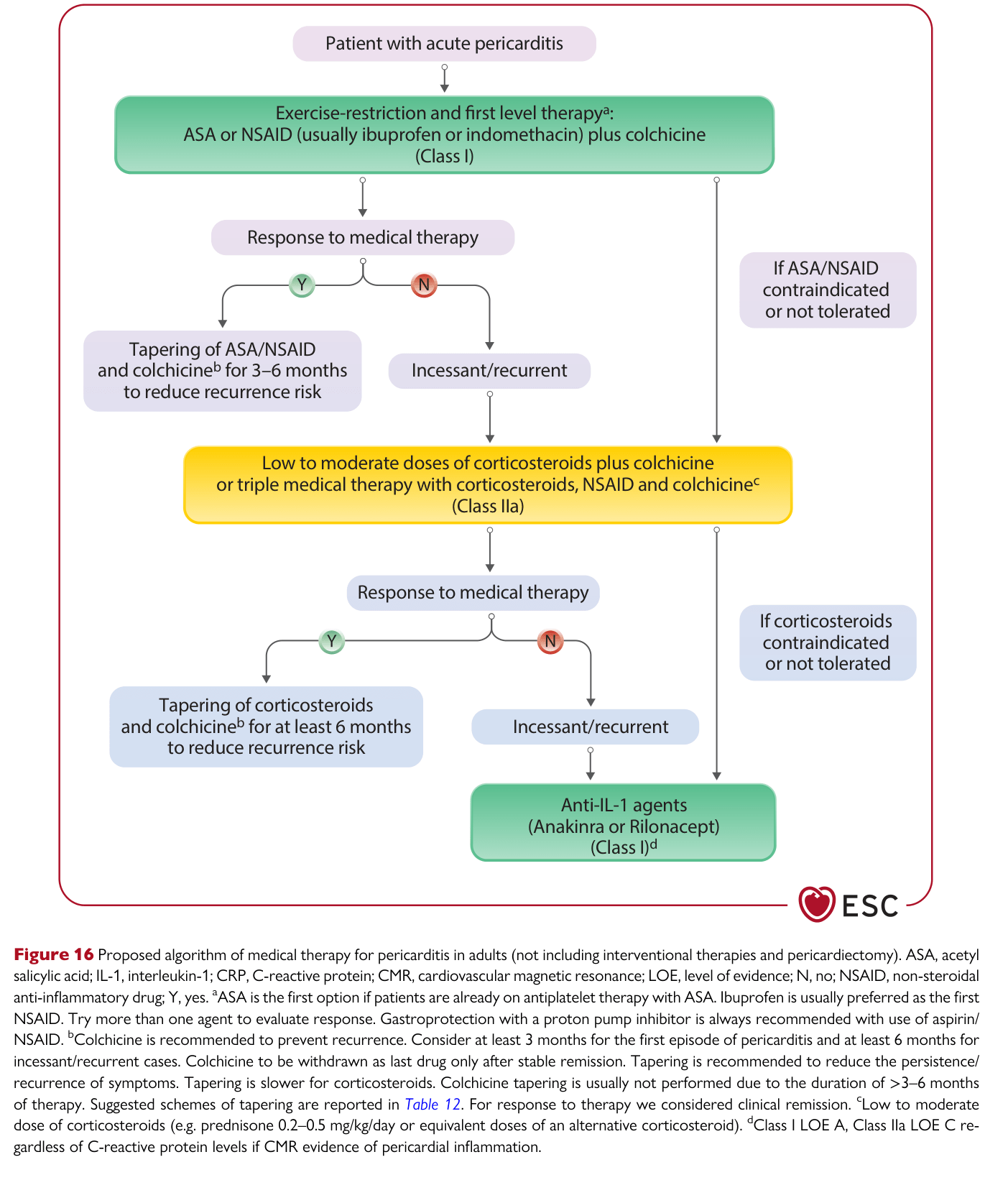
來源:2025 ESC Guidelines for the management of myocarditis and pericarditis (EHJ 2025;46:3952–4041, doi:10.1093/eurheartj/ehaf192) — 個人教學使用,原始版權屬 ESC。
🧭 圖表逐步解析:Figure 16 — Pericarditis Medical Therapy Algorithm
這張圖在回答什麼問題:從首次發作 → 反覆復發 → 治療無反應,整套藥物升級邏輯是什麼?什麼時候上 anti-IL-1?
逐步走完:
Exercise restriction(直到 CRP 正常 + 症狀消失)+
ASA 750–1000 mg q8h × 1–2 週 → 慢慢 taper
OR NSAID(ibuprofen 600–800 mg q8h / indomethacin 25–50 mg q8h) × 1–2 週
加 colchicine 0.5 mg q12h(<70 kg q24h) × 3 個月(first episode)
※ 這是首次發作的標準三角,不要省略 colchicine。
Good response(症狀消、CRP 下降)→ Tapering of ASA/NSAID and colchicine for 3–6 months to reduce recurrence risk
Incessant / recurrent → 進入 Step 3
Low to moderate dose corticosteroid(prednisolone 0.2–0.5 mg/kg/day)
+ colchicine 0.5 mg q12h
+ NSAID / ASA(依耐受度)
⚠️ 重要:高劑量 steroid(>1 mg/kg)III——舊版常見的 high-dose pulse 已被淘汰
Good response → Tapering corticosteroid + colchicine for at least 6 months。Taper 速度依 CRP 與症狀非常慢地降——每 1–2 個月降 1 mg。
Steroid contraindicated / not tolerated / 仍復發 → 進入 Step 5
Anakinra 100 mg subcutaneous daily(IL-1 receptor antagonist)
OR Rilonacept 160 mg subcutaneous weekly(IL-1 trap,loading 320 mg)
適應症:colchicine-resistant + corticosteroid-dependent recurrent pericarditis
療程:建議至少 6–12 個月,部分病人需要更久(年單位)
容易踩雷的地方:
- colchicine 給太短:first episode 3 個月是標準,recurrent 6 個月。給 1–2 週就停是常見錯誤。
- colchicine 不依體重調整:<70 kg 應 q24h,不是 q12h。腎功能不好或併用 statin/macrolide 要小心 toxicity。
- 急著用 steroid 第一線:first episode 不該用 steroid(增加 recurrence rate 至 32–50%)。Steroid 只用於 NSAID 禁忌(孕婦、PUD)、autoimmune cause、或 NSAID+colchicine 無反應者。
- steroid 高劑量 + 快 taper:這是過去最大的錯。低至中劑量 + 慢 taper >6 個月才能減少 steroid-dependent rebound。
- 反覆 recurrent 還在用 steroid 慢慢壓:2025 版的態度很明確——colchicine-resistant + steroid-dependent 就是 anti-IL-1 的 indication。轉介到有處方經驗的中心,不要繼續折磨病人。
- anti-IL-1 治療太短就停:rilonacept 在 RHAPSODY 試驗的 long-term 部分顯示——停藥後 recurrence rate 仍高。建議至少 6-12 個月,期間 close monitoring。
- NSAID 與 steroid 在 myopericarditis 給太多:troponin 高的病人,NSAID 需 caution(HF risk);high dose steroid 在 active myocarditis 不建議。
🧪 ICAP(2013, NEJM)— colchicine 把 acute pericarditis 的復發/持續砍掉一半,是 colchicine 列 Class I 的根基
設計:多中心、雙盲、隨機、安慰劑對照。240 名首次急性心包膜炎病人,在 conventional therapy(aspirin / NSAID)之上,隨機加 colchicine(0.5 mg q12h,<70 kg q24h)× 3 個月 vs placebo;主要終點為 incessant 或 recurrent pericarditis。
結果:主要終點 colchicine 16.7% vs placebo 37.5%(RR 0.56;95% CI 0.30–0.72;P<0.001);單看 recurrence 也下降(9.2% vs 20.8%)。colchicine 並縮短症狀持續、降低住院與 72 小時 persistence;副作用(多為腹瀉)與停藥率兩組相當。
臨床意義:連同更早的 COPE(2005, Circulation;首次發作 colchicine 把 18 個月復發 32.3% → 10.7%)與 CORP-2(2014, Lancet;240 名多次復發者,6 個月再復發 21.6% vs 42.5%,P=0.0009),三組 RCT 撐起 2025 版把 colchicine 從 IIa 升級為首發 + 復發的 Class I(LOE A)。易踩雷:療程必須走完——首發 3 個月、復發 6 個月,給 1–2 週就停是最常見錯誤;<70 kg 與腎功能差者要減量避免毒性。
📊 急性心包膜炎標準藥物方案(Table 13 整理)
| 藥物 | 劑量 | 療程 | 備註 |
|---|---|---|---|
| Aspirin (ASA) | 750–1000 mg q8h | 1–2 週 + taper × 2–4 週 | 第一線;對 post-MI / 同時 antiplatelet indication 病人特別適合 |
| Ibuprofen | 600–800 mg q8h | 1–2 週 + taper | NSAID 第一選擇 |
| Indomethacin | 25–50 mg q8h | 1–2 週 + taper | 較強 anti-inflammatory,副作用較多(GI、CNS) |
| Colchicine | 0.5 mg q12h(<70 kg q24h) | 3 個月(first) / 6 個月(recurrent) | 必加項目,COR I |
| Prednisolone | 0.2–0.5 mg/kg/day(low-moderate) | 視 CRP/症狀 → 慢 taper ≥6 個月 | 避免 high-dose (>1 mg/kg);只用於特定情況 |
| Anakinra | 100 mg SC daily | ≥6 個月 | COR I, LOE A for refractory |
| Rilonacept | 320 mg SC loading → 160 mg SC weekly | ≥12 個月 | COR I, LOE A for refractory; RHAPSODY data |
Corticosteroid taper schedule(Table 14 邏輯)
Steroid 開始 → 直到 CRP 正常 + 症狀消失(通常 2–4 週)→ 非常慢地 taper:
- Prednisolone >50 mg/day → 每 1–2 週減 10 mg
- 50–25 mg/day → 每 1–2 週減 5–10 mg
- 25–15 mg/day → 每 2–4 週減 2.5 mg
- 15–10 mg/day → 每 2–6 週減 1.25 mg
- 10–5 mg/day → 每 2–6 週減 1.25 mg
- <5 mg/day → 每 2–6 週減 0.625 mg
每次降劑量都檢查:CRP、症狀復發。若任一者復發 → 回上一個劑量並維持更久。大多數 steroid-dependent 病人最後 0.5–1 年才能完全 taper off——這也是為什麼 anti-IL-1 是更好選項。
🔄 反覆性心包膜炎(Recurrent pericarditis, RP)深度解析
定義與流行病學
- 定義:首次 acute pericarditis 緩解 ≥4 週後再次發作。
- 發生率:單用 NSAID 約 15–30%;加 colchicine 可降至 8–10%(CORP, CORE, CORP-2 trials)。
- 機轉:NLRP3 inflammasome 過度活化 → IL-1β 大量釋出 → 心包膜持續發炎。這就是為什麼 IL-1 blockade 這麼有效。
- 風險因子:首次發作未用 colchicine、用 steroid 第一線、未完整療程、autoinflammatory background(NLRP3、MEFV、TNFRSF1A 變異)。
Anti-IL-1 agents 證據總覽
| 試驗 | 藥物 | 主要結果 |
|---|---|---|
| AIRTRIP (Brucato et al. JAMA 2016) | Anakinra | vs placebo,median recurrence-free time 1.6 → >14 個月;HR 0.05 |
| IRAP (Imazio et al. EHJ 2020) | Anakinra(observational) | 降低復發率 80%,steroid-sparing 效應顯著 |
| RHAPSODY (Klein et al. NEJM 2021) | Rilonacept | 復發率 7% vs 74% placebo;HR 0.04 (95% CI 0.025–0.066);steroid-free 比例顯著上升 |
🧪 RHAPSODY(2021, NEJM)— rilonacept 讓 colchicine-resistant、steroid-dependent 反覆心包膜炎幾乎不再復發,是 anti-IL-1 升 Class I 的核心證據
設計:Phase 3,event-driven 隨機撤藥(randomized-withdrawal)設計。先讓 RP 病人 open-label 用 rilonacept(IL-1 trap,loading 320 mg → 160 mg SC weekly)達到臨床穩定並停掉背景藥物,再把達穩定的 61 人隨機分配繼續 rilonacept(n=30)vs placebo(n=31);主要終點為 time to first adjudicated pericarditis recurrence。
結果:撤藥期復發率 rilonacept 7%(2/30)vs placebo 74%(23/31),HR 0.04(95% CI 0.01–0.18;P<0.001)——約 96% 風險下降;placebo 組中位復發時間僅 8.6 週。安全性以 injection-site reaction、upper respiratory infection 為主,無新的安全訊號。
臨床意義:RHAPSODY 撐起 2025 版把 anti-IL-1 用於 colchicine-resistant + corticosteroid-dependent RP 的 Class I(LOE A)建議(也是 Fig 16 third-level therapy)。易踩雷:這是撤藥設計——意味停藥後 rebound 風險高,故療程建議拉到 6–12 個月再 gradual taper;別把它當「打一針就好」。
🧪 AIRTRIP(2016, JAMA)— anakinra(短效 IL-1 受體拮抗劑)在難治 RP 的小型但決定性 RCT
設計:單中心群、雙盲、隨機撤藥試驗。21 名 colchicine-resistant + corticosteroid-dependent RP 病人先 open-label anakinra 100 mg SC daily 達穩定,再隨機續用 anakinra(n=11)vs placebo(n=10);中位追蹤約 14 個月。
結果:復發率 anakinra 18.2%(2/11)vs placebo 90%(9/10),incidence rate difference −1.95/患者-年(95% CI −3.3 to −0.6;P=0.001)。安全性以 injection-site reaction 為主(多自限),無嚴重感染。
臨床意義:AIRTRIP 是最早證實 IL-1 阻斷在難治 RP 有效的 RCT,與後續 IRAP(2020, observational,降復發約 80%)、RHAPSODY 一同把 anti-IL-1 推上 Class I。易踩雷:樣本數小(n=21)、單一族群;anakinra 半衰期短需每日注射,突然停藥常見 rebound——同樣需足療程後緩降。
Anti-IL-1 使用實務
- 誰是 candidate:colchicine-resistant + corticosteroid-dependent(即至少嘗試過 NSAID+colchicine ± steroid 仍復發)。
- Anakinra 用法:100 mg SC daily。半衰期短(4–6 小時),需要 daily injection。Local injection site reaction 常見(80%,多自限)。
- Rilonacept 用法:320 mg SC loading → 160 mg SC q週。半衰期較長,patient compliance 較好;台灣 access 較難。
- 副作用:injection site reaction、minor infections(avoid live vaccine)、neutropenia 罕見。整體 safety profile 比 high-dose steroid 好很多。
- 停藥策略:沒有標準答案。建議至少 6–12 個月,若 ≥12 個月 quiescent → 嘗試 gradual tapering(如 anakinra 改 q2-3 日)。突然停藥常見 rebound recurrence。
- 其他選項:對 anti-IL-1 也無反應的 ultra-refractory 病人 → 考慮 azathioprine、methotrexate、IVIG、cyclosporin。最終手段 = pericardiectomy(詳見篇 V)。
🦠 結核性心包膜炎(Tuberculous Pericarditis)
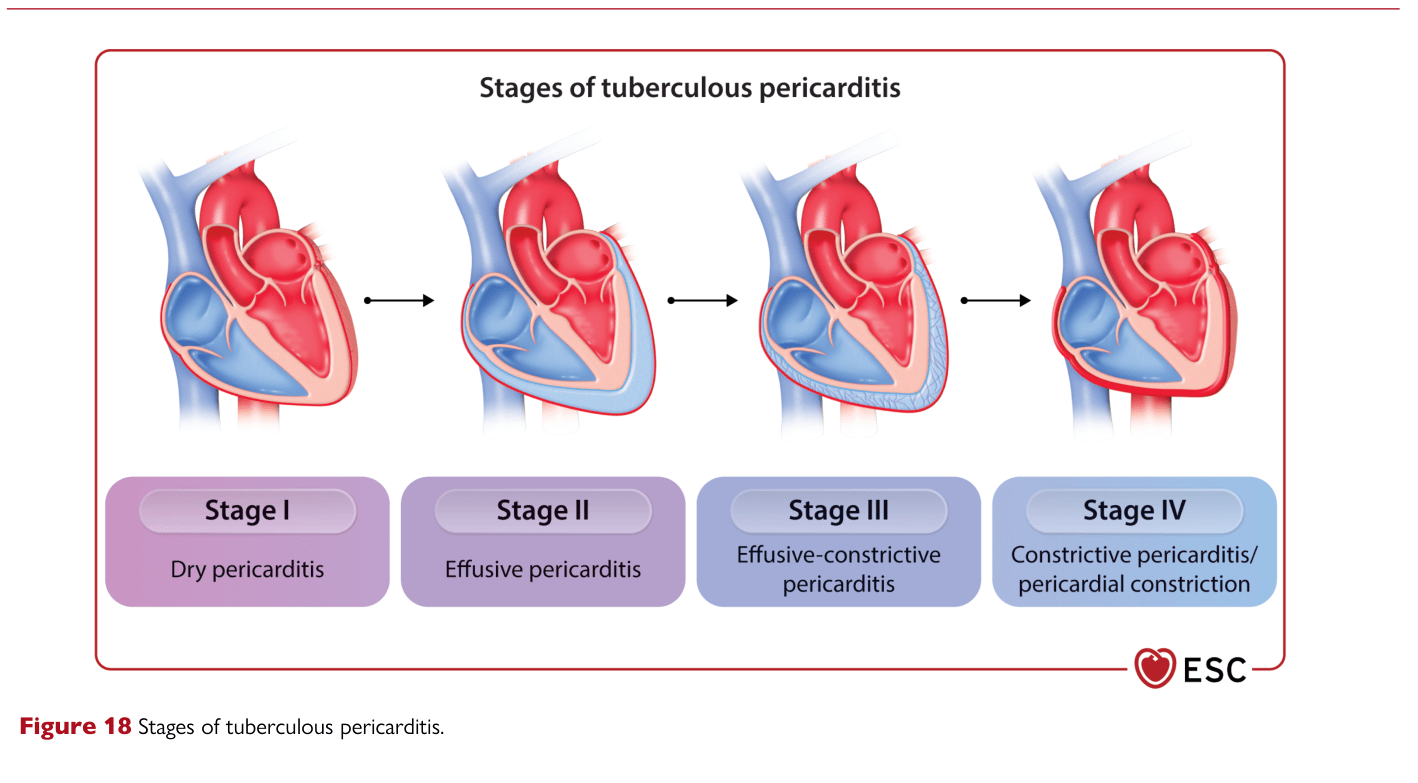
來源:2025 ESC Guidelines for the management of myocarditis and pericarditis (EHJ 2025;46:3952–4041, doi:10.1093/eurheartj/ehaf192) — 個人教學使用,原始版權屬 ESC。
🧭 圖表逐步解析:Figure 18 — Stages of TB pericarditis
這張圖在回答什麼問題:結核性心包膜炎不是一個時間點,而是一個演化過程。圖 18 把四個階段視覺化,提醒臨床醫師:看到哪一階段就要警覺前一階段可能漏診、後一階段可能很快到來。
逐步走完:
診斷與治療(與 2015 版差異不大但更明確)
- 診斷金標:(a) Pericardial fluid AFB stain + culture (low sensitivity); (b) PCR for MTB; (c) ADA >40 U/L + lymphocytic predominance(強烈支持); (d) Unstimulated IFN-γ >44 pg/mL; (e) Pericardial biopsy(granulomatous + caseation)。
- 治療(COR I):標準 4-drug anti-TB(HREZ × 2 個月 → HR × 4 個月,共 6 個月)。若同時合併 constriction 進展快 → 延長到 9–12 個月。
- Corticosteroid 角色(IMPI trial 啟示):2015 版建議常規加 prednisolone;2025 版謹慎——HIV-negative 可考慮 short-course steroid 減少 constriction 進展,HIV-positive 不建議(會增加 cancer / opportunistic infection risk)。
- Pericardiocentesis:large effusion 或 tamponade → 必做。同時送 fluid analysis。
- Pericardiectomy:對發展中的 constriction,越早做越好(在 calcification 形成前)。
📋 關鍵 Recommendations 表
| 建議 | COR | LOE | vs 舊版 | 白話解讀 |
|---|---|---|---|---|
| 急性心包膜炎首次發作 → ASA / NSAID + colchicine 三角療法 | I | A | 升級(colchicine 從 IIa → I) | colchicine 必加 |
| colchicine 療程:first episode 3 個月、recurrent 6 個月 | I | A | 沿用 CORP/COPE | 療程不能省 |
| NSAID/colchicine 無反應 / NSAID 禁忌 → low-moderate dose corticosteroid + colchicine + NSAID(triple) | IIa | B | 強調低劑量 | high-dose steroid 已淘汰 |
| Corticosteroid 必須 ≥6 個月慢 taper | I | B | 強化 | 過去 taper 太快是 rebound recurrence 主因 |
| Colchicine-resistant + corticosteroid-dependent recurrent pericarditis → Anakinra / Rilonacept | I | A | 🟢 升級(從 IIb → I) | 2025 版最大變革 |
| Anti-IL-1 治療療程至少 6-12 個月 | I | B | 新增 | 停太早 = rebound |
| 結核性心包膜炎 → 標準 6 個月 anti-TB(HREZ → HR) | I | A | 沿用 | 合併 constriction → 延長 |
| TB pericarditis + HIV-negative → 考慮 short-course steroid 降 constriction 風險 | IIa | B | 精緻化 | HIV-positive 不建議 |
| Acute pericarditis with troponin elevation → 升級為 myopericarditis 處置(住院、CMR、加強監測) | I | B | 強化 | 不能當「pericarditis 而已」 |
| 急性心包膜炎發作至少 2 次(recurrent)→ 主動找 autoimmune / autoinflammatory / genetic 病因 | I | B | 新增 | 不再標 “idiopathic” |
- 急性心包膜炎首次發作的標準三角:ASA/NSAID + colchicine + 適度休息。Colchicine 必加,療程 3 個月(first) / 6 個月(recurrent)。
- High-dose corticosteroid 已被淘汰。第二線改為 低至中劑量 (0.2–0.5 mg/kg) + ≥6 個月慢 taper。
- 反覆性心包膜炎 anti-IL-1(anakinra / rilonacept)升級為 Class I LOE A——2025 版最重大變革。
- Triage algorithm(Fig 7)依 high-risk features 分流:outpatient / admission with close f/u / admission + early anti-inflammatory + aetiology search。
- 反覆性心包膜炎應主動找 autoimmune / autoinflammatory / genetic 病因——不要直接標 “idiopathic”。
- 結核性心包膜炎四階段演化(Fig 18),台灣 endemic 議題。診斷靠 ADA + IFN-γ + PCR;治療 6 個月 4-drug + 對 HIV-negative 可考慮 short-course steroid。
- Troponin 高的 pericarditis → 升級為 myopericarditis 處置。
📖 References(本篇)
- Schulz-Menger J, Collini V, Groeschel J, et al. 2025 ESC Guidelines for the management of myocarditis and pericarditis. Eur Heart J. 2025;46(40):3952–4041. doi:10.1093/eurheartj/ehaf192
- Adler Y, Charron P, Imazio M, et al. 2015 ESC Guidelines for the diagnosis and management of pericardial diseases. Eur Heart J. 2015;36(42):2921–2964. doi:10.1093/eurheartj/ehv318
- Imazio M, Brucato A, Cemin R, et al. A Randomized Trial of Colchicine for Acute Pericarditis (ICAP). N Engl J Med. 2013;369(16):1522–1528. doi:10.1056/NEJMoa1208536
- Klein AL, Imazio M, Cremer P, et al. Phase 3 Trial of Interleukin-1 Trap Rilonacept in Recurrent Pericarditis (RHAPSODY). N Engl J Med. 2021;384(1):31–41. doi:10.1056/NEJMoa2027892
- Brucato A, Imazio M, Gattorno M, et al. Effect of Anakinra on Recurrent Pericarditis Among Patients With Colchicine Resistance and Corticosteroid Dependence (AIRTRIP). JAMA. 2016;316(18):1906–1912. doi:10.1001/jama.2016.15826
- Imazio M, Andreis A, De Ferrari GM, et al. Anakinra for corticosteroid-dependent and colchicine-resistant pericarditis: The IRAP Study. Eur J Prev Cardiol. 2020;27(9):956–964. doi:10.1177/2047487319879534
- Imazio M, Bobbio M, Cecchi E, et al. Colchicine in addition to conventional therapy for acute pericarditis: results of the COPE trial. Circulation. 2005;112(13):2012–2016. doi:10.1161/CIRCULATIONAHA.105.542738
- Imazio M, Belli R, Brucato A, et al. Efficacy and safety of colchicine for treatment of multiple recurrences of pericarditis (CORP-2): a multicentre, double-blind, placebo-controlled, randomised trial. Lancet. 2014;383(9936):2232–2237. doi:10.1016/S0140-6736(13)62709-9
- Mayosi BM, Ntsekhe M, Bosch J, et al. Prednisolone and Mycobacterium indicus pranii in tuberculous pericarditis (IMPI Trial). N Engl J Med. 2014;371(12):1121–1130. doi:10.1056/NEJMoa1407380
本文以教學為目的整理 2025 ESC Guidelines for the management of myocarditis and pericarditis,所有原文 Figure 之版權屬 ESC;商業使用請洽 ESC 取得授權。