- §13 是 2025 ESC pregnancy 指引最重要的新增章節—把妊娠重新定位為「終身 CV 健康的壓力測試」。Adverse pregnancy outcomes(HDP、GDM、SGA、preterm、loss、abruption)不只是孕期 events,更是未來 5-30 年 CV 事件的強預測因子。
- Class I B 新加:所有 APO 史的女性都該做 CV risk assessment,在 CV 評估時 recognize + document APOs,並 provide lifestyle counselling。
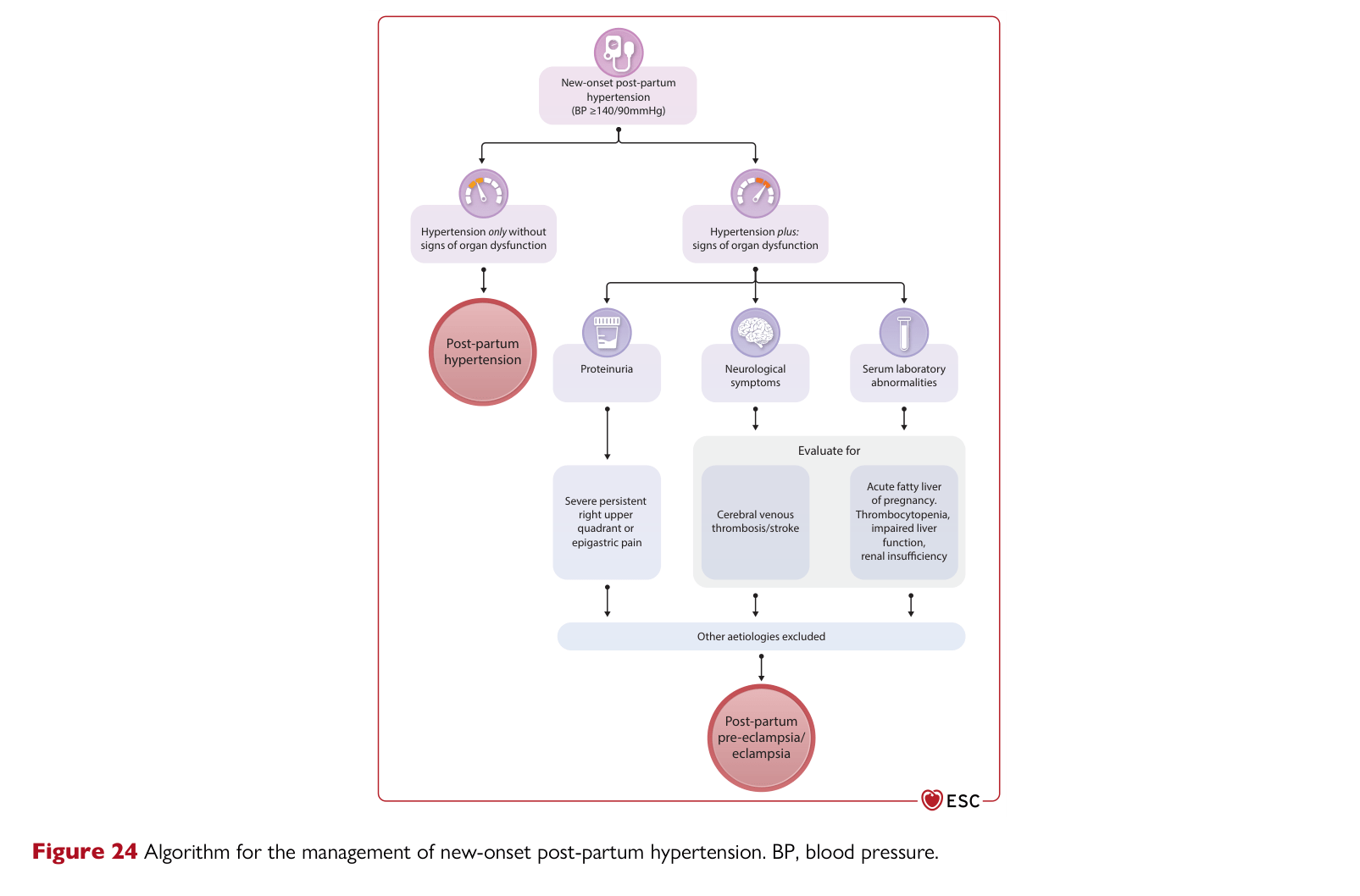
- Post-partum hypertension(Fig 24):新發 ≥140/90 mmHg 不是 always pre-eclampsia 復發;需要排 organ dysfunction(proteinuria、neurological、肝腎功能)。有 organ dysfunction → post-partum pre-eclampsia / eclampsia;無 → simple post-partum HTN。
- APO 長期管理(Fig 25):產後 6 週 OBGYN → 8-12 週 handover to primary care → 6 個月 → 12 個月,期間個別化 CV risk factor screening。Re-check every 6 to 12 months IIa。
- Women’s Heart Clinic—新概念:multidisciplinary 整合女性 CV 風險與 lifecourse approach;建議區域醫學中心設立。
🌐 §13.1 Adverse Pregnancy Outcomes (APO) — 為什麼這章存在
APO 與 CV 風險的證據鏈
過去 15 年累積的 cohort 與 meta-analysis 顯示:
| APO 類型 | 長期 CV 風險升高 | 關鍵 reference |
|---|---|---|
| Hypertensive disorders of pregnancy(HDP) | Future hypertension RR 3.7;CHD RR 2.5;stroke RR 1.8;HF RR 4.2;overall CV mortality RR 2.0 | Wu et al. Circulation 2017; CALIBER cohort |
| Pre-eclampsia (severe) | T2DM RR 1.7;future ESRD RR 4.7;dementia 風險升高 | multiple meta-analyses |
| Gestational diabetes (GDM) | T2DM 50% within 10y;CVD RR 1.7 | Bellamy et al. Lancet 2009 |
| Preterm delivery(<37w) | Maternal IHD RR 1.4;stroke RR 1.7 | BMJ 2019 meta-analysis |
| Small for gestational age (SGA) | Maternal IHD RR 1.4-1.8 | Bonamy et al. 2011 |
| Pregnancy loss (recurrent) | CHD RR 1.4;CV mortality RR 1.5 | EPIC-Norfolk cohort |
| Placental abruption | Future CVD RR 1.8 | Norwegian cohort |
機制假說(兩個非互斥):
- 「Common origins」:相同 endothelial dysfunction、insulin resistance、inflammation 既影響 placentation 又驅動 atherosclerosis。
- 「Pregnancy as a stress test」:孕期 4-6 個月的 volume + metabolic 負荷揭露原本 latent CV vulnerability。
核心建議(Class I B 新加)
| 建議 | COR/LOE |
|---|---|
| It is recommended to undertake a cardiovascular risk assessment in women with APOs, to recognize and document APOs when CVD risk is evaluated in women, and to provide counselling on the importance of healthy lifestyle choices that optimize cardiovascular health. | I B |
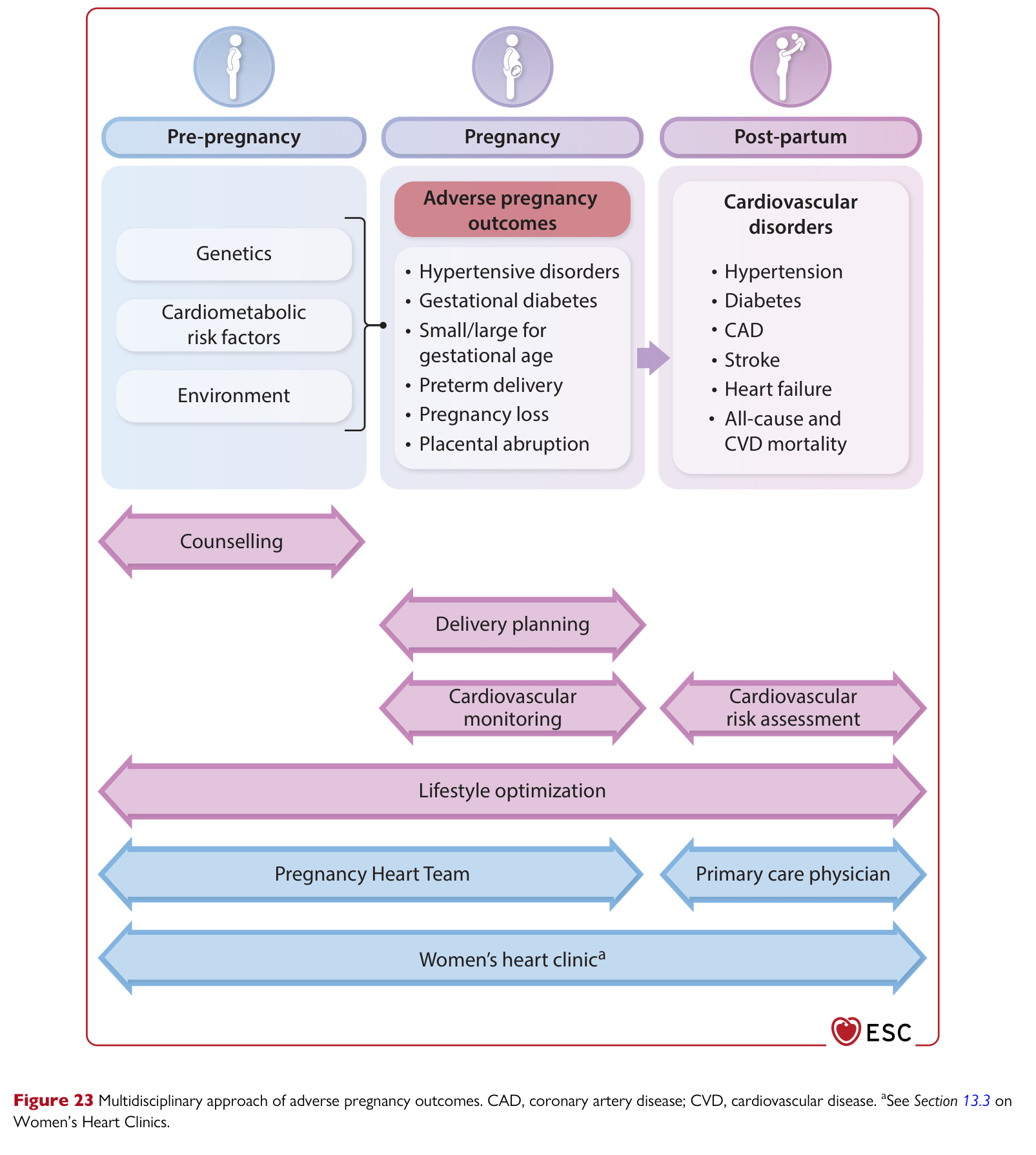
🖼️ Figure 23 — APO 後 lifelong 管理框架
來源:2025 ESC Guidelines for the management of cardiovascular disease and pregnancy (Eur Heart J, doi:10.1093/eurheartj/ehaf193) — 個人教學使用,原始版權屬 ESC。
🧭 圖表逐步解析:Figure 23
這張圖在回答什麼問題:從 pre-pregnancy 到 post-partum,跨領域團隊如何整合管理 APO 與 CV 風險?
- Counselling — 從 pre-pregnancy 到 post-partum
- Delivery planning
- Cardiovascular monitoring — pregnancy + post-partum
- Cardiovascular risk assessment — post-partum
- Lifestyle optimization — pregnancy + post-partum
- Pregnancy Heart Team ↔ Primary care physician(藍色 handover 箭頭)
- Women’s heart clinica(最下)
標註:aSee Section 13.3 on Women’s Heart Clinics。
實務意涵:圖中段強調 PHT 與 primary care physician 的 handover — APO 後不是 OB/Gyn 結案,而是要交接給 primary care + cardiology(女性 CV health clinic)。這是整個指引從急性照護延伸到 lifecourse approach 的精神。
🖼️ Figure 24 — 新發產後 HTN 處置
來源:2025 ESC Guidelines for the management of cardiovascular disease and pregnancy (Eur Heart J, doi:10.1093/eurheartj/ehaf193) — 個人教學使用,原始版權屬 ESC。
🧭 圖表逐步解析:Figure 24
這張圖在回答什麼問題:產後新發 HTN(BP ≥140/90)—怎麼判斷是 simple post-partum HTN 還是 post-partum pre-eclampsia / eclampsia?
- Hypertension only without signs of organ dysfunction(左)→ Post-partum hypertension 診斷。
- Hypertension plus signs of organ dysfunction(右)→ 進 Step 3 評估。
- Proteinuria(試紙或定量)
- Neurological symptoms(severe headache、visual disturbance、altered mental status、seizure)
- Serum laboratory abnormalities(platelet 下降、肝酶升高、creatinine 升高)
- Proteinuria → 評估是否伴 severe persistent right upper quadrant or epigastric pain → 排 HELLP / pre-eclampsia → 進 Step 5。
- Neurological symptoms → 「Evaluate for」box — Cerebral venous thrombosis / stroke。
- Serum lab abnormalities → 「Evaluate for」box — Acute fatty liver of pregnancy / Thrombocytopenia / impaired liver function / renal insufficiency。
容易踩雷的地方:
🖼️ Figure 25 — APO 後長期 CV 風險追蹤
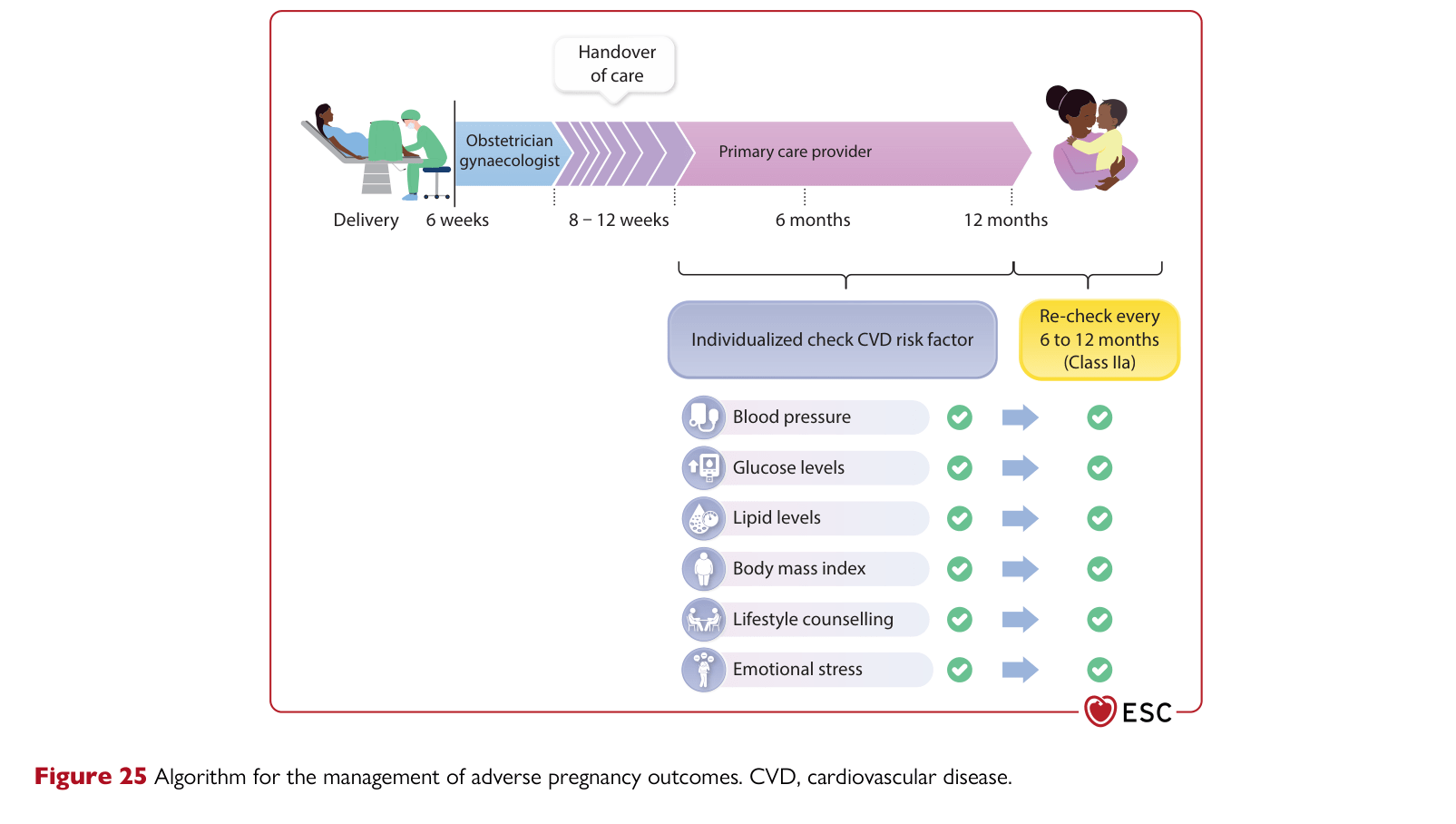
來源:2025 ESC Guidelines for the management of cardiovascular disease and pregnancy (Eur Heart J, doi:10.1093/eurheartj/ehaf193) — 個人教學使用,原始版權屬 ESC。
🧭 圖表逐步解析:Figure 25
這張圖在回答什麼問題:產後從 OB 交接到 primary care,怎麼設計 long-term CV 監測 schedule?
- Delivery to 6 weeks:由 Obstetrician/gynaecologist 主導。
- 8-12 weeks 是 handover 時機(圖上有 5 個紫色箭頭顯示 handover process)。
- 8-12 weeks 至 long term:由 Primary care provider(家醫科)接手;含 cardiology consult 依需求。
- Blood pressure
- Glucose levels
- Lipid levels
- Body mass index
- Lifestyle counselling
- Emotional stress
- 初次 8-12 weeks check(包括 OGTT for GDM 患者)
- 6 months check
- 12 months check
- 之後 re-check every 6 to 12 months IIa
容易踩雷的地方:
🤱 §13.2 Breastfeeding — 對母體 CV 健康的影響
核心訊息
- Breastfeeding 與母體 CVD 風險降低相關(meta-analysis:每多 12 個月 breastfeeding,T2DM RR 0.91、HTN RR 0.84、CHD RR 0.86)。
- 但 breastfeeding 的代謝 demand 與 fluid balance 可能 challenging some CV conditions。
- ROPAC III 顯示 HTAD 患者 breastfeeding 與 MACE 降低相關(個別評估)。
Breastfeeding 的藥物對照(Fig 6 速覽)
| 類別 | 哺乳 safe | 需評估 | 禁忌 |
|---|---|---|---|
| HF | captopril、enalapril、metoprolol、digoxin、HCTZ、furosemide、SGLT2i(limited data) | spironolactone(個別評估) | amiodarone(高 concentration) |
| HTN | labetalol、methyldopa、nifedipine、enalapril、captopril | — | atenolol(infant bradycardia 累積) |
| Anticoagulation | warfarin、UFH、LMWH | DOAC(limited data,多數 avoid) | — |
| LQTS / CPVT | nadolol、propranolol(pre-pregnancy dose) | — | — |
| Transplant IS | tacrolimus、prednisone、azathioprine | cyclosporine(可接受) | sirolimus、everolimus、mycophenolate |
| Statins / Cardio-onco | aspirin、metoprolol、clopidogrel、statins acceptable | — | methotrexate、trastuzumab |
🏥 §13.3 Women’s Heart Clinic — 新概念
為什麼需要 Women’s Heart Clinic
女性 CV 風險過去被 systematic underdiagnosed + undertreated:
- ACS 表現不典型(多 nausea、 SOB、 fatigue 而非典型胸痛)。
- SCAD、MINOCA、Takotsubo 多為女性。
- HF 在女性多 HFpEF + sex-specific 機制。
- APO 的 long-term CV impact 過去被 OB 與 cardiology 分開 view。
Women’s Heart Clinic 模式
多學科整合:
- Cardiologist(女性 CV 專長)
- Primary care physician(家醫科)
- OBGYN(轉介者)
- Endocrinologist(GDM/HDP 後 metabolic 風險)
- Dietitian + Physical therapist(lifestyle counselling)
- Psychologist(post-partum 與 chronic illness psychological support)
- Genetic counsellor(含 HTAD / channelopathy / PPCM family screening)
適合的患者
- APO 史(HDP、GDM、SGA、preterm、loss、abruption)
- Pre-existing CVD(CHD、CMP、PAH、aortic disease)
- Inherited cardiac conditions(LQTS、HCM、Marfan 等)
- Post-PPCM follow-up
- Menopause + CV risk transition
實務:台灣可由區域醫學中心心臟科 + 婦女醫學中心合設「女性心臟健康整合門診」。Primary care physician 為 gatekeeper,cardiology 為 consultant。
📋 §13 重點 Recommendations 整理
| 主題 | 2025 建議 | COR/LOE | vs 2018 |
|---|---|---|---|
| APO + CV risk assessment | 所有 APO 史女性 → CV risk assessment + lifestyle counselling | I B | 新加 |
| APO 記錄在 medical record | 每次 CV risk evaluation 時 document APO 史 | I B | 新加 |
| Post-partum CV risk re-check every 6-12 months | BP、glucose、lipid、BMI、lifestyle、emotional | IIa | 新加 |
| Handover OB → primary care | 8-12 週 standardized handover | I C | 新加 |
| Women’s Heart Clinic 制度 | 區域醫學中心建立 multidisciplinary 整合門診 | IIa C | 新加 |
| Breastfeeding 鼓勵(with disease-specific 藥物審慎) | 支持 breastfeeding,個別評估藥物安全 | IIa | 明確化 |
| GDM 後 OGTT 6-12 週 | 建議 baseline 與 1-3 年 surveillance | I B | 確認 |
| Aspirin prophylaxis for recurrent pre-eclampsia high-risk pregnancies | 下次 pregnancy 80-150 mg qd from 12-16w to 36w | I A | 確認 |
🌍 全指引整體回顧 — 6 篇貫通的精神
2025 ESC CVD & Pregnancy 指引的核心改變總結(橫跨 6 篇):
- Pregnancy Heart Team 制度化(篇 I)— mWHO II-III+ 強制 PHT 管理;PHT 涵蓋 pre-conception → long-term 5 階段。
- mWHO IV 從禁忌變共享決策(篇 I, II)— 尊重 woman autonomy;強化 counselling 與心理支持。
- Gene-based approach(篇 II)— HTAD 手術閾值依 variant 分;LQTS / CPVT 精準藥物(nadolol / propranolol)。
- 專屬 algorithm 文化(篇 III, IV)— VTE(Fig 9/10)、Chest pain(Fig 11)、HDP(Fig 12A-C)、SVT/AF/VT(Fig 14-16)、Cardiac arrest(Fig 19)每個都有清楚 flowchart。
- Cardiac arrest 三條 Class I C(篇 IV)— manual uterine displacement、IV above diaphragm、不為 teratogenicity 停藥。
- Acute HF / CS 完整路徑(篇 V)— inotrope 選擇、PPCM bromocriptine、MCS bridge 系統化。
- §13 全新章節:lifelong CV health(篇 VI)— APO 是 lifelong CV stress test;Women’s Heart Clinic 制度。
- §13 是 2025 版最重要的新增章節—把妊娠定位為「終身 CV 健康的壓力測試」。
- Class I B 新加:APO 史 → CV risk assessment + lifestyle counselling。所有有 APO 史的女性都該定期 CV monitoring。
- Post-partum HTN(Fig 24):新發 HTN ≠ 一律 pre-eclampsia;要排 organ dysfunction、CVT、AFLP、HELLP。
- APO 長期 schedule(Fig 25):8-12 週 handover OB → primary care;之後 6 個月、12 個月、recheck every 6-12 months。
- Women’s Heart Clinic 概念:multidisciplinary 整合女性 CV 風險 lifecourse approach。
- Breastfeeding 與母體 CV 健康相關(T2DM RR 0.91、HTN RR 0.84、CHD RR 0.86),藥物需個別 review。
- 整個指引從 pre-conception 到 long-term,跨越 5 階段的Pregnancy Heart Team 制度貫穿—台灣建議由區域醫學中心建立此整合照護模式。
📖 References
- De Backer J, Haugaa KH, Hasselberg NE, et al. 2025 ESC Guidelines for the management of cardiovascular disease and pregnancy. Eur Heart J 2025;46(43):4462–4568. doi:10.1093/eurheartj/ehaf193
- Parikh NI, Gonzalez JM, Anderson CAM, et al. Adverse Pregnancy Outcomes and Cardiovascular Disease Risk: AHA Scientific Statement. Circulation 2021;143(18):e902-e916.
- Wu P, Haththotuwa R, Kwok CS, et al. Preeclampsia and future cardiovascular health: a systematic review and meta-analysis. Circ Cardiovasc Qual Outcomes 2017;10:e003497.
- Bellamy L, Casas JP, Hingorani AD, et al. Type 2 diabetes mellitus after gestational diabetes: a systematic review and meta-analysis. Lancet 2009;373:1773-1779.
- Kessous R, Shoham-Vardi I, Pariente G, et al. Adverse pregnancy outcomes and long-term maternal renal disease. J Matern Fetal Neonatal Med 2019;32:3127-3133.
- Aune D, Sen A, Henriksen T, et al. Breastfeeding and the maternal risk of type 2 diabetes: meta-analysis. Eur J Epidemiol 2019;34:935-952.
- Mehta LS, Velarde GP, Lewey J, et al. Cardiovascular Disease Risk Factors in Women: The Impact of Race and Ethnicity (AHA Scientific Statement). Circulation 2023;147:1471-1487.
- Peters PNJ, van der Zande JA, De Backer J, et al. Pregnancy outcomes in women with heritable thoracic aortic disease (ROPAC III). Eur Heart J Qual Care Clin Outcomes 2025;11:1091-1107.
本文以教學為目的整理 2025 ESC Guidelines for the management of cardiovascular disease and pregnancy;所有原文 Figure 之版權屬 ESC。商業使用請洽 ESC 取得授權。