🎯 Take-home Message
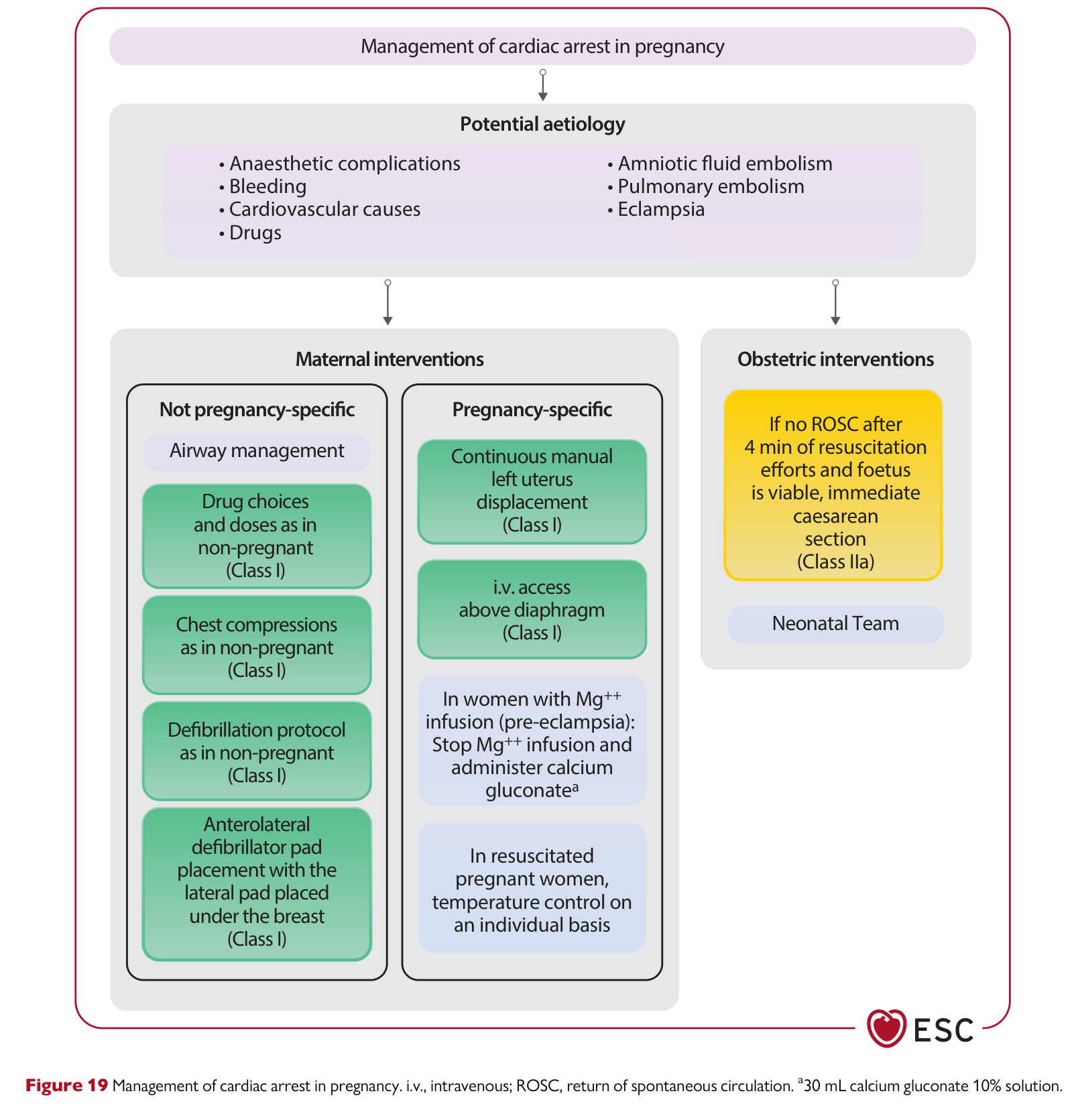
- 新發 cardiac arrest 三條 Class I C:(1) Manual left uterine displacement(≥20w)解 aortocaval compression;(2) IV access above diaphragm;(3) 不可因 teratogenicity 顧慮停藥—ACLS drugs 一律給。
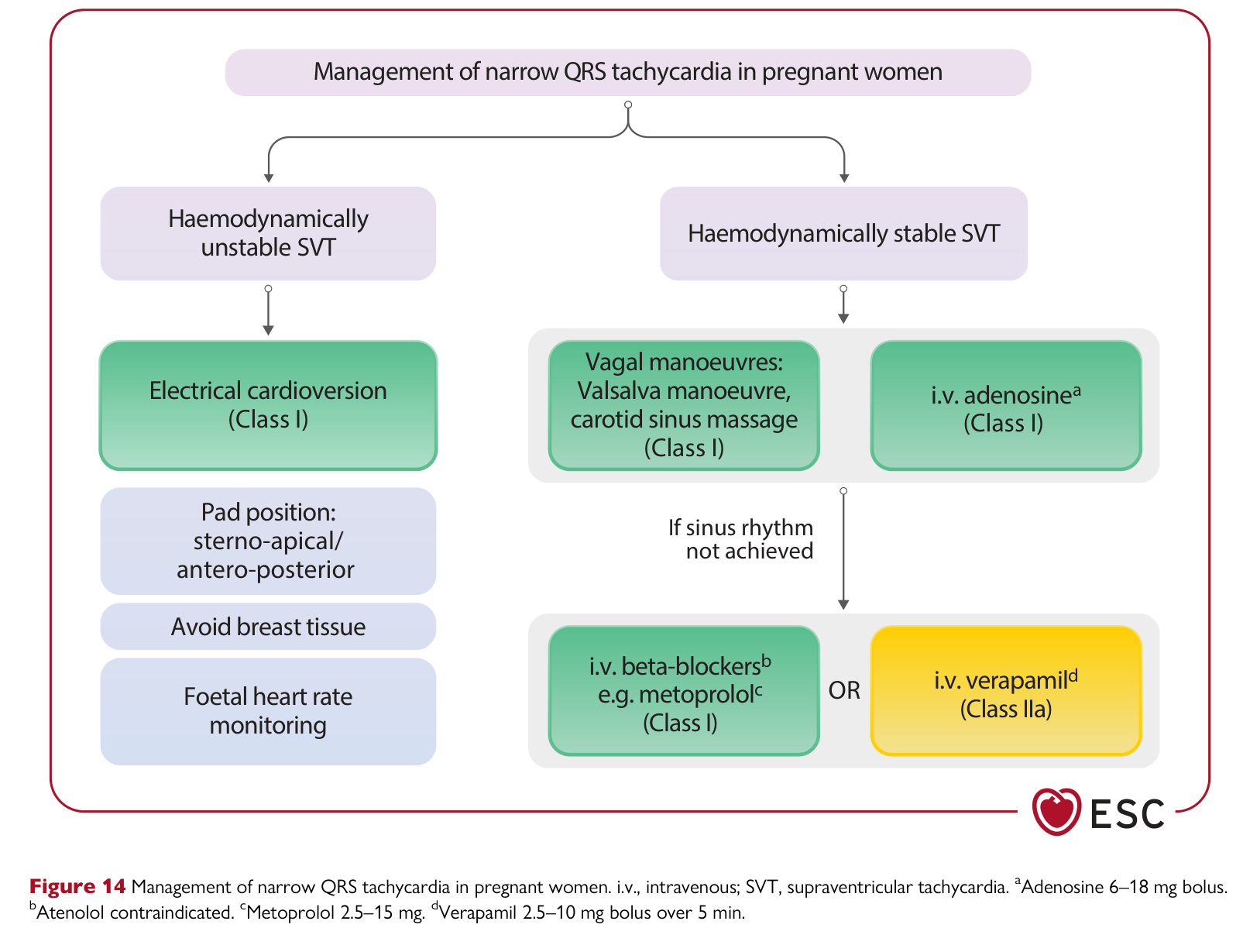
- Narrow QRS SVT(Fig 14):stable 用 vagal → adenosine;unstable 立即 electrical cardioversion;recurrent → metoprolol。
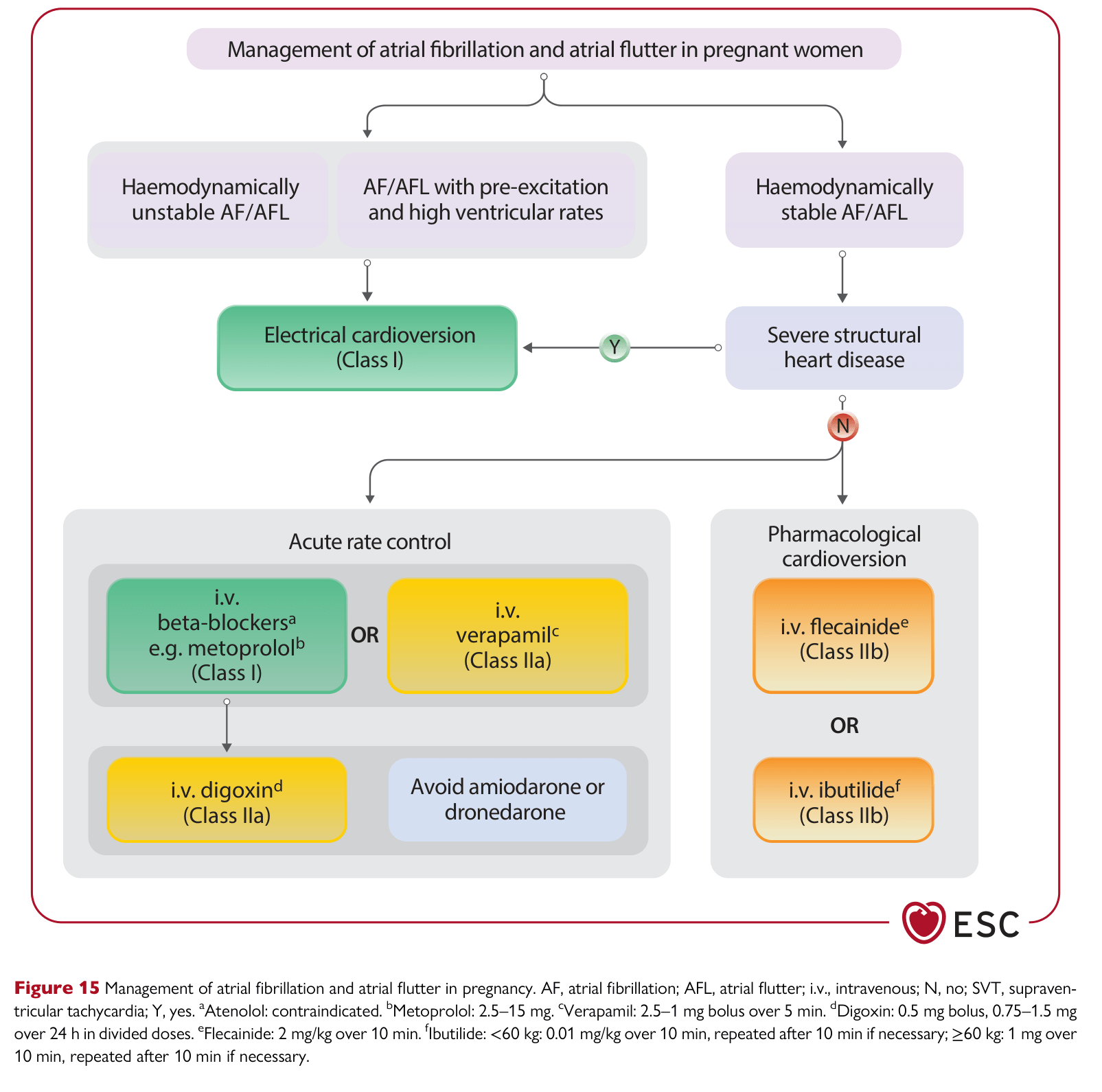
- AF/AFL(Fig 15):unstable / pre-excitation 立即 electrical cardioversion;stable 結構性心臟病 → IV metoprolol;無結構性 → IV flecainide 或 ibutilide;AVOID amiodarone(fetal thyroid)。
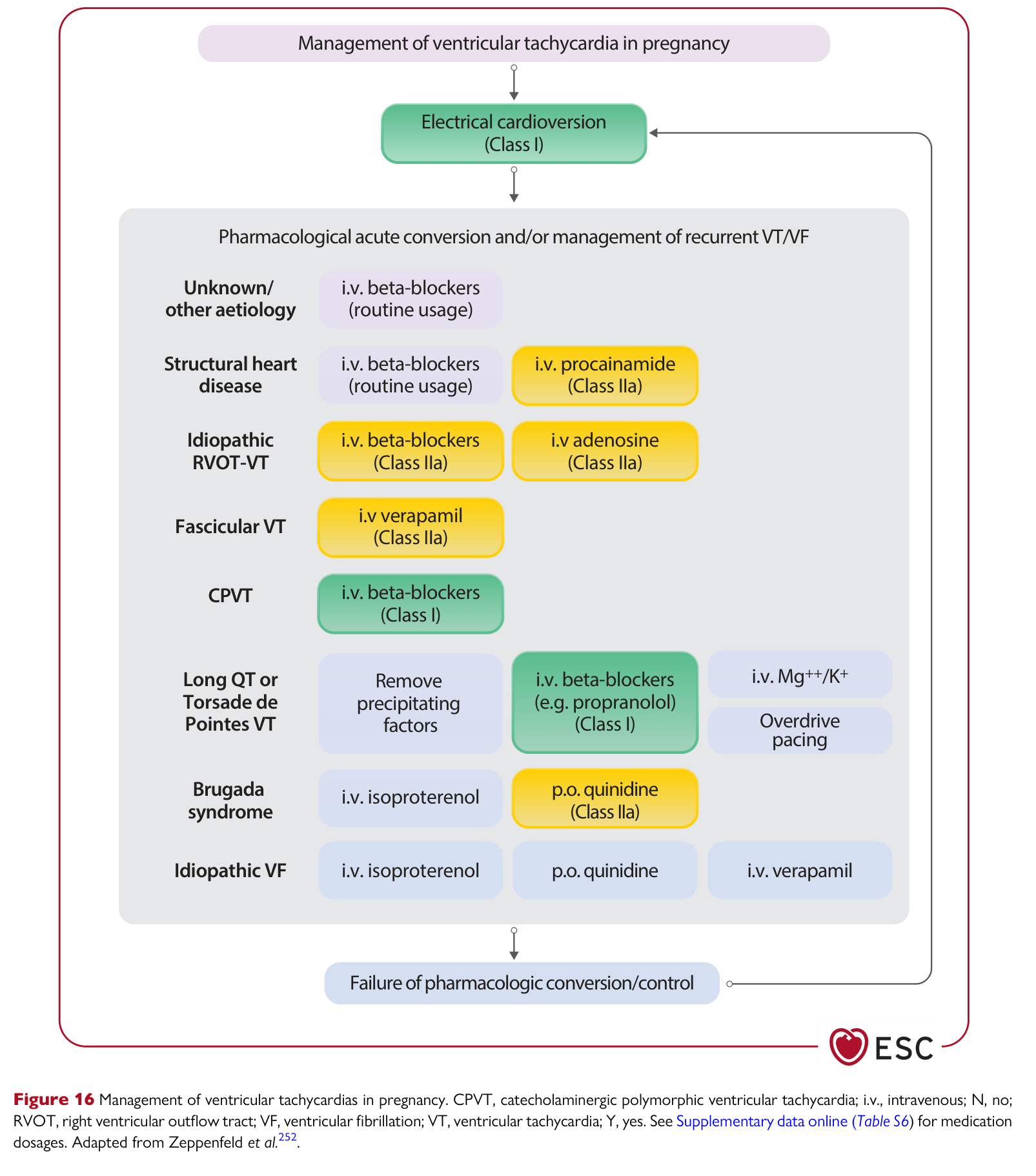
- VT(Fig 16):依 aetiology 細分(unknown、structural、idiopathic RVOT、fascicular、CPVT、LQT/TdP、Brugada、idiopathic VF),每群有特定 IV drug。
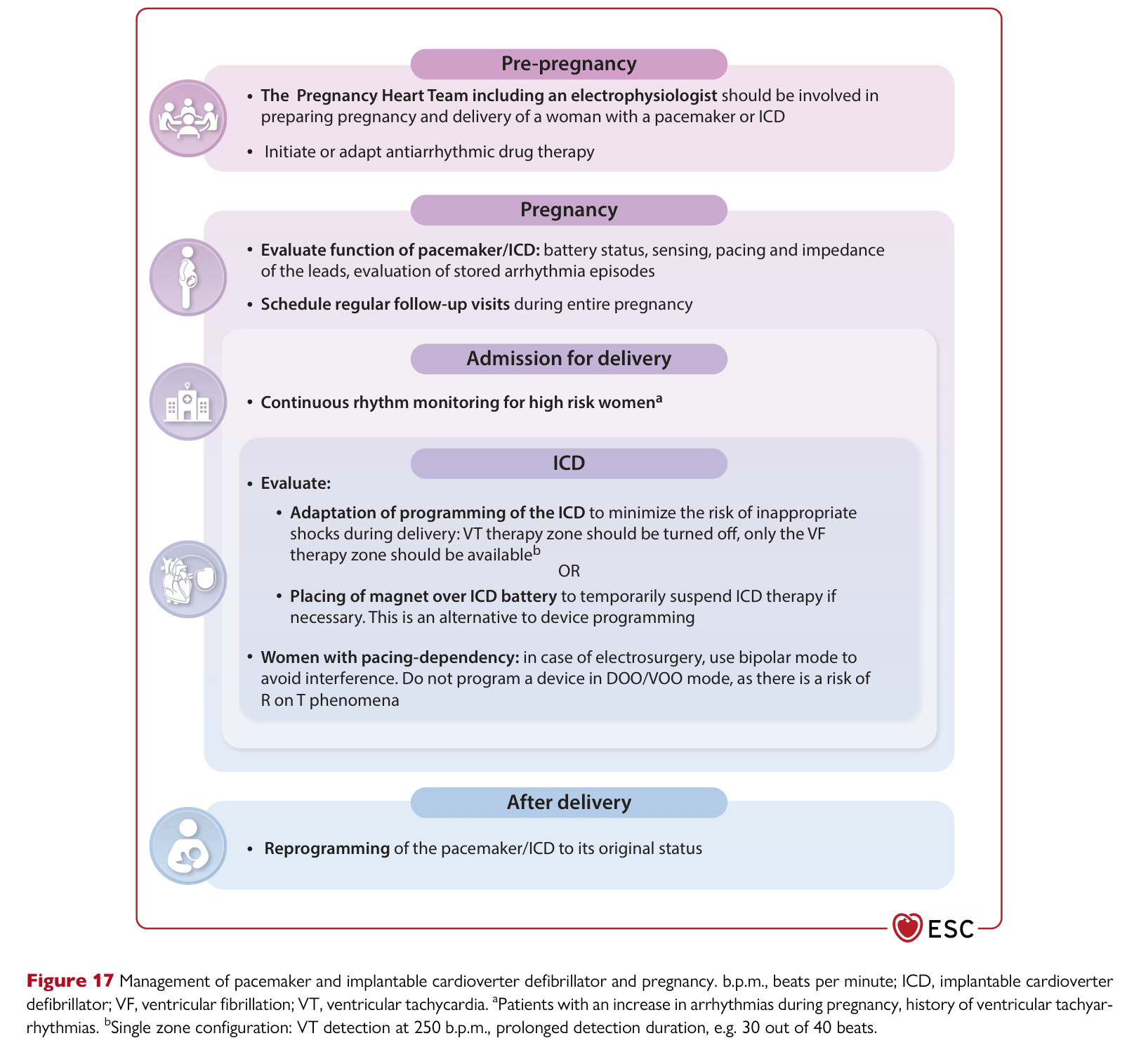
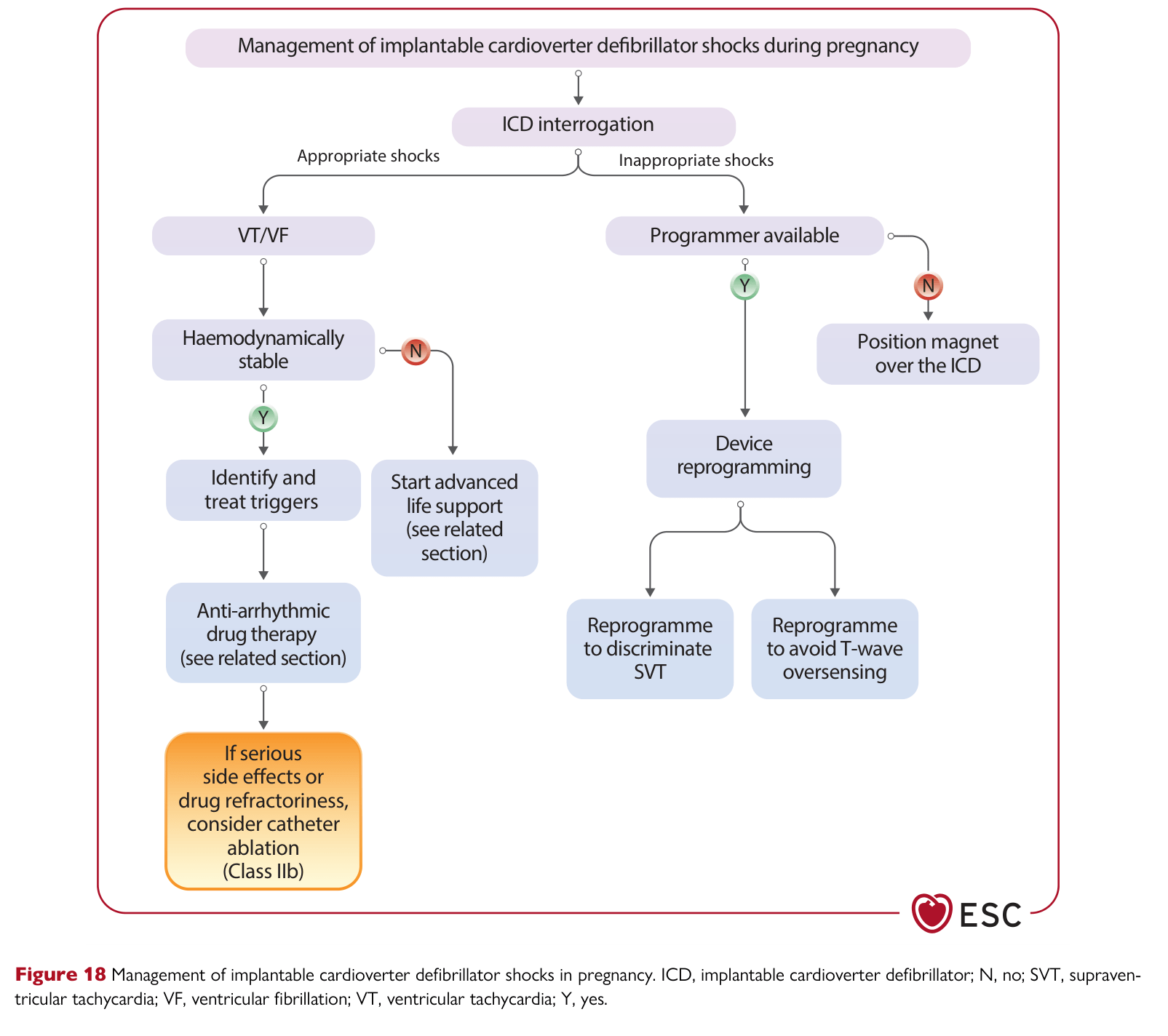
- PM/ICD(Fig 17/18):產前 PHT + electrophysiologist 介入;分娩 high-risk 用 continuous rhythm monitoring + 暫時關 ICD VF therapy(用 magnet)或 reprogramming。
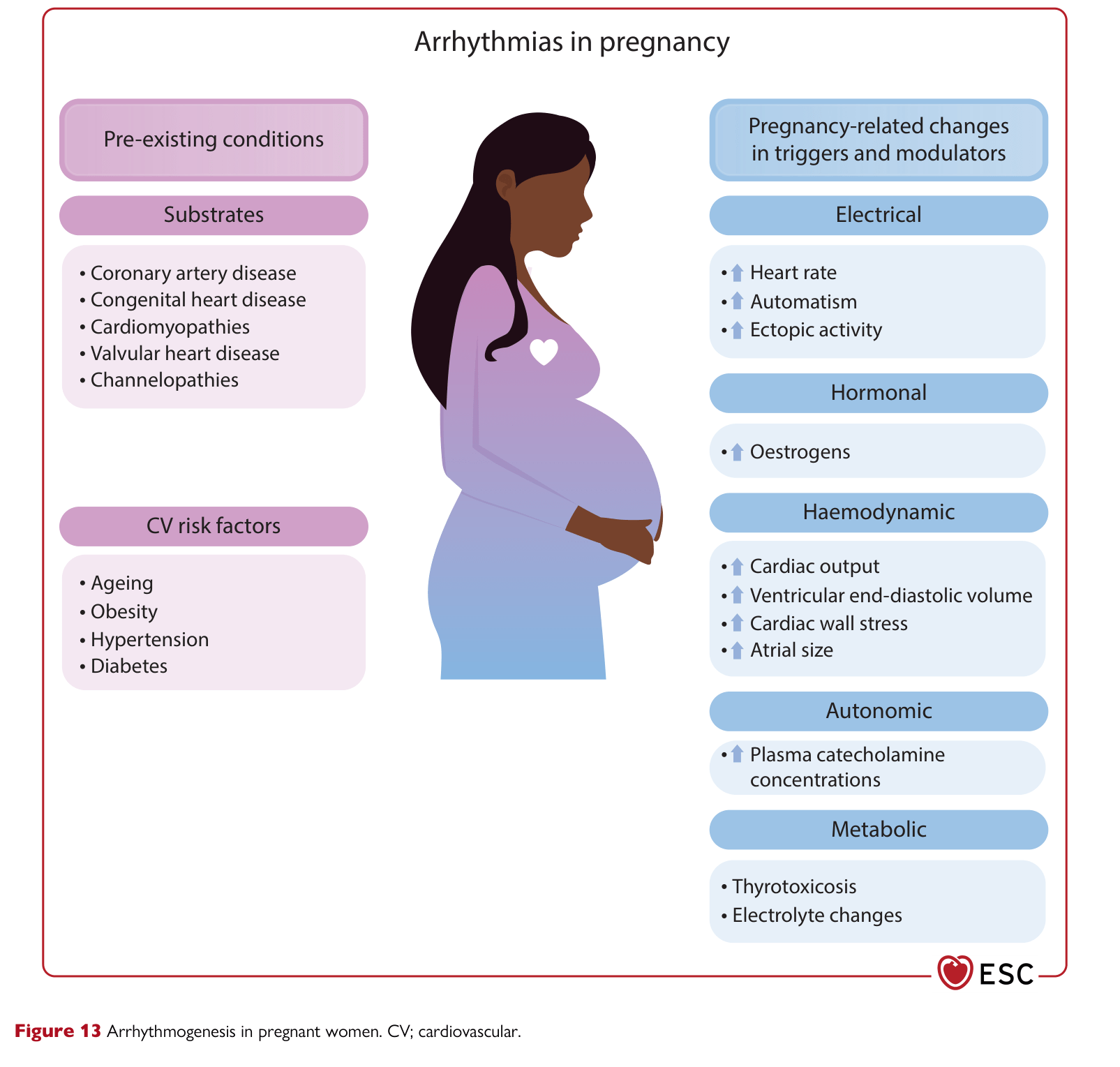
⚡ §12.4 Arrhythmias 概論 — Figure 13(為什麼孕期會有 arrhythmia)
來源:2025 ESC Guidelines for the management of cardiovascular disease and pregnancy (Eur Heart J, doi:10.1093/eurheartj/ehaf193) — 個人教學使用,原始版權屬 ESC。
🧭 圖表逐步解析:Figure 13
這張圖在回答什麼問題:為什麼孕期 / 產後 arrhythmia 發作率上升?分 pre-existing 與 pregnancy-related 兩面分析。
Left — Pre-existing conditions:
- Substrates(解剖 substrate):CAD、CHD、CMP、valvular HD、channelopathies
- CV risk factors:ageing、obesity、hypertension、diabetes
Right — Pregnancy-related changes in triggers and modulators(5 大類):
- Electrical:HR 上升、automaticity 增、ectopic activity 增
- Hormonal:oestrogen 上升(影響 QT、refractoriness)
- Haemodynamic:cardiac output ↑、ventricular end-diastolic volume ↑、cardiac wall stress ↑、atrial size ↑(atrial stretch → AF/AT trigger)
- Autonomic:plasma catecholamine concentrations 上升
- Metabolic:thyrotoxicosis(部分孕婦 transient)、electrolyte changes(Mg、K shift)
實務意涵:pre-existing substrate + pregnancy trigger 是 arrhythmia 高發的根因。處置策略要同時 (a) treat acute event、(b) consider substrate management、(c) post-partum re-evaluate(多數 trigger 在產後 6 週緩解)。
💓 Narrow QRS Tachycardia — Figure 14
來源:2025 ESC Guidelines for the management of cardiovascular disease and pregnancy (Eur Heart J, doi:10.1093/eurheartj/ehaf193) — 個人教學使用,原始版權屬 ESC。
🧭 圖表逐步解析:Figure 14
這張圖在回答什麼問題:孕婦 SVT(narrow QRS tachycardia),怎麼分流處置?
Step 1:Management of narrow QRS tachycardia in pregnant women。
Step 2 — 血流動力學分流:
- Haemodynamically unstable SVT → Electrical cardioversion (Class I);pad position 為 sterno-apical / antero-posterior、avoid breast tissue、foetal heart rate monitoring。
- Haemodynamically stable SVT → Vagal manoeuvres:Valsalva、carotid sinus massage(Class I)→ 進 Step 3。
Step 3:Vagal 無效 → i.v. adenosinea(Class I)— Adenosine 6-18 mg bolus;safe in pregnancy。
Step 4 — If sinus rhythm not achieved:
- i.v. beta-blockersb e.g. metoprolol(Class I)— 2.5-5 mg bolus over 5 min(atenolol contraindicated)
OR - i.v. verapamilc(Class IIa)— 2.5-10 mg bolus over 5 min
容易踩雷的地方:
陷阱 1 — Adenosine 不敢給:adenosine 半衰期短(<10s)、不過胎盤、不影響胎兒。Vagal 不行就立即 adenosine。
陷阱 2 — Verapamil 一線:Verapamil 是 IIa 而非 I(在 BB 之後)。Atenolol 禁忌(IUGR)。
陷阱 3 — Defib pad 放在 breast 上:避免 breast tissue(impedance 高),用 sterno-apical 或 antero-posterior position;fetal HR monitoring 同步。
💗 AF / Atrial Flutter — Figure 15
來源:2025 ESC Guidelines for the management of cardiovascular disease and pregnancy (Eur Heart J, doi:10.1093/eurheartj/ehaf193) — 個人教學使用,原始版權屬 ESC。
🧭 圖表逐步解析:Figure 15
Step 1:Management of AF/AFL in pregnant women。
Step 2 — 三條分流:
- Haemodynamically unstable AF/AFL → Electrical cardioversion (Class I)。
- AF/AFL with pre-excitation and high ventricular rates(WPW)→ Electrical cardioversion (Class I)。絕對不要 AV node blockers(會造成 1:1 AV conduction)。
- Haemodynamically stable AF/AFL → 進 Step 3。
Step 3 — Severe structural heart disease?
- 有 severe structural HD(左下分支):
- Acute rate control:i.v. beta-blockersa(metoprolol)(Class I)OR i.v. verapamilc(Class IIa)OR i.v. digoxind(Class IIa)
- Avoid amiodarone or dronedarone
- 無嚴重結構性疾病(右下分支):
- Pharmacological cardioversion:i.v. flecainidee(Class IIb)OR i.v. ibutilidef(Class IIb)
標註:
- aMetoprolol 2.5–15 mg;batenolol contraindicated;cVerapamil 2.5–5 mg over 5 min;dDigoxin 2 mg/kg over 10 min;eFlecainide <60 kg 0.01 mg/kg over 10 min, repeated after 10 min if necessary;fIbutilide ≥60 kg 1 mg over 10 min, repeated after 10 min if necessary
容易踩雷的地方:
陷阱 1 — Amiodarone 在妊娠 AF:絕對禁忌(fetal hypothyroidism、goiter、neurodevelopmental impairment)。Lactation 也要避免(lipid-soluble,乳汁濃度高)。
陷阱 2 — Pre-excited AF 用 BB / verapamil / digoxin:禁忌!這些 AV node blockers 會增加 accessory pathway conduction → 危險的 1:1 → VF。直接 electrical cardioversion。
陷阱 3 — 無結構心臟病者直接 amiodarone:無結構心 + stable AF 用 flecainide / ibutilide 為一線;amiodarone 是 last resort(給 unstable + 無其他選項)。
陷阱 4 — 抗凝決策:CHA2DS2-VA in pregnancy 採個別評估。Pregnancy itself 是 prothrombotic state;多數 AF + pregnancy 給 LMWH(不是 VKA 也不是 DOAC)。
🔥 Ventricular Tachycardia — Figure 16
來源:2025 ESC Guidelines for the management of cardiovascular disease and pregnancy (Eur Heart J, doi:10.1093/eurheartj/ehaf193) — 個人教學使用,原始版權屬 ESC。
🧭 圖表逐步解析:Figure 16
這張圖在回答什麼問題:孕婦 VT 怎麼依 aetiology 決定 IV 用藥?
Step 1:Management of ventricular tachycardia in pregnancy。
Step 2 — 一線:Electrical cardioversion (Class I) if unstable。
Step 3 — Pharmacological acute conversion 或 recurrent VT/VF management(按 aetiology 分 9 群):
| Aetiology | 一線 IV drug | 二線 / 補充 |
|---|---|---|
| Unknown / other aetiology | i.v. beta-blockers(routine usage) | i.v. procainamide (Class I) |
| Structural heart disease | i.v. beta-blockers(routine usage) | i.v. procainamide (Class I) |
| Idiopathic RVOT-VT | i.v. beta-blockers(Class I) | i.v. adenosine (Class IIa) |
| Fascicular VT | i.v. verapamil (Class IIa) | — |
| CPVT | i.v. beta-blockers (Class I) | — |
| Long QT or Torsade de Pointes VT | Remove precipitating factors;i.v. beta-blockers (e.g. propranolol) (Class I) | i.v. Mg++/K+;Overdrive pacing |
| Brugada syndrome | i.v. isoproterenol | p.o. quinidine (Class IIa) |
| Idiopathic VF | i.v. isoproterenol | p.o. quinidine、i.v. verapamil |
Step 4 — Failure of pharmacological conversion/control → MCS / catheter ablation 評估。
容易踩雷的地方:
陷阱 1 — LQTS-related TdP 用 amiodarone:禁忌!Amiodarone 延長 QT 更甚,會 worsen。用 BB(propranolol IV)+ Mg + K + overdrive pacing。
陷阱 2 — Brugada-related VT 用 BB:禁忌!Brugada VT 是 isoproterenol + quinidine 的組合(BB 反而觸發)。
陷阱 3 — Fascicular VT 用 BB:fascicular VT 對 verapamil 特別有效(dose 2.5-10 mg);BB 反而效果差。
陷阱 4 — Idiopathic RVOT-VT 不試 adenosine:RVOT-VT 對 adenosine 有反應(用以區分),雙 IIa 適應症。
📟 PM / ICD Management — Figure 17, 18
來源:2025 ESC Guidelines for the management of cardiovascular disease and pregnancy (Eur Heart J, doi:10.1093/eurheartj/ehaf193) — 個人教學使用,原始版權屬 ESC。
🧭 圖表逐步解析:Figure 17
四階段:
Pre-pregnancy:PHT including electrophysiologist 介入準備(pre-pregnancy battery、lead check、anti-arrhythmic drug review);initiate 或 adapt antiarrhythmic therapy。
Pregnancy:(a) Evaluate function of PM/ICD:battery status、sensing、pacing、impedance of leads、evaluation of stored arrhythmia events;(b) Schedule regular follow-up visits during entire pregnancy。
Admission for delivery:Continuous rhythm monitoring for high-risk womena。
ICD-specific(delivery)evaluation:
- Adaptation of programming of the ICD to minimize the risk of inappropriate shocks during delivery:VT therapy zone should be turned off, only the VF therapy zone should be availableb OR
- Placing of magnet over ICD battery—temporarily suspends ICD therapy if necessary。This is an alternative to device reprogramming。
- Women with pacing-dependency:in case of electrosurgery, use bipolar mode to avoid interference。Do not program a device in DOO/VOO mode, as there is a risk of R on T phenomena
After delivery:Reprogramming of PM/ICD to its original status。
來源:2025 ESC Guidelines for the management of cardiovascular disease and pregnancy (Eur Heart J, doi:10.1093/eurheartj/ehaf193) — 個人教學使用,原始版權屬 ESC。
🧭 圖表逐步解析:Figure 18
這張圖在回答什麼問題:孕婦 ICD 放電了,怎麼快速分流?
Step 1:ICD interrogation。
Step 2 — Appropriate vs Inappropriate shocks 分流:
Appropriate shocks 分支(左):
- VT/VF → Haemodynamically stable? →
- 是:Identify and treat triggers → Anti-arrhythmic drug therapy (see related section)
- 否:Start advanced life support (see related section)
- If serious side effects or drug refractoriness → consider catheter ablation (Class IIb)。
Inappropriate shocks 分支(右):
- Programmer available? →
- 是:Device reprogramming → reprogram to discriminate SVT 或 reprogram to avoid T-wave oversensing。
- 否:Position magnet over the ICD(暫時 suspend therapy)→ get programmer / call EP。
容易踩雷的地方:
陷阱 1 — ICD 放電後立即假設 inappropriate:先 interrogate 看 stored EGM。若 VT/VF 真實事件,要找 trigger(電解質、發燒、antiarrhythmic 漏服)。
陷阱 2 — Pregnant women 不放 magnet:magnet 可以 safe 用於 pregnancy,會 suspend ICD therapy(但保留 anti-bradycardia pacing)。
陷阱 3 — VT zone 留著做 delivery:分娩劇烈 sinus tachycardia 可能 trigger inappropriate shocks。Delivery 前關 VT zone(只留 VF zone)或用 magnet。
🚨 Cardiac Arrest in Pregnancy — Figure 19(新增重點)
來源:2025 ESC Guidelines for the management of cardiovascular disease and pregnancy (Eur Heart J, doi:10.1093/eurheartj/ehaf193) — 個人教學使用,原始版權屬 ESC。
🧭 圖表逐步解析:Figure 19
這張圖在回答什麼問題:孕婦 cardiac arrest,maternal 與 obstetric 介入怎麼整合?
Step 1:Management of cardiac arrest in pregnancy。
Step 2 — Potential aetiology(10 條左右):
- Anaesthetic complications
- Bleeding
- Cardiovascular causes
- Drugs
- Amniotic fluid embolism
- Pulmonary embolism
- Eclampsia
Step 3 — 三大 intervention 軸(並行進行):
- Maternal interventions(非 pregnancy-specific):
- Airway management
- Drug choices and doses as in non-pregnant I — 不可因 teratogenicity 顧慮停藥
- Chest compressions as in non-pregnant I
- Defibrillation protocol as in non-pregnant I
- Anterolateral defibrillator pad placement with the lateral pad placed under the breast I
- Maternal interventions(pregnancy-specific):
- Continuous manual left uterus displacement (Class I) — 解 aortocaval compression(≥20w)
- i.v. access above the diaphragm (Class I) — 確保藥物不被孕子宮阻擋
- In women with magnesium infusion (pre-eclampsia):Stop Mg++ infusion and administer calcium gluconatea (30 mL Ca gluconate 10% solution)
- In resuscitated pregnant women, temperature control on an individual basis
- Obstetric interventions:
- If no ROSC after 4 min of resuscitation efforts and foetus is viable, immediate caesarean section (Class IIa)
- Neonatal Team
容易踩雷的地方:
陷阱 1 — Resuscitative caesarean 等太久:明確 4 min 後無 ROSC + 胎兒 viable 立即做 caesarean。延後會降低 maternal survival(解 aortocaval compression 後 CPR 才有效)+ fetal survival。
陷阱 2 — 不打 epinephrine 因為「會傷胎兒」:明確 Class I C 不可因 teratogenicity 顧慮停藥。Maternal survival 是第一優先;ACLS dose 與 protocol 與非孕婦相同。
陷阱 3 — IV access 放下肢:≥20w 子宮會 compress IVC → 下肢藥物 ineffective。一律 above-diaphragm(jugular、subclavian、ante-cubital)。
陷阱 4 — 沒做 manual uterine displacement:>20w 必須 manual lateral displacement(一手放右側腰,把子宮往左推),不要用左側 tilt(影響 chest compression 質量)。
陷阱 5 — Pre-eclampsia + Mg infusion 持續:Mg 過量本身可造成 cardiac arrest。Stop infusion + give calcium gluconate 30 mL 10%。
陷阱 6 — 後 ROSC 不持續監測:產後 24-48 小時 closely 監測 maternal 與 fetal status;post-arrest team 持續到 stable。
📋 §12.4 重點 Recommendations 整理
| 主題 | 2025 建議 | COR/LOE | vs 2018 |
|---|---|---|---|
| Unstable SVT/AF/VT | 立即 electrical cardioversion | I C | 確認 |
| Stable SVT | Vagal → adenosine → BB(metoprolol) | I C | 確認 |
| Stable AF/AFL with structural HD | i.v. metoprolol / verapamil / digoxin | I / IIa | 確認 |
| Stable AF/AFL without structural HD | i.v. flecainide 或 ibutilide | IIb | 新加細項 |
| LQTS-related TdP | BB + Mg + K + overdrive pacing | I | 明確化 |
| Brugada-related VT | Isoproterenol + quinidine | I | 明確化 |
| Cardiac arrest manual uterine displacement | ≥20w | I C | 新加 |
| Cardiac arrest IV access above diaphragm | 避免 IVC compression | I C | 新加 |
| Cardiac arrest no drug withholding | 不為 teratogenicity 顧慮停藥 | I C | 新加 |
| Perimortem caesarean <4 min no ROSC + viable foetus | 立即進行 | IIa | 明確 4 分鐘 |
| Pre-eclampsia + Mg overdose | Stop Mg + Ca gluconate | I | 新加細項 |
| Congenital AVB asymptomatic + normal anatomy + narrow QRS + HR ≥50 bpm | 不建議 prophylactic temporary pacemaker | III C | 新加 |
✅ 重點回顧
- SVT(Fig 14):vagal → adenosine → BB(metoprolol)→ verapamil;unstable 立即 cardioversion。
- AF/AFL(Fig 15):unstable / pre-excited 立即 cardioversion;structural HD → rate control(metoprolol/verapamil/digoxin);無結構 → flecainide/ibutilide;amiodarone 全程禁忌。
- VT(Fig 16):依 aetiology 8 群分藥;LQTS-TdP 用 BB+Mg+K+overdrive,Brugada 用 isoproterenol+quinidine,fascicular 用 verapamil。
- PM/ICD(Fig 17/18):PHT + EP 全期介入;delivery 高風險者 continuous monitoring + 暫關 VT therapy zone 或 magnet;ICD 放電先 interrogate 看是 appropriate 還是 inappropriate。
- Cardiac arrest(Fig 19):三條 Class I C 新加 — manual uterine displacement、IV above diaphragm、不停 ACLS drug;4 min no ROSC + viable → 立即 caesarean (IIa);Pre-eclampsia + Mg overdose → stop Mg + Ca gluconate。
📖 References
- De Backer J, Haugaa KH, Hasselberg NE, et al. 2025 ESC Guidelines for the management of cardiovascular disease and pregnancy. Eur Heart J 2025;46(43):4462–4568. doi:10.1093/eurheartj/ehaf193
- Lipman S, Cohen S, Einav S, et al. The Society for Obstetric Anesthesia and Perinatology consensus statement on the management of cardiac arrest in pregnancy. Anesth Analg 2014;118:1003-1016.
- Jeejeebhoy FM, Zelop CM, Lipman S, et al. Cardiac Arrest in Pregnancy: Scientific Statement From the AHA. Circulation 2015;132:1747-1773.
- Hindricks G, Potpara T, Dagres N, et al. 2020 ESC Guidelines for the diagnosis and management of atrial fibrillation. Eur Heart J 2021;42:373-498.
- Zeppenfeld K, Tfelt-Hansen J, de Riva M, et al. 2022 ESC Guidelines for the management of patients with ventricular arrhythmias and the prevention of sudden cardiac death. Eur Heart J 2022;43:3997-4126.
- Van Gelder IC, Rienstra M, Bunting KV, et al. 2024 ESC Guidelines for the management of atrial fibrillation. Eur Heart J 2024;45:3314-3414.
本文以教學為目的整理 2025 ESC Guidelines for the management of cardiovascular disease and pregnancy;所有原文 Figure 之版權屬 ESC。商業使用請洽 ESC 取得授權。