- AAA 篩檢:從「所有 >65 歲男性」收斂為「≥65 歲男性 + 有抽菸史」(I A);對 symptomatic/asymptomatic PAD 患者機會性篩檢(IIa B,新)。
- Aortic aneurysm 介入閾值:TAA root/ascending TAV ≥55 mm(I B);low-risk + 解剖適合可降至 >52 mm(IIa B,新);AAA >55 mm 男性 / >50 mm 女性。
- TAAD 修復新標準:(1) valve resuspension > replacement(無 leaflet 病變者,I B);(2) open distal anastomosis(I B);(3) 無 arch tear → hemi-arch 優於 total arch(I B)。
- TBAD:complicated → TEVAR 第一線(I B);uncomplicated 高風險族群 → subacute 期 14-90 天 TEVAR(IIa B,新)。
- AAS 急性管理:HR 60-80、SBP 100-120 mmHg 為目標;IV β-blocker(labetalol/esmolol)為一線;vasodilator 後置。所有 AD 都需要 ICU、arterial line、3-lead ECG(I B)。
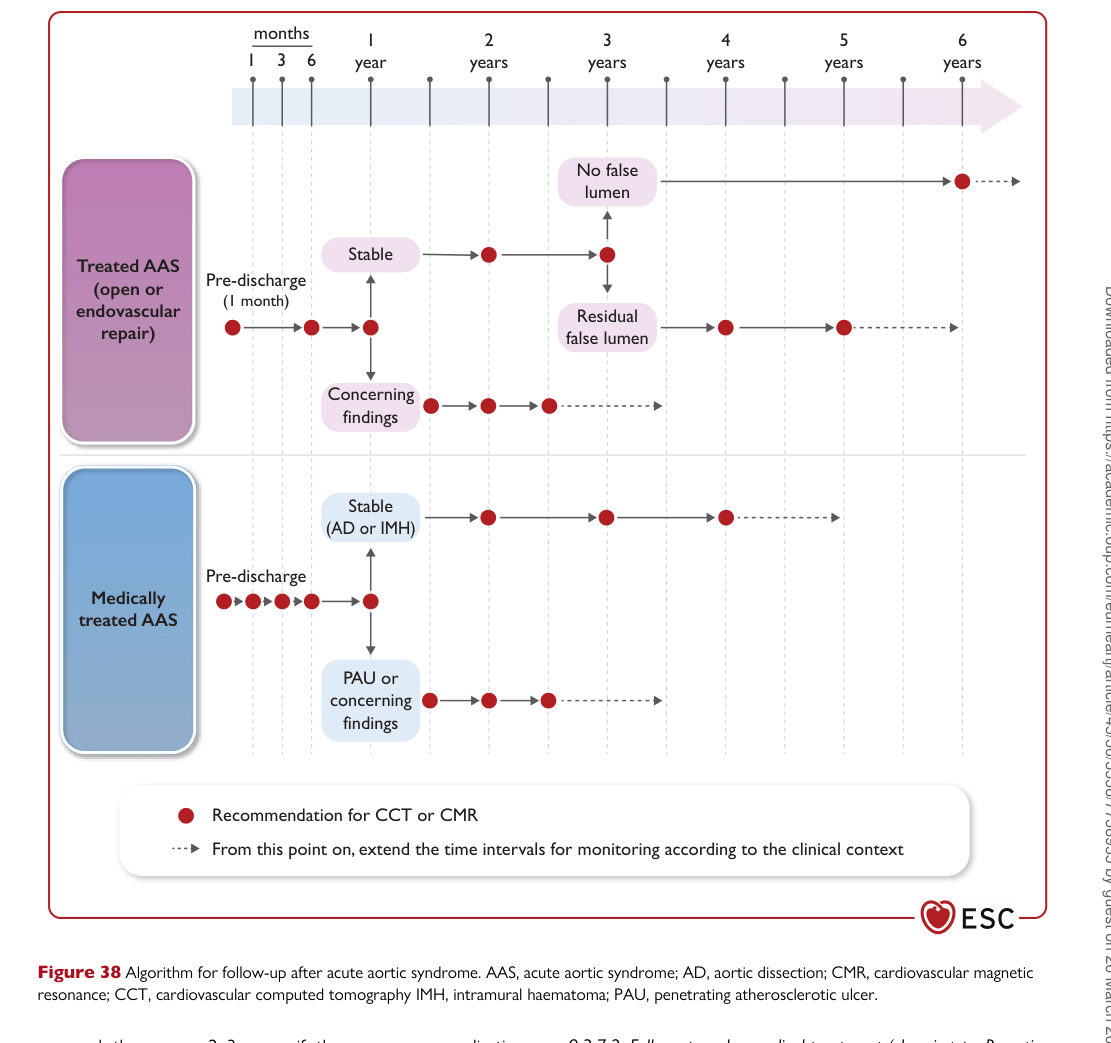
- follow-up:TAA 開放術後 1 個月 + 每年 CCT × 2 年 + 之後每 5 年;TEVAR 後 1+12 個月 + 每年至第 5 年;醫療管理 type B AAS/IMH 1、3、6、12 個月 + 之後每年。
🗺️ 章節對應
本篇對應原文 Ch 9 全章:9.1 aortic aneurysm(含 TAA/AAA/監測/修復/追蹤)、9.2 thoracoabdominal aortic aneurysm、9.3 acute aortic syndrome(含 dissection/IMH/PAU/TAI/iatrogenic)。共嵌入 Figure 21-38(18 張),是本系列流程圖最密集的一篇。
- 動脈瘤=Laplace 定律的競賽:管壁張力 ∝ 壓力 × 半徑。瘤越大、管壁張力越高 → 越容易破裂,形成「越大越快長、越快破」的惡性循環。所以監測與修補門檻是看直徑與生長速度(如腹主動脈瘤多在 ~5.5 cm 男/5.0 cm 女、或快速增大時修補)——權衡的是「破裂風險 vs 手術風險」,太早修手術風險不划算,太晚修會破。控血壓、戒菸(吸菸是 AAA 最強危險因子,會加速擴大)是核心內科治療。
- 急性主動脈症候群(AAS:剝離/壁內血腫/穿透性潰瘍)為何降「剪力」最重要:主動脈剝離的擴大動力是血流對內膜撕裂口的剪應力(dP/dt,與血壓和心收縮速度有關)。所以治療不只降血壓,更要先用 β-blocker 降心率與收縮速度再降壓(單純血管擴張劑會反射性心搏過速、增加剪力)。Type A(升主動脈)是外科急症;Type B 無併發症多以藥物控制(降剪力+疼痛控制),有併發症才介入(TEVAR)。
📐 9.1 Aortic Aneurysm — 從定義到監測
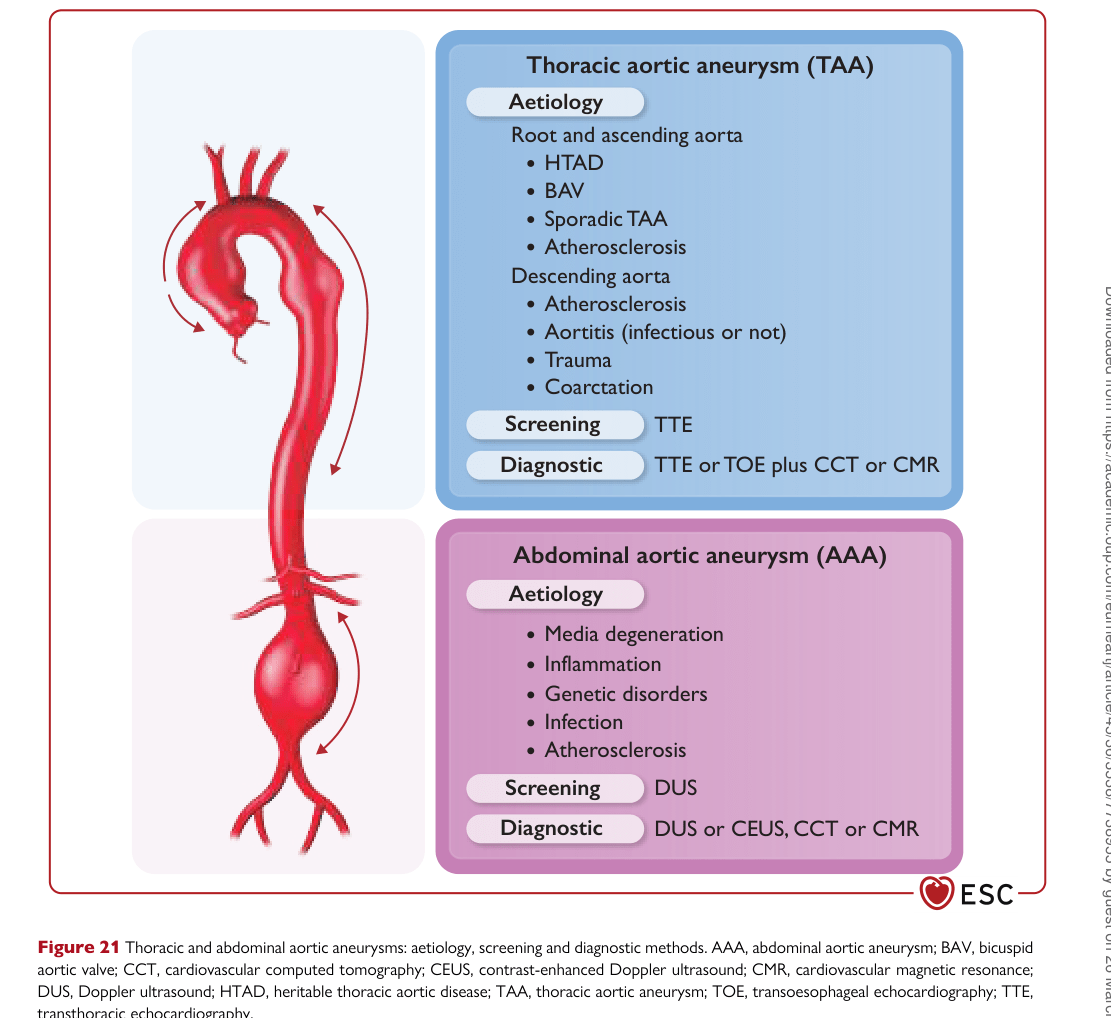
來源:2024 ESC Guidelines for the Management of Peripheral Arterial and Aortic Diseases (Eur Heart J 2024;45:3538-3700, doi:10.1093/eurheartj/ehae179) — 個人教學用,原始版權屬 ESC/EACTS。
Figure 21 把 TAA/AAA 的 aetiology(degenerative/genetic/inflammatory/post-traumatic)→ screening(超音波/CT)→ diagnostic methods 三步驟整合成圖。degenerative 是最大宗,但 genetic(Marfan、Loeys-Dietz、Turner、bicuspid valve)需特別處置(見系列文 V)。
解剖分類(Crawford)
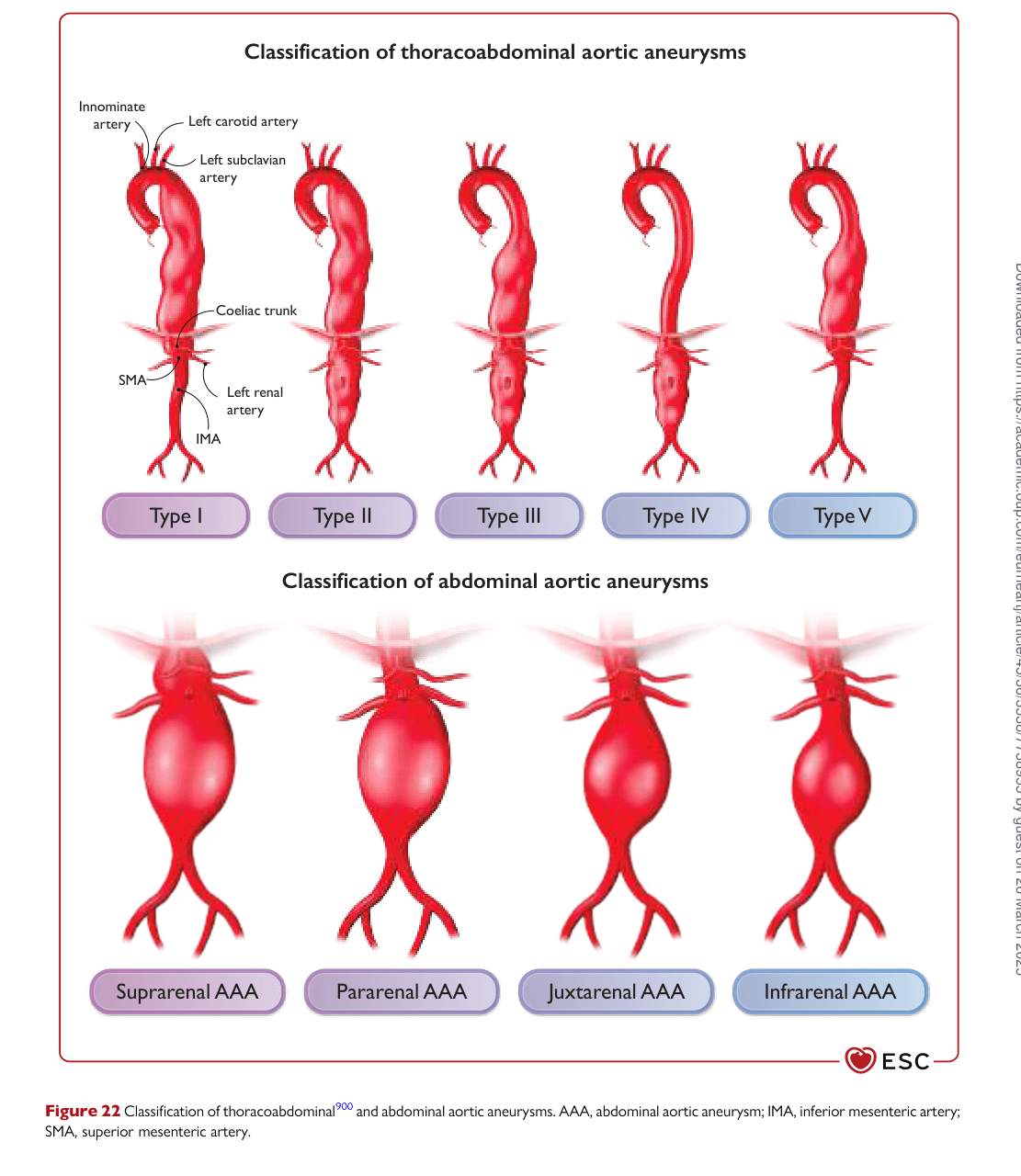
來源:2024 ESC Guidelines for the Management of Peripheral Arterial and Aortic Diseases (Eur Heart J 2024;45:3538-3700, doi:10.1093/eurheartj/ehae179) — 個人教學用,原始版權屬 ESC/EACTS。
Crawford 分類(thoracoabdominal AA):
- Type I:左 subclavian 以下到 abdominal aorta 上端(renal 以上)
- Type II:左 subclavian 以下到 aortic bifurcation(最 extensive,手術風險最高)
- Type III:mid descending(T6 以下)到 aortic bifurcation
- Type IV:純 abdominal(從 diaphragm 到 bifurcation)
- Type V:mid descending 到 renal 之上
破裂風險因子
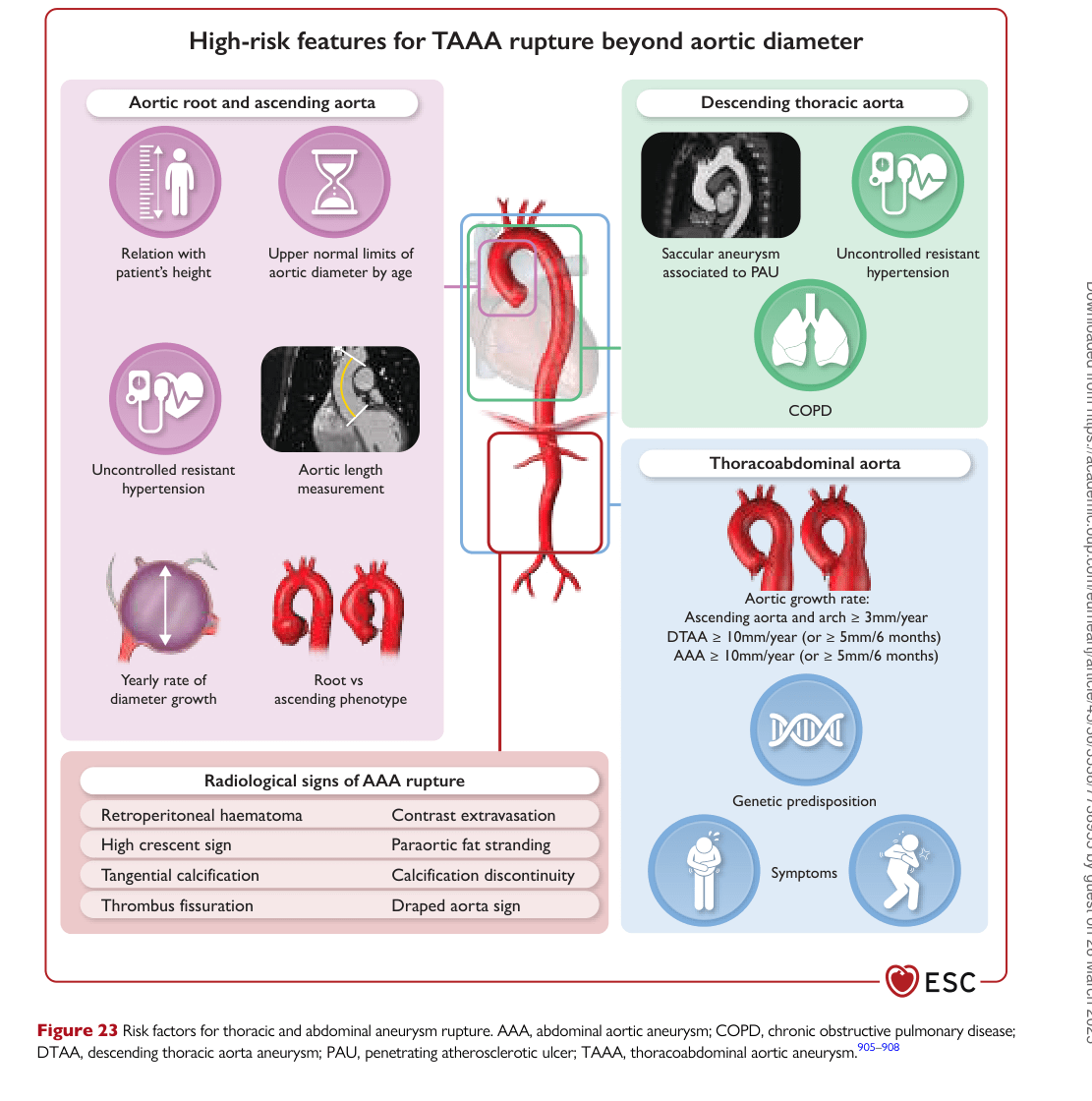
來源:2024 ESC Guidelines for the Management of Peripheral Arterial and Aortic Diseases (Eur Heart J 2024;45:3538-3700, doi:10.1093/eurheartj/ehae179) — 個人教學用,原始版權屬 ESC/EACTS。
Figure 23 把 rupture risk 量化:
- 大小:每年 rupture risk — AAA 4.0-4.9 cm: 1%;5.0-5.9 cm: 1-11%;6.0-6.9 cm: 6.6-22%;>7.0 cm: >30%。
- 生長速率:>5 mm/6 個月(TAA)或 >10 mm/year(AAA)顯著增加 rupture risk。
- 女性:相同直徑下 rupture 風險高於男性 → 切點較低(女性 AAA >50 mm 即考慮介入)。
- COPD、smoking、家族史:獨立增加 rupture。
- HTN 控制:BP >140 顯著增加 rupture。
監測(surveillance)
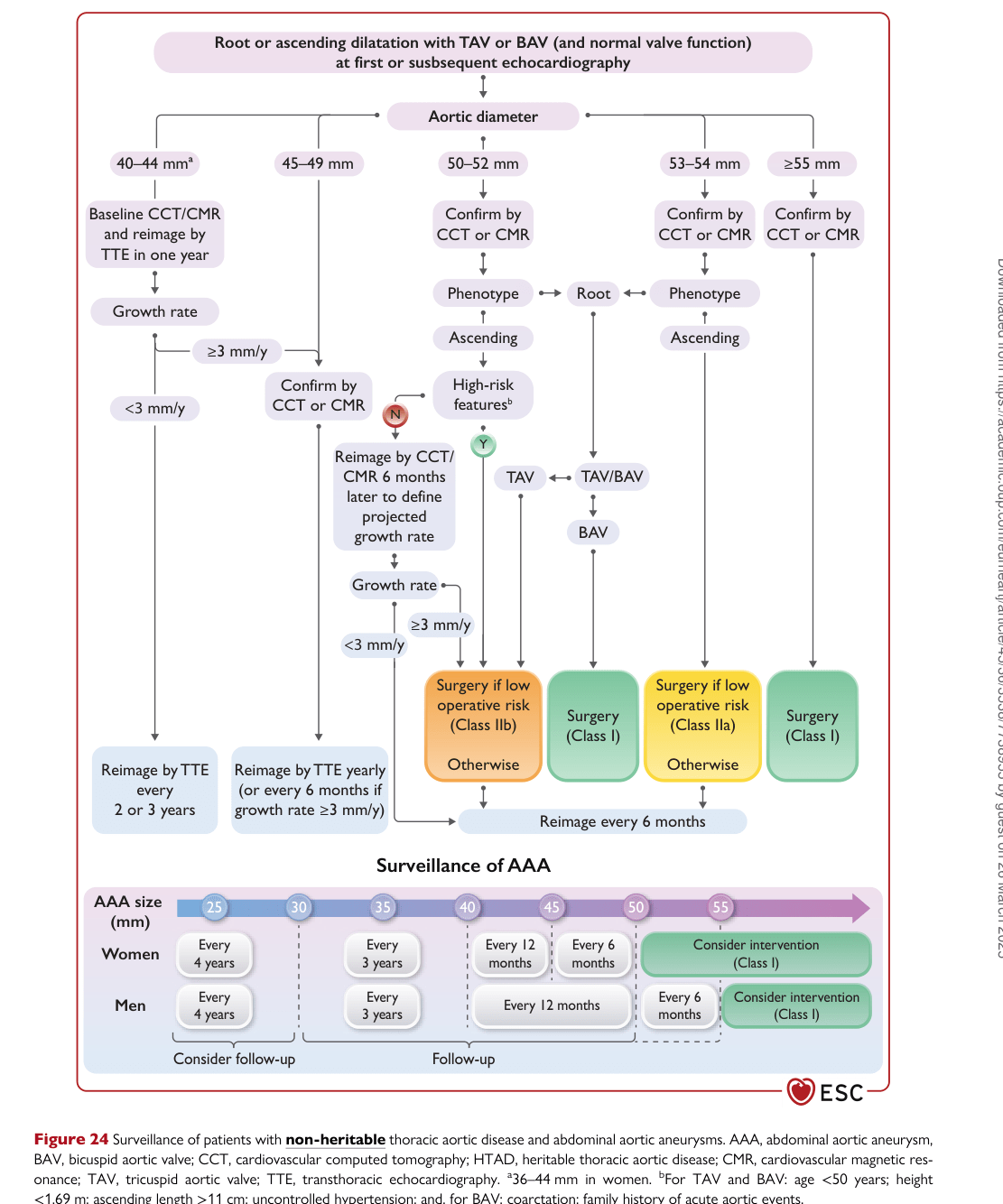
來源:2024 ESC Guidelines for the Management of Peripheral Arterial and Aortic Diseases (Eur Heart J 2024;45:3538-3700, doi:10.1093/eurheartj/ehae179) — 個人教學用,原始版權屬 ESC/EACTS。
🧭 圖表逐步解析:Figure 24(非遺傳性 TAA/AAA 的 surveillance)
這張圖在回答什麼問題:診斷 TAA / AAA 但未達手術閾值,多久追蹤一次?
逐步走完:
- 30-39 mm → 每 3 年追蹤 DUS(過去是每年,2024 拉長)
- 40-44 mm → 每 2 年
- ≥45 mm → 每 1 年(女性 40-45 mm 已每年)
- ≥50-55 mm → 每 3-6 個月,並評估介入
- <40 mm → 每 2-3 年 CCT
- 40-44 mm → 每年 CCT
- 45-49 mm → 每 6-12 個月
- ≥50 mm → 每 6 個月
容易踩雷的地方:
🛠️ 9.1.4 修復策略
術前手術全期管理
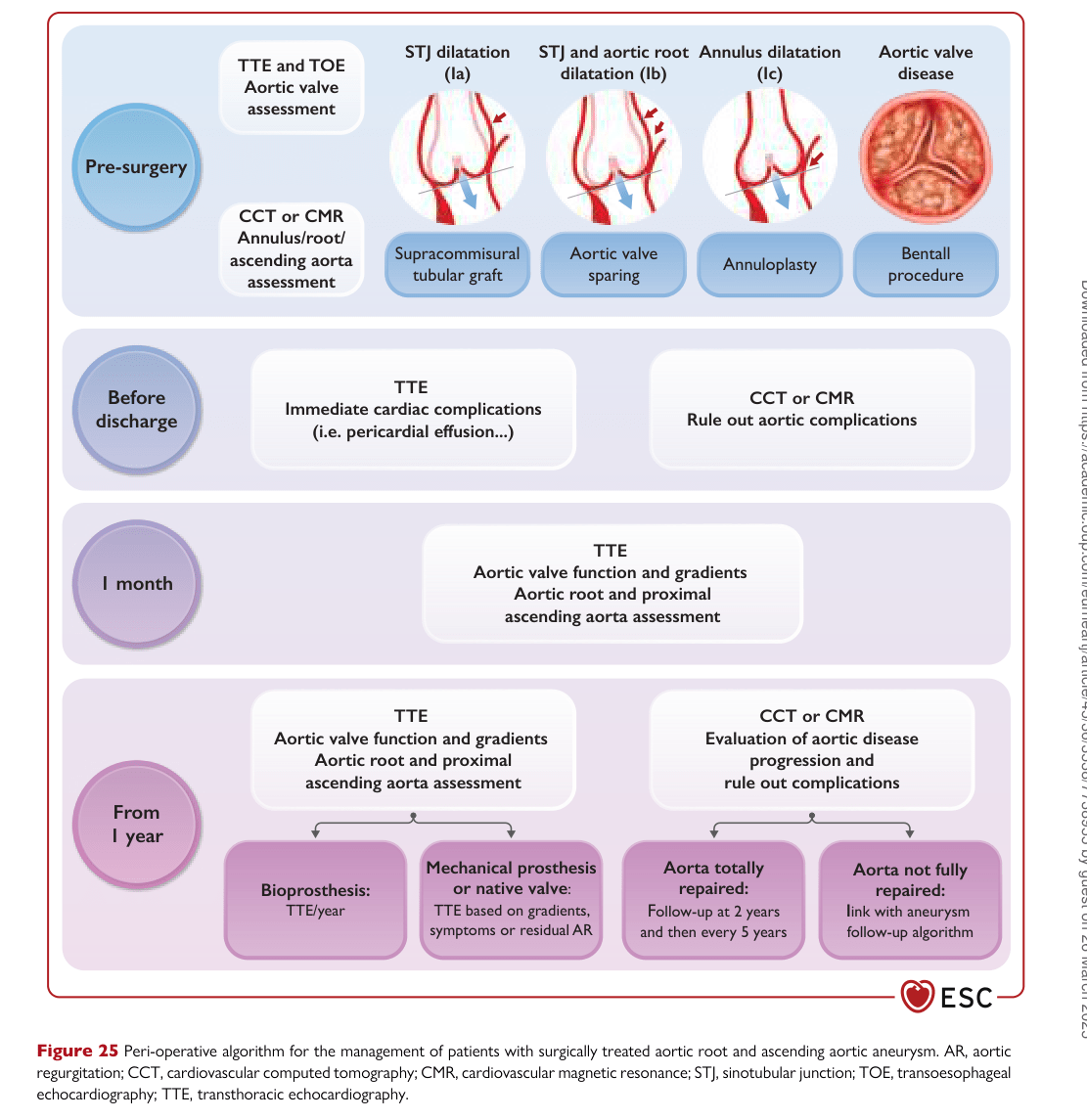
來源:2024 ESC Guidelines for the Management of Peripheral Arterial and Aortic Diseases (Eur Heart J 2024;45:3538-3700, doi:10.1093/eurheartj/ehae179) — 個人教學用,原始版權屬 ESC/EACTS。
Figure 25 把 aortic root/ascending 開放手術的 peri-operative algorithm 整理:
- 術前:CCT 全主動脈評估、CAG(>40 歲或 CAD risk)、TTE(valve 與 LV function)、aortic team meeting(heart team + cardiac surgeon + cardiac anaesthesia + perfusionist)。
- 術中:cardiopulmonary bypass、cerebral protection(hypothermic circulatory arrest if arch involved)、SCP(selective cerebral perfusion)或 RCP(retrograde);axillary cannulation 已成首選。
- 術後:ICU 監測、neurological exam(stroke / paraplegia screening)、CSF drain(thoracoabdominal repair 預防 paraplegia);1 個月內 CCT;之後每年 × 2 年,第 3 年起每 5 年。
AAA 個別化決策
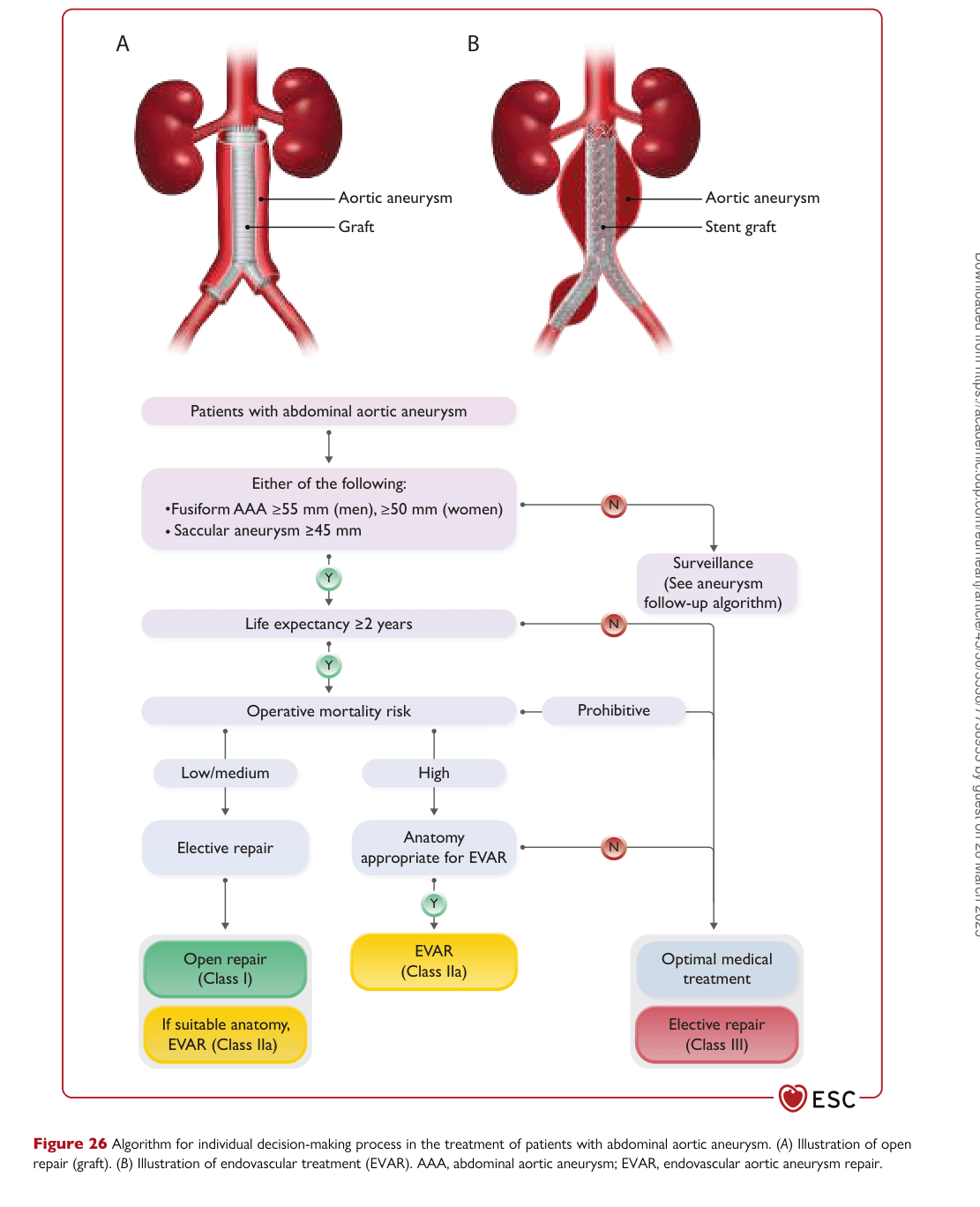
來源:2024 ESC Guidelines for the Management of Peripheral Arterial and Aortic Diseases (Eur Heart J 2024;45:3538-3700, doi:10.1093/eurheartj/ehae179) — 個人教學用,原始版權屬 ESC/EACTS。
🧭 圖表逐步解析:Figure 26(AAA 修復個別化決策)
這張圖在回答什麼問題:對特定 AAA 病人,選 EVAR、open surgery 還是繼續觀察?
逐步走完:
- 解剖適合 + 高 surgical risk + life expectancy 適中 → EVAR(NICE 2020 與 ESC 趨同)。
- 解剖適合 + 低 surgical risk + 年輕 → open repair 仍可考慮(long-term durability 較佳)。
- 解剖不適合 EVAR + 低 surgical risk → open。
- 解剖不適合 + 高 surgical risk → fenestrated/branched EVAR;或 conservative。
容易踩雷的地方:
TEVAR 後 endoleak 管理
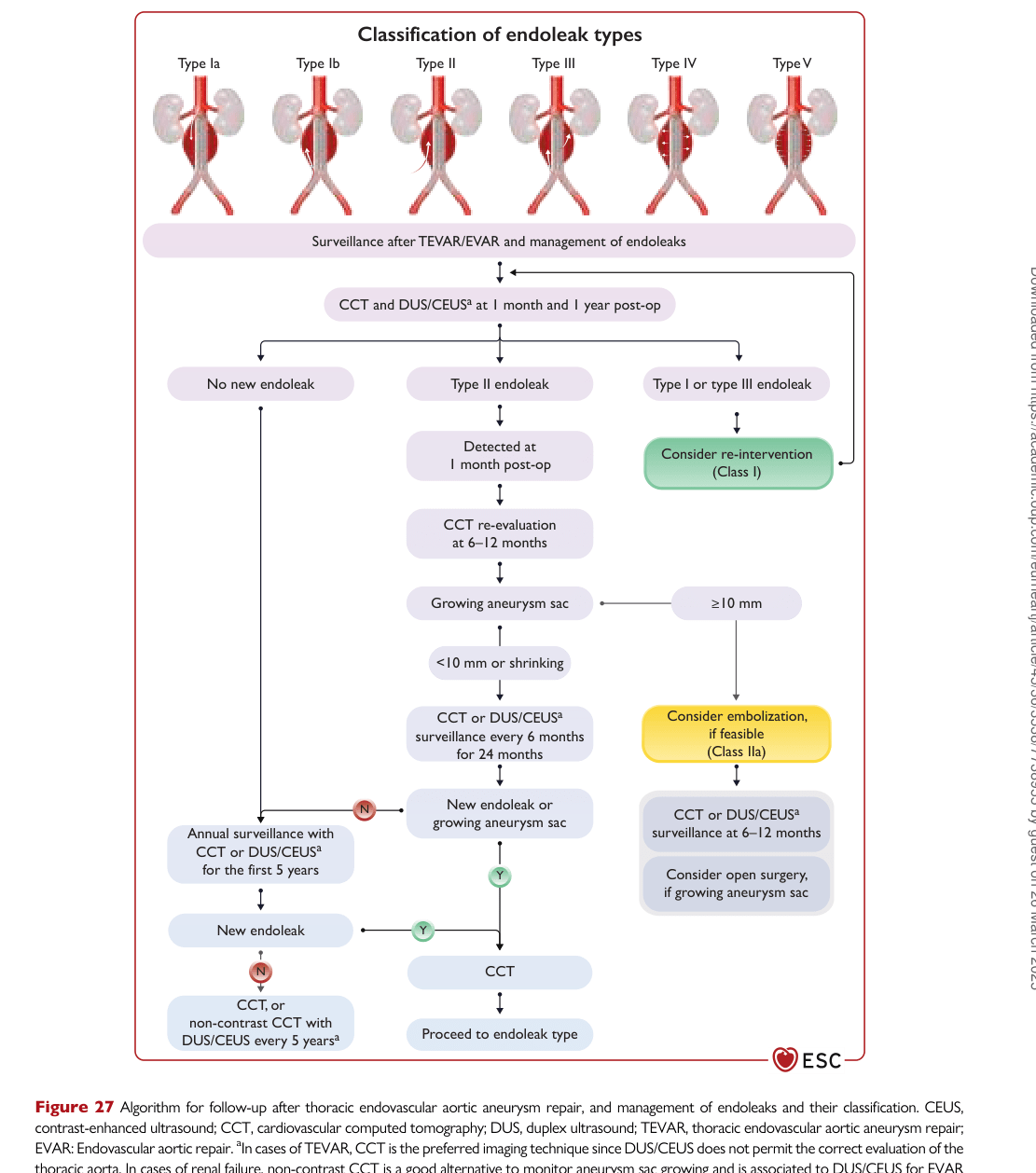
來源:2024 ESC Guidelines for the Management of Peripheral Arterial and Aortic Diseases (Eur Heart J 2024;45:3538-3700, doi:10.1093/eurheartj/ehae179) — 個人教學用,原始版權屬 ESC/EACTS。
🧭 圖表逐步解析:Figure 27(TEVAR follow-up 與 endoleak 管理)
逐步走完:
- Type I:proximal (Ia) or distal (Ib) attachment site 漏 → 立即處理(cuff extension、proximal extension、open conversion)
- Type II:分支動脈(lumbar、IMA)逆流入 sac → 多數可觀察,sac 持續 >5 mm/year 才處理
- Type III:component separation 或 graft fabric tear → 立即處理
- Type IV:graft porosity → 通常自限
- Type V(endotension):sac 增大但找不到 endoleak → 仔細排除 occult type I/III;持續增大考慮 open
容易踩雷的地方:
⚡ 9.3 Acute Aortic Syndrome(AAS)
AAS 的分類
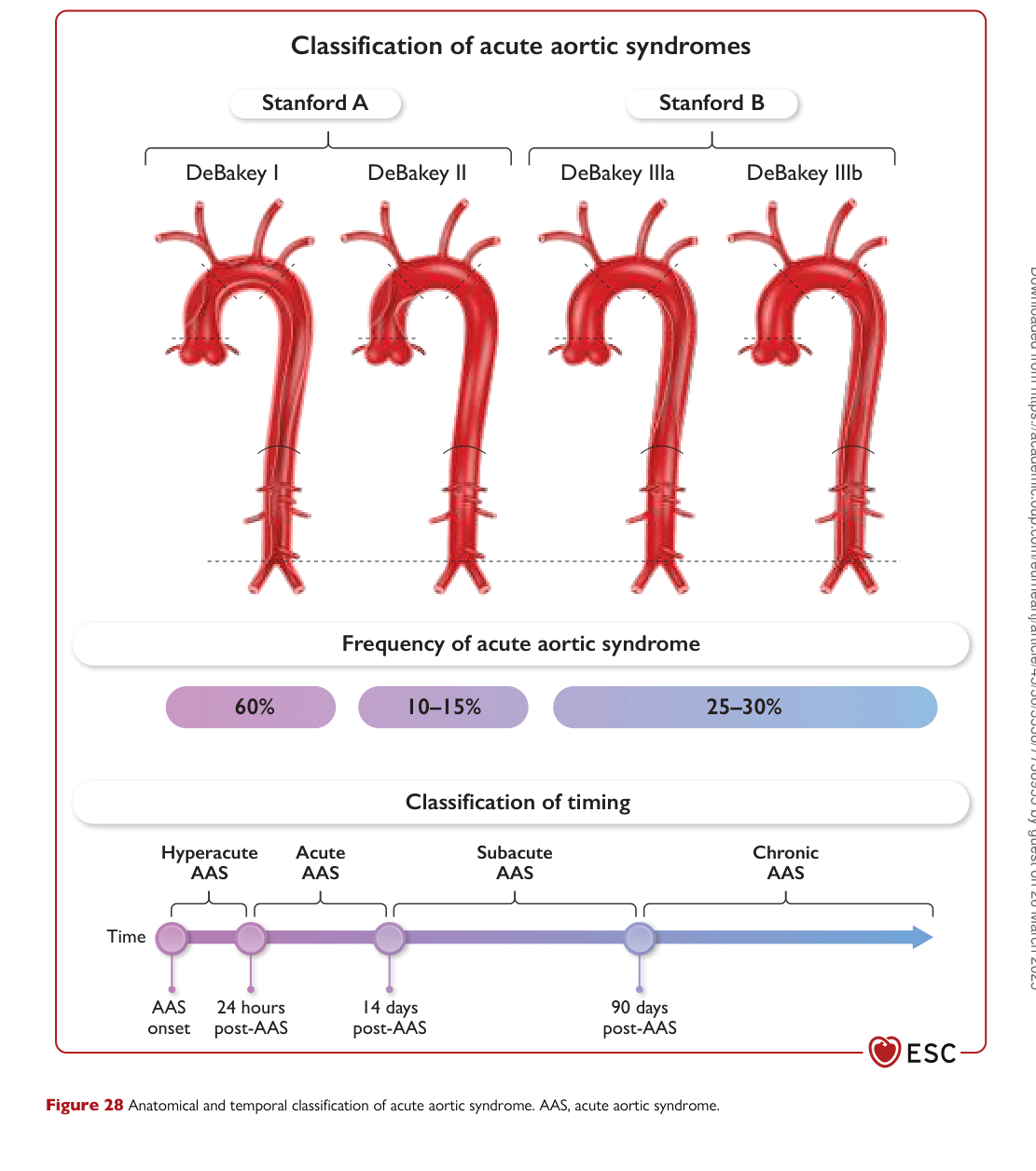
來源:2024 ESC Guidelines for the Management of Peripheral Arterial and Aortic Diseases (Eur Heart J 2024;45:3538-3700, doi:10.1093/eurheartj/ehae179) — 個人教學用,原始版權屬 ESC/EACTS。
Figure 28 把 AAS 拆成 4 個亞型(anatomical)+ 3 個時期(temporal):
- 4 亞型:(1) classic aortic dissection(intimal tear + false lumen);(2) intramural haematoma(IMH,無 intimal tear,vasa vasorum 出血);(3) penetrating atherosclerotic ulcer(PAU,plaque 破壞 intima);(4) traumatic/iatrogenic aortic injury(TAI)。
- 3 時期:hyperacute <24h、acute 1-14 天、subacute 15-90 天、chronic >90 天。注意:subacute 期是 2024 新強調的 TEVAR window(uncomplicated TBAD)。
Aortic dissection 的 SVS/STS 解剖分類
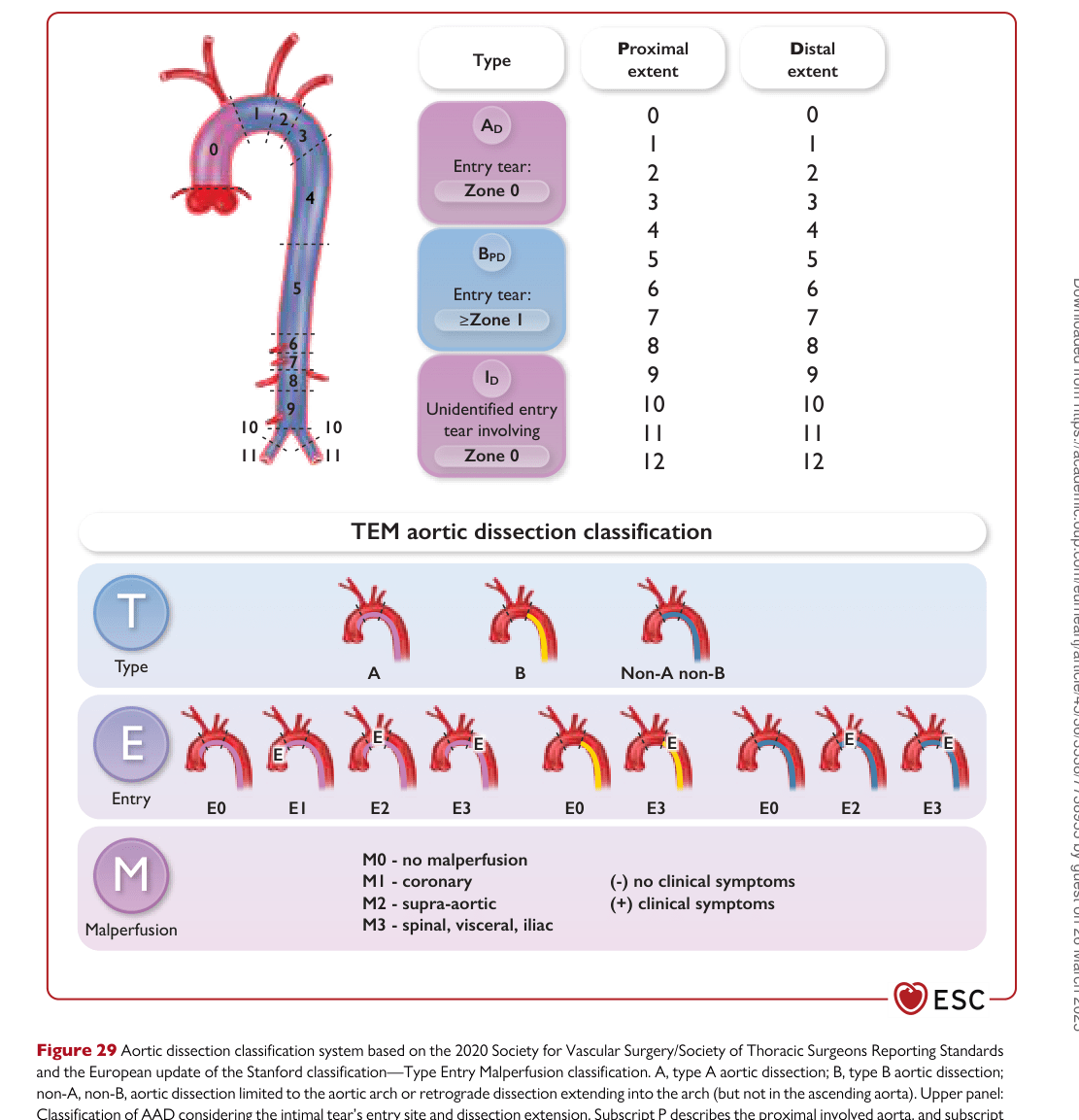
來源:2024 ESC Guidelines for the Management of Peripheral Arterial and Aortic Diseases (Eur Heart J 2024;45:3538-3700, doi:10.1093/eurheartj/ehae179) — 個人教學用,原始版權屬 ESC/EACTS。
2020 SVS/STS 新分類用「Zone N(near-zone)− Zone F(far-zone)」標示 dissection 範圍。例:A (Z0-Z9) = type A 從 zone 0 延到 zone 9(從 ascending 到 descending);B (Z3-Z10) = type B 從 zone 3 到 abdominal。這套分類取代過去 Stanford A/B 二分法,能更精確指引 TEVAR landing zone。
AAS 診斷流程

來源:2024 ESC Guidelines for the Management of Peripheral Arterial and Aortic Diseases (Eur Heart J 2024;45:3538-3700, doi:10.1093/eurheartj/ehae179) — 個人教學用,原始版權屬 ESC/EACTS。
🧭 圖表逐步解析:Figure 30(AAS 多參數診斷 work-up)
這張圖在回答什麼問題:急診胸痛 + 高度懷疑 AAS,30 分鐘內要做哪些動作?
逐步走完:
- CCT(contrast):第一線(廣布、快速、可看完整 aortic 範圍 + branch vessel)
- TTE:床邊快速,看 root + AV、pericardial effusion/tamponade,但對 descending aorta 看不清
- TOE:適合不穩定病人、CT 不便者;對 type A intimal tear 敏感度高
- CMR:穩定的 chronic dissection follow-up
容易踩雷的地方:
AAS 急性藥物管理
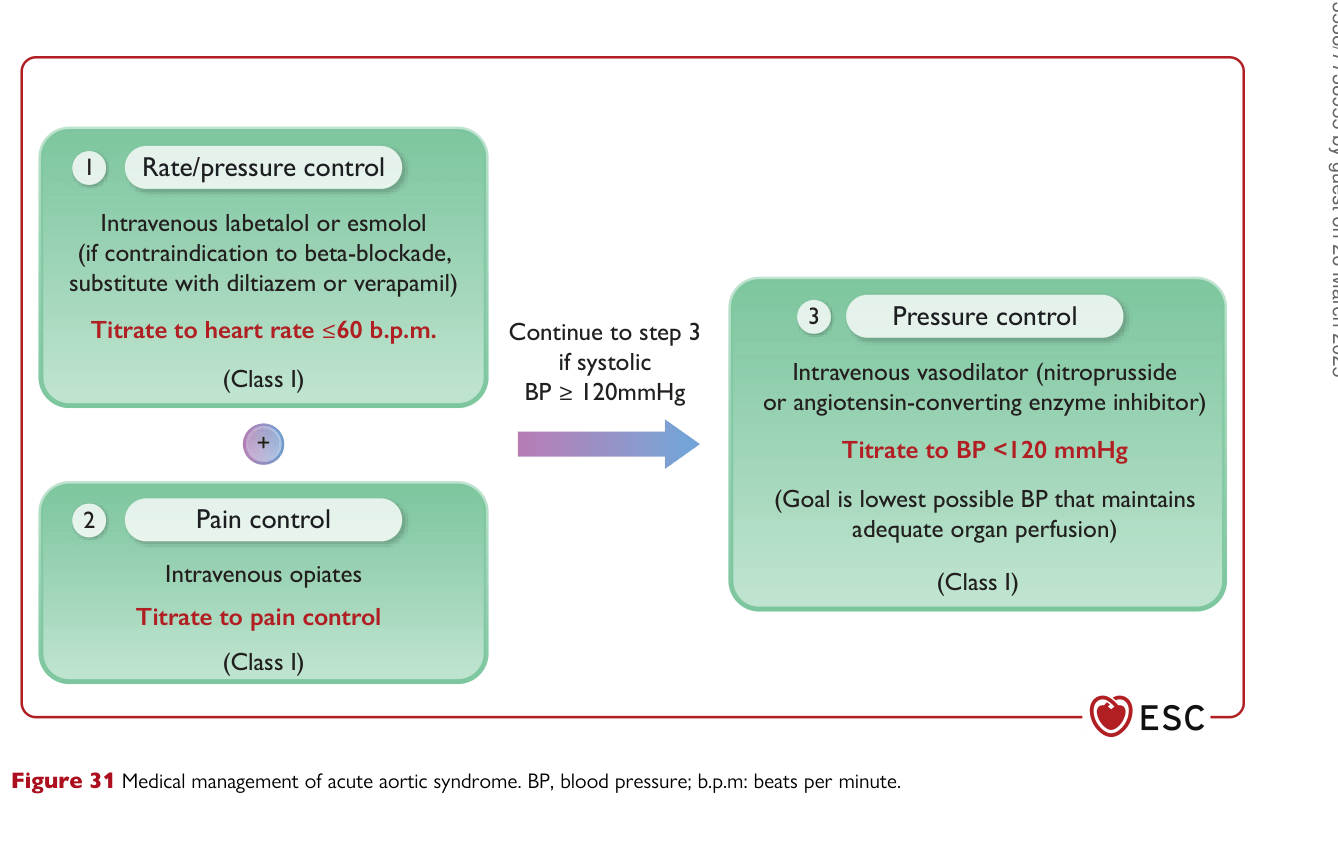
來源:2024 ESC Guidelines for the Management of Peripheral Arterial and Aortic Diseases (Eur Heart J 2024;45:3538-3700, doi:10.1093/eurheartj/ehae179) — 個人教學用,原始版權屬 ESC/EACTS。
🧭 圖表逐步解析:Figure 31(AAS 醫療管理)
逐步走完:
容易踩雷的地方:
AAS 併發症
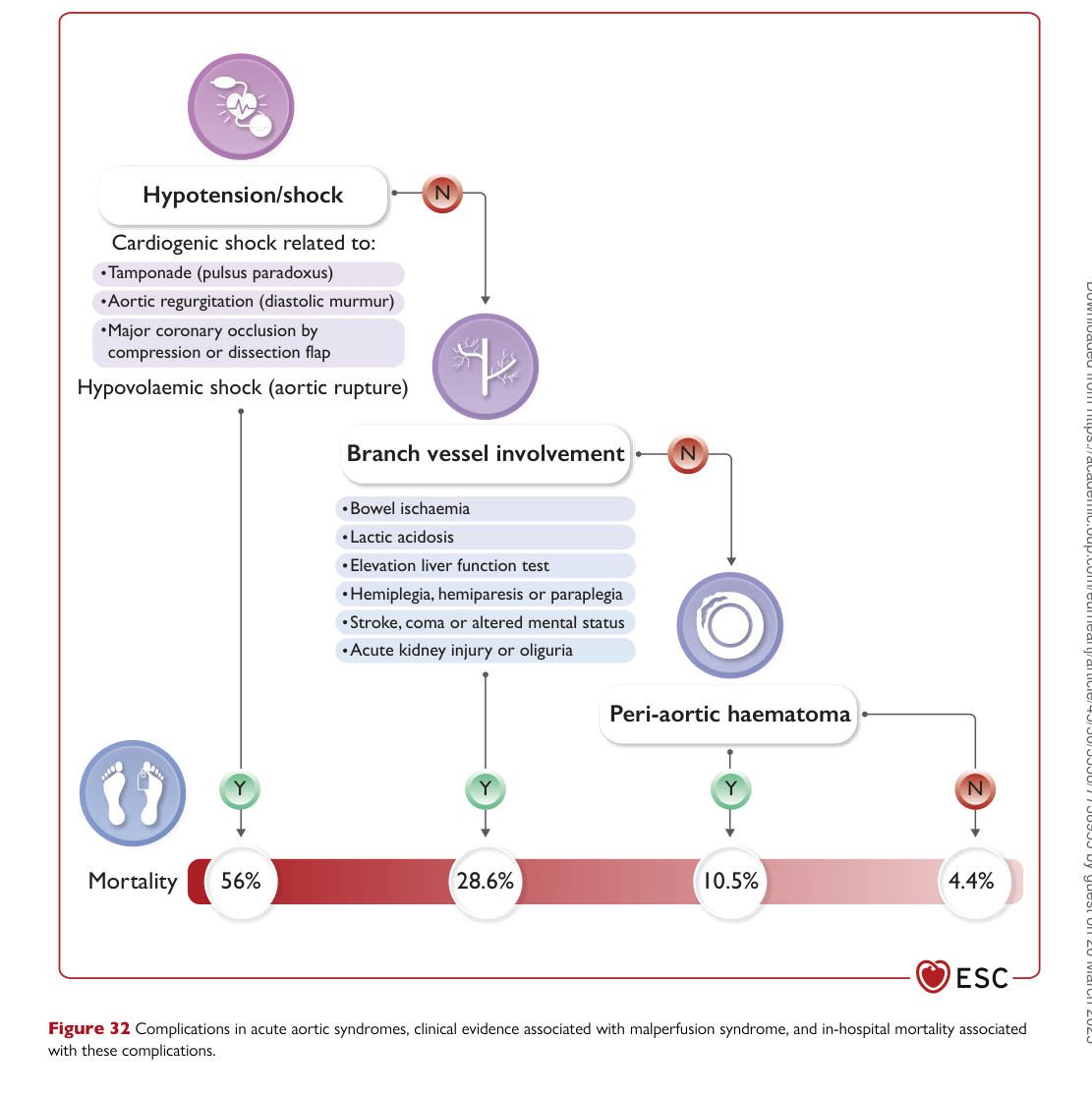
來源:2024 ESC Guidelines for the Management of Peripheral Arterial and Aortic Diseases (Eur Heart J 2024;45:3538-3700, doi:10.1093/eurheartj/ehae179) — 個人教學用,原始版權屬 ESC/EACTS。
Figure 32 列出 AAS 的主要併發症與管理:cardiac tamponade(type A 第一死因,需 emergent surgery)、severe AR、myocardial infarction(coronary involvement)、stroke、malperfusion syndrome(renal/mesenteric/limb/spinal)。各併發症都會大幅改變 management priority。
Acute dissection 介入決策
來源:2024 ESC Guidelines for the Management of Peripheral Arterial and Aortic Diseases (Eur Heart J 2024;45:3538-3700, doi:10.1093/eurheartj/ehae179) — 個人教學用,原始版權屬 ESC/EACTS。
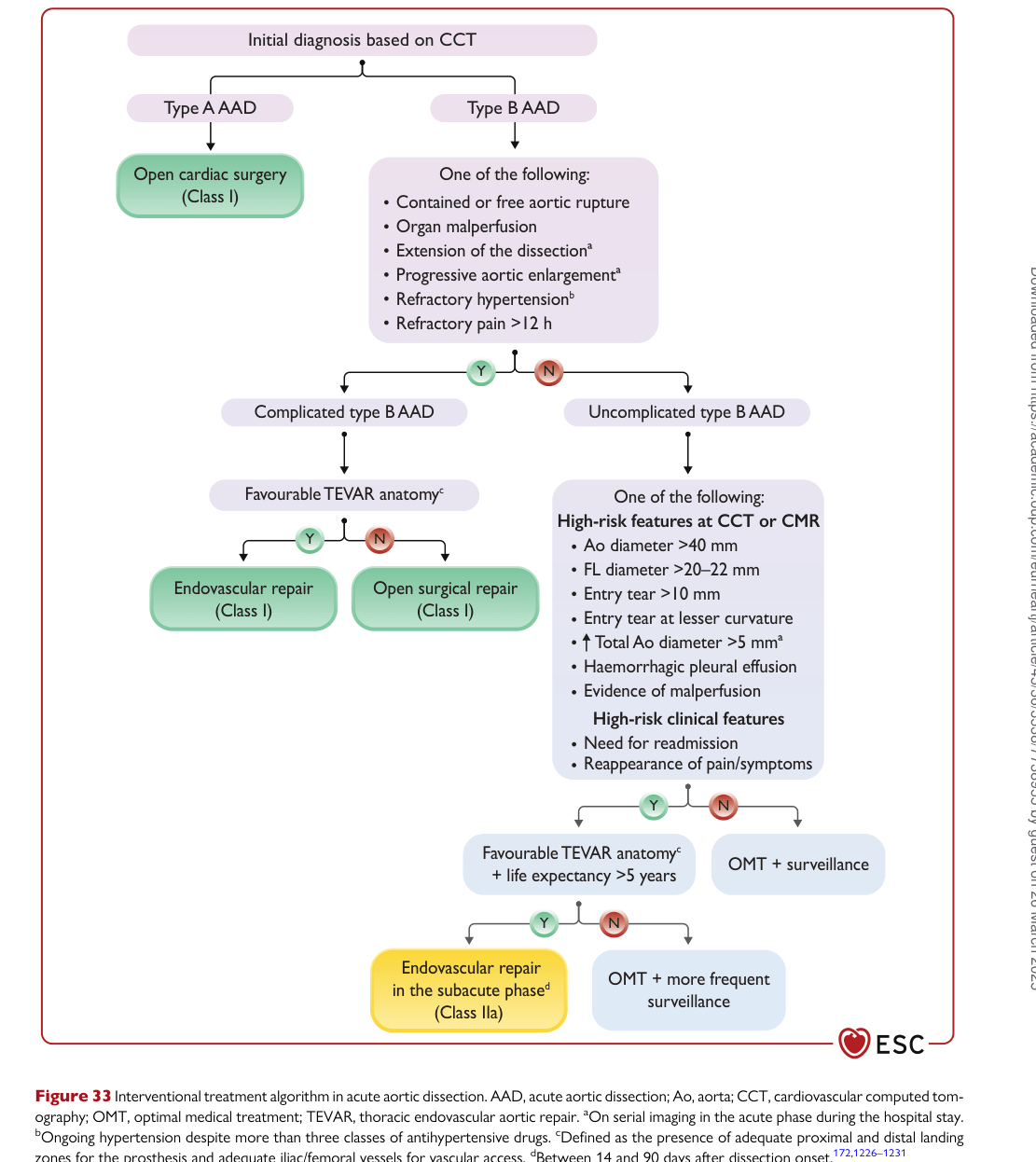
🧭 圖表逐步解析:Figure 33(Acute aortic dissection 介入治療流程)
逐步走完:
- Aortic valve resuspension > replacement(無 leaflet 病變者)I B
- Open distal anastomosis(不夾 cross-clamp distal)I B
- 無 arch intimal tear → hemi-arch repair(不做 total arch)I B
- 有 arch tear 或 proximal DTA → frozen elephant trunk 可考慮(IIb C)
- Malperfusion(renal、mesenteric、limb、spinal)
- 持續疼痛/HTN refractory
- Aortic diameter rapid expansion(>5 mm/2-4 weeks)
- Rupture/impending rupture(peri-aortic haematoma、pleural effusion 持續增加)
- 有「high-risk features」(partial false lumen thrombosis、entry tear >10 mm in concavity、aortic diameter >40 mm at presentation、refractory HTN/pain)→ subacute 期(14-90 天)TEVAR 可考慮,IIa B(新)。INSTEAD-XL/ADSORB 長期數據支持。
- 無 high-risk features → continue medical therapy + 影像 follow-up。
容易踩雷的地方:
🧪 INSTEAD-XL(2013, Circ Cardiovasc Interv)— uncomplicated TBAD「subacute TEVAR」的長期證據
設計:140 名 stable(uncomplicated)type B aortic dissection 存活者,於亞急性/慢性期隨機分到 TEVAR + OMT(n=72) vs OMT only(n=68);INSTEAD-XL 為原 INSTEAD 的延長追蹤,分析至 5 年。
結果:2 年時兩組總死亡無差異(早期 TEVAR 無立即好處),但 5 年 aorta-specific mortality 顯著較低(TEVAR 6.9% vs OMT 19.3%,p=0.04),dissection progression 亦較少(27.0% vs 46.1%,p=0.04);好處與 stent graft 誘發 false lumen thrombosis(約 91%)與 aortic remodelling 相關。
臨床意義:連同 ADSORB 數據,撐起「uncomplicated TBAD 高風險族群於 subacute 期(14-90 天)TEVAR」IIa B。易踩雷:好處是「晚期才浮現」、且限於有 high-risk features 者 — 不能據此對所有 uncomplicated TBAD 在急性期就 TEVAR(急性期併發症較高)。
Aortic branch obstruction(Malperfusion)
來源:2024 ESC Guidelines for the Management of Peripheral Arterial and Aortic Diseases (Eur Heart J 2024;45:3538-3700, doi:10.1093/eurheartj/ehae179) — 個人教學用,原始版權屬 ESC/EACTS。
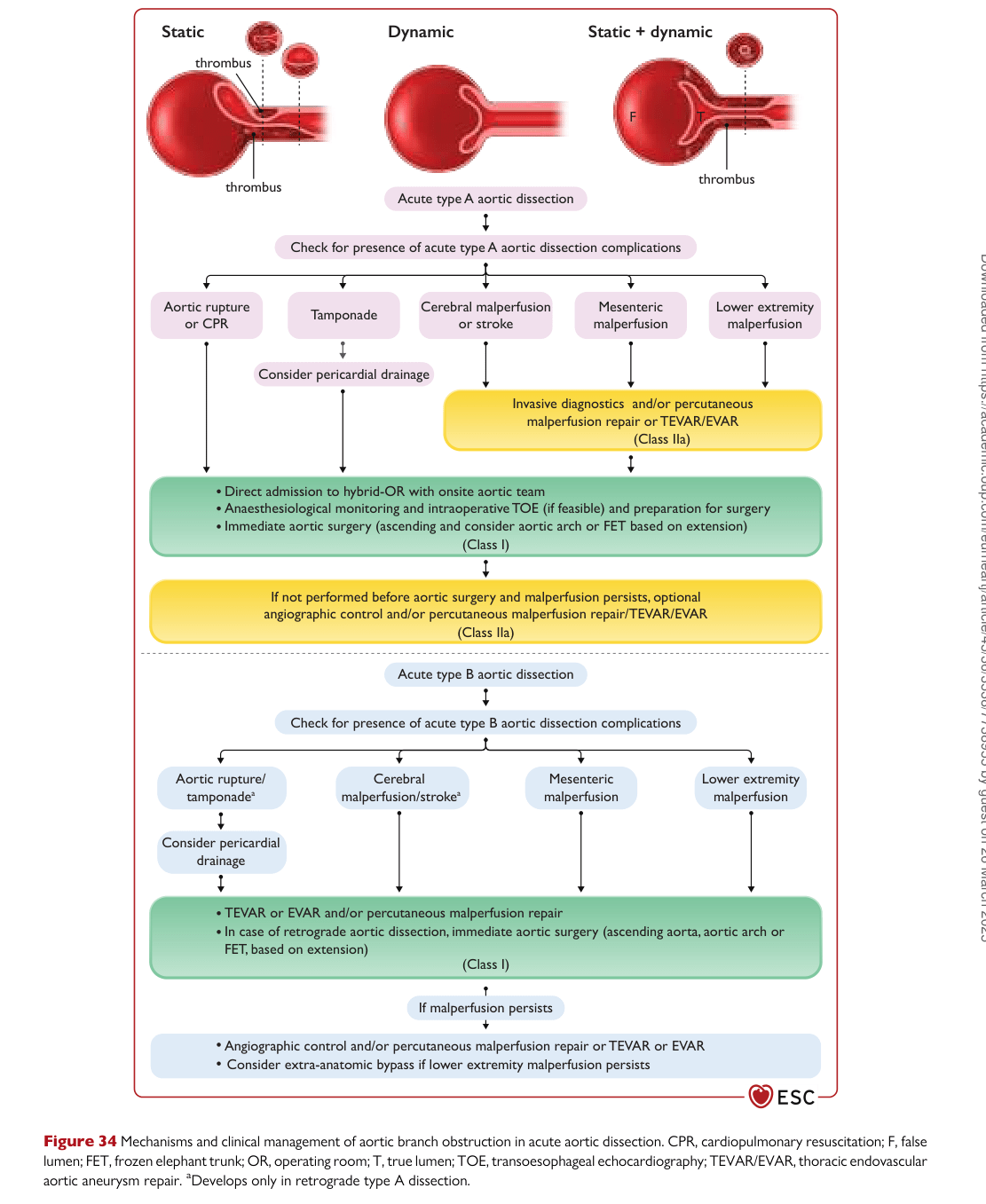
Figure 34 把 malperfusion 機轉分為:
- Static obstruction:dissection flap 延伸進入分支動脈,造成持續阻塞 → 影響:renal、mesenteric、limb。
- Dynamic obstruction:dissection flap 隨血流飄動,間歇性阻塞分支 ostium → 可能 reperfusion after central repair。
處置原則:type A 合併 malperfusion → 立即 central repair(aortic 開放)通常能解決 dynamic obstruction;若 type A 修復後 mesenteric/renal 仍 malperfused → 介入解決 static obstruction。少數情況 type A + 嚴重 mesenteric malperfusion 需先做 mesenteric revascularization 再做 aortic repair(IIa C)。
PAU 高風險特徵
來源:2024 ESC Guidelines for the Management of Peripheral Arterial and Aortic Diseases (Eur Heart J 2024;45:3538-3700, doi:10.1093/eurheartj/ehae179) — 個人教學用,原始版權屬 ESC/EACTS。
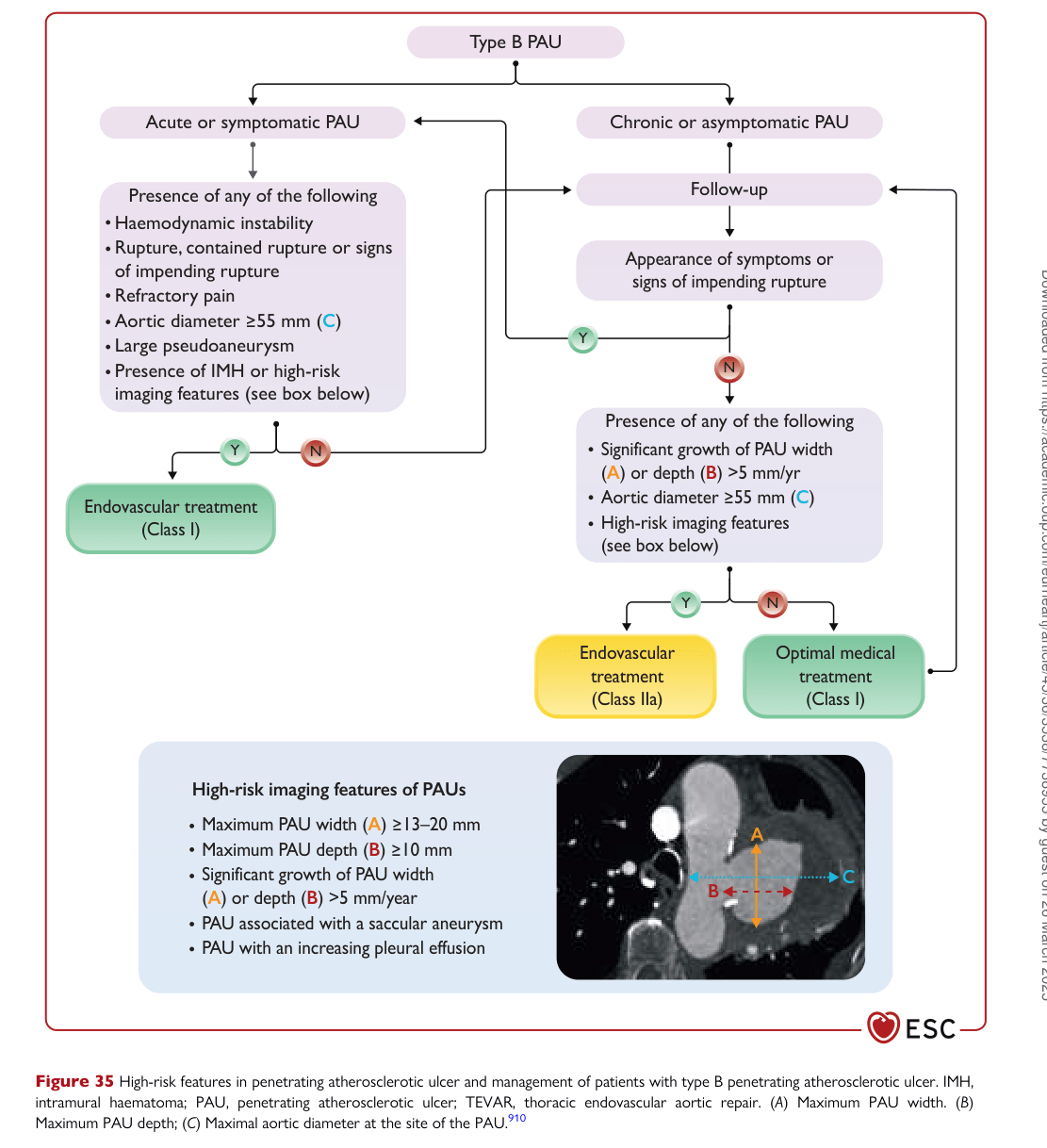
Penetrating atherosclerotic ulcer 的 high-risk features(增加 rupture/progression risk):
- Diameter >20 mm
- Depth >10 mm
- Saccular shape
- Associated IMH
- Persistent pain
- Pleural effusion
- Rapid progression
Traumatic aortic injury(TAI)
來源:2024 ESC Guidelines for the Management of Peripheral Arterial and Aortic Diseases (Eur Heart J 2024;45:3538-3700, doi:10.1093/eurheartj/ehae179) — 個人教學用,原始版權屬 ESC/EACTS。
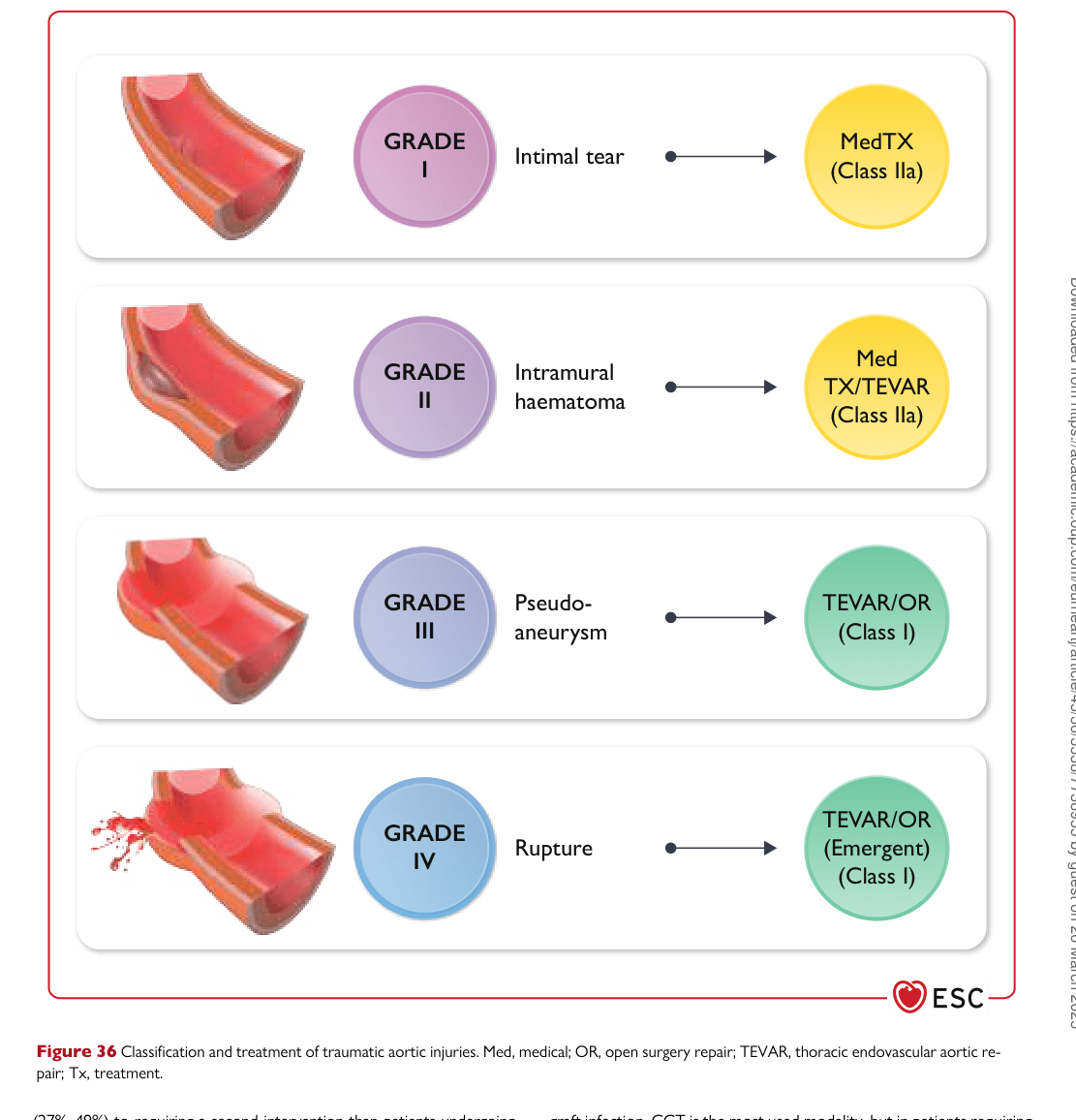
TAI 分級與處置:
- Grade 1(intimal tear):medical management + 影像追蹤(IIa C)
- Grade 2(IMH):medical management;若 progression → semi-elective repair within 24-72h(IIa C)
- Grade 3(pseudoaneurysm):emergent TEVAR(I A,TEVAR > open)
- Grade 4(rupture/free contrast extravasation):immediate repair(I A)
Iatrogenic aortic injury
來源:2024 ESC Guidelines for the Management of Peripheral Arterial and Aortic Diseases (Eur Heart J 2024;45:3538-3700, doi:10.1093/eurheartj/ehae179) — 個人教學用,原始版權屬 ESC/EACTS。
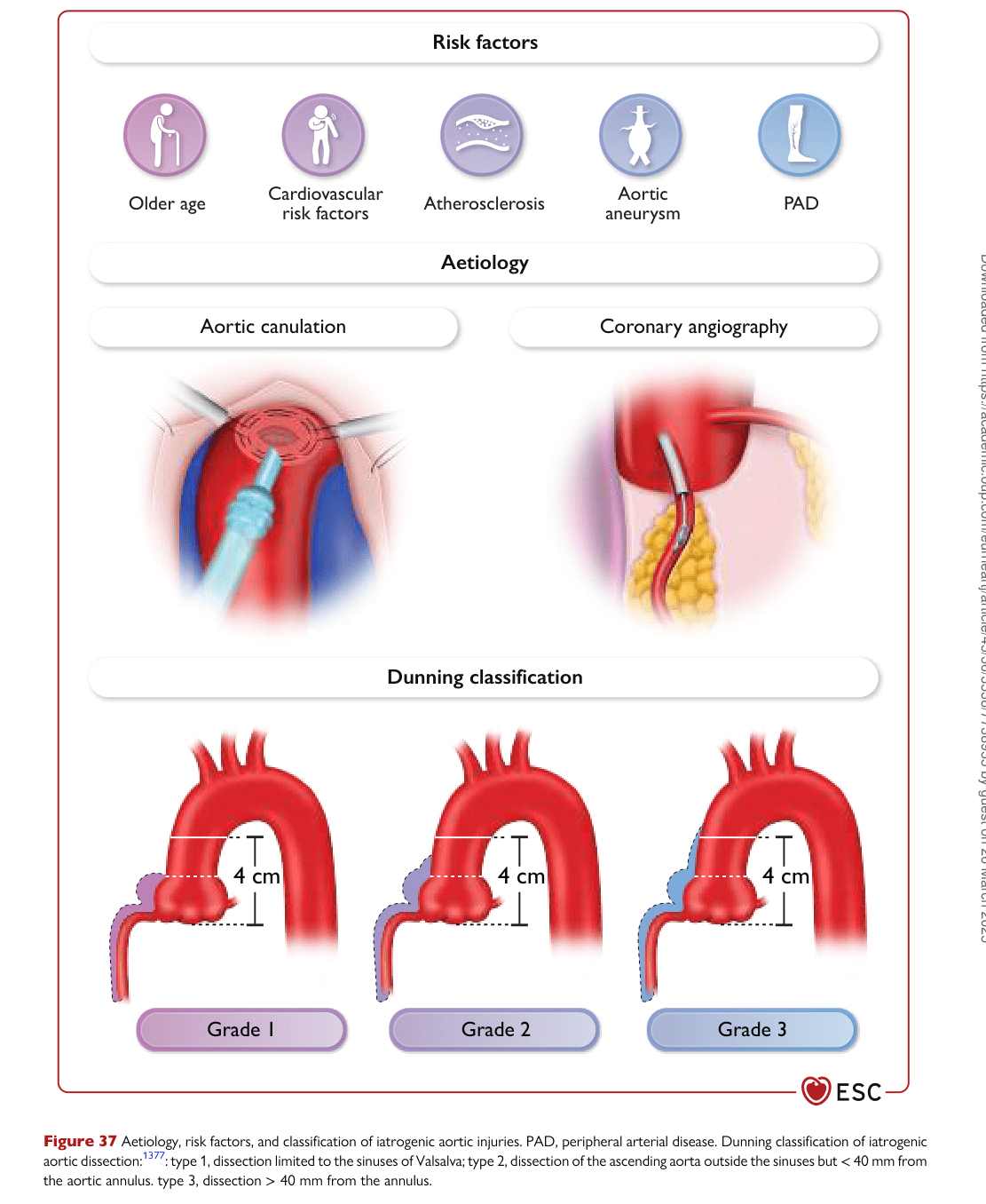
Figure 37 整理 iatrogenic injury:
- 來源:cardiac cath、TAVI、open heart surgery、IABP、ECMO cannulation、轉位術中。
- 分類:dissection / perforation / rupture / pseudoaneurysm / haematoma。
- 處置:minor & stable → conservative;significant → endovascular(covered stent)或 open repair;TAVI 相關 root rupture 視範圍可能需 emergent cardiac surgery。
AAS 後 follow-up
來源:2024 ESC Guidelines for the Management of Peripheral Arterial and Aortic Diseases (Eur Heart J 2024;45:3538-3700, doi:10.1093/eurheartj/ehae179) — 個人教學用,原始版權屬 ESC/EACTS。
🧭 圖表逐步解析:Figure 38(Acute aortic syndrome 後 follow-up)
逐步走完:
容易踩雷的地方:
📋 關鍵 Recommendations 對照表
| 主題 | 建議 | 2024 Class / LOE | vs 舊版 |
|---|---|---|---|
| AAA 篩檢 (men) | ≥65 歲 + smoking history | I A | 新(過去:all men >65) |
| AAA opportunistic screening (PAD) | DUS in symptomatic/asymptomatic PAD | IIa B | 新 |
| TAA surgery (TAV root/ascending) | ≥55 mm | I B | 不變 |
| TAA surgery (low-risk) | >52 mm 可考慮 | IIa B | 新 |
| Aortic valve resuspension (TAAD) | 無 leaflet 病變者 > replacement | I B | 新 |
| Open distal anastomosis | TAAD 標準 | I B | 新 |
| Hemi-arch (無 arch tear) | vs total arch | I B | 新 |
| Complicated TBAD | TEVAR first-line | I B | 升級(過去 IIb) |
| Uncomplicated TBAD high-risk | Subacute 14-90 天 TEVAR | IIa B | 新 |
| AAS medical (HR/BP) | HR 60-80, SBP 100-120 | I C | 不變 |
| AAS ICU + arterial line | standard | I B | 升級 |
| Type A PAU | surgery | I C | 升級(IIa→I) |
| Complicated type B IMH | TEVAR | I C | 升級 |
| Acute mesenteric ischaemia (SMA) | endovascular first-line | I B | 升級 |
| TAI grade 3-4 | TEVAR > open | I A | 升級 |
| Post-open TAA 1m + yearly × 2 + 5y | CCT follow-up | I B | 新明文 |
| Post-TEVAR 5 年後 | 每 5 年 CCT 可考慮 | IIa B | 新 |
- AAA 篩檢:男性 ≥65 歲 + smoking → DUS;PAD 病人 opportunistic 加篩。
- 修復閾值:TAA TAV ≥55;low-risk + 適合解剖 >52 mm;女性 AAA ≥50 mm。
- TAAD 修復三大新標準:valve resuspension、open distal anastomosis、hemi-arch(無 arch tear)。
- TBAD:complicated → TEVAR I B;uncomplicated 高風險 → subacute 14-90 天 TEVAR(IIa B,新)。
- AAS 急性:ICU + arterial line + HR 60-80 + SBP 100-120;β-blocker 必須先於 vasodilator。
- follow-up:medically treated type B 1/3/6/12m + yearly;post-open 1m + yearly×2 + every 5y;post-TEVAR 1+12m + yearly to year 5。
- 不要忘記:terminal residual dissection 後仍需終生 β-blocker + BP <130/80 + 影像追蹤。
📖 References
- Mazzolai L, Teixido-Tura G, Lanzi S, et al. 2024 ESC Guidelines for the management of peripheral arterial and aortic diseases. Eur Heart J 2024;45(36):3538-3700. doi:10.1093/eurheartj/ehae179. PMID: 39210710.
- Aboyans V, Ricco JB, Bartelink ME, et al. 2017 ESC Guidelines on the Diagnosis and Treatment of Peripheral Arterial Diseases. Eur Heart J 2018;39(9):763-816.
- Erbel R, Aboyans V, Boileau C, et al. 2014 ESC Guidelines on the diagnosis and treatment of aortic diseases. Eur Heart J 2014;35(41):2873-2926.
- Anand SS, Bosch J, Eikelboom JW, et al. Rivaroxaban with or without aspirin in patients with stable peripheral or carotid artery disease (COMPASS). Lancet 2018;391(10117):219-29.
- Bonaca MP, Bauersachs RM, Anand SS, et al. Rivaroxaban in Peripheral Artery Disease after Revascularization (VOYAGER PAD). N Engl J Med 2020;382(21):1994-2004.
- Bonaca MP, Nault P, Giugliano RP, et al. Low-Density Lipoprotein Cholesterol Lowering With Evolocumab and Outcomes in Patients With Peripheral Artery Disease (FOURIER subanalysis). Circulation 2018;137(4):338-50.
- Nienaber CA, Kische S, Rousseau H, et al. Endovascular repair of type B aortic dissection: long-term results of the randomized investigation of stent grafts in aortic dissection trial (INSTEAD-XL). Circ Cardiovasc Interv 2013;6(4):407-16. doi:10.1161/CIRCINTERVENTIONS.113.000463.
本文以教學為目的整理 2024 ESC Guidelines for the management of peripheral arterial and aortic diseases,所有原文 Figure 之版權屬 ESC/EACTS;商業使用請洽 ESC 取得授權。