- Carotid stenosis:用 NASCET(北美法)而非 ECST(歐洲法)計算狹窄百分比;symptomatic ≥50% 或 asymptomatic ≥70% 且有 high-risk features 才考慮 revascularization;CEA 仍是 standard,CAS 在高 surgical risk 或解剖適合者可考慮(IIa B)。
- Renal artery stenosis:純 atherosclerotic 單側 RAS 不要常規 revascularize(III A);只在「>70% 狹窄 + 高風險 features(resistant HTN、flash pulmonary oedema、急性 kidney injury)+ kidney viable」才考慮(IIa B);fibromuscular dysplasia 則是 balloon angioplasty bailout stent(IIa B)。
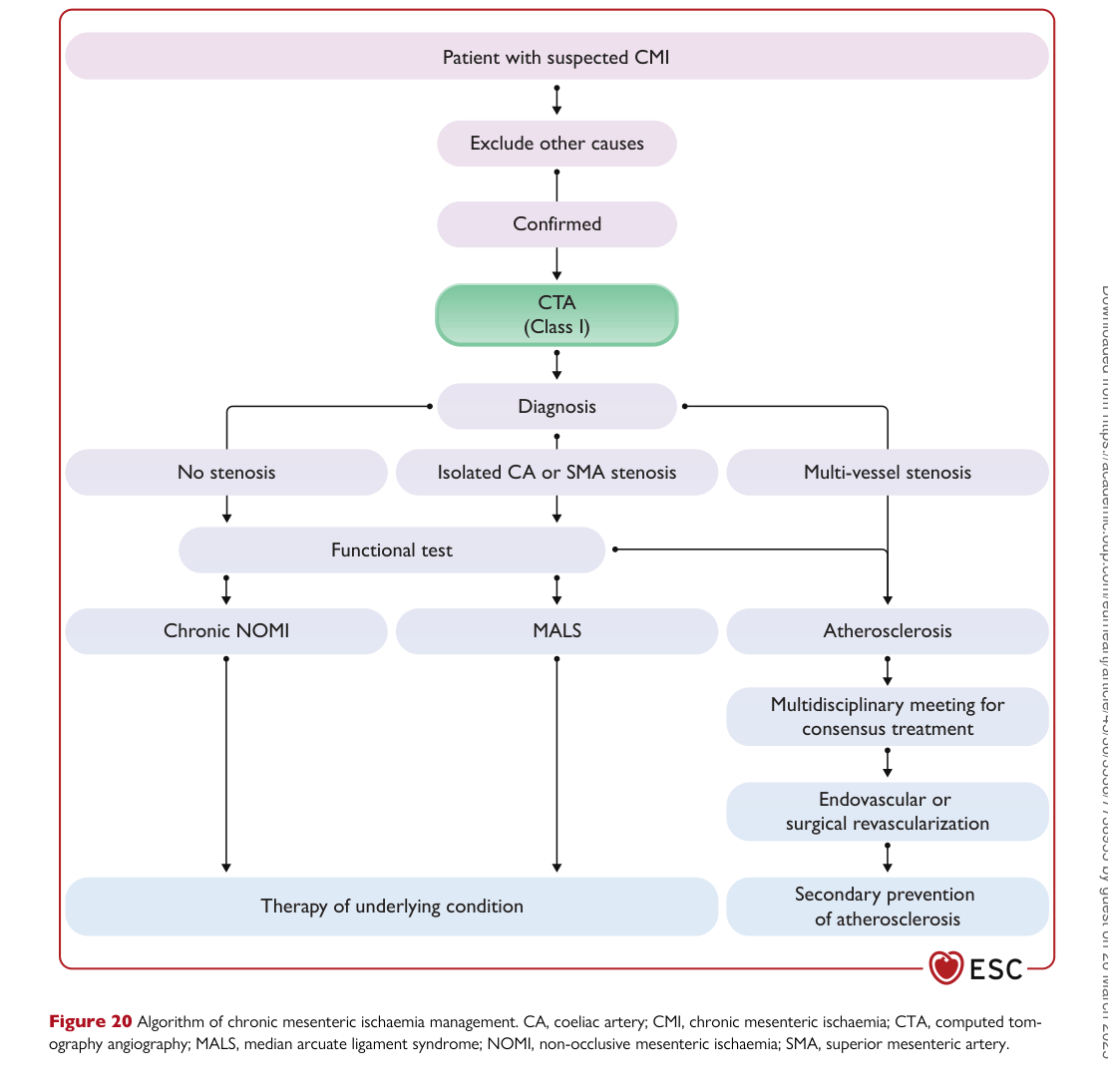
- Chronic mesenteric ischaemia:典型三聯(餐後痛、體重減輕、食欲下降);2 個 visceral artery 嚴重狹窄即可診斷;asymptomatic 不 revascularize;symptomatic 第一線 endovascular。
- Acute mesenteric ischaemia:embolic occlusion of SMA — 從「endo 或 open 都可」升為「endovascular 為第一線(I B)」。
- Polyvascular disease(Ch 11):≥2 vascular bed 病灶。LDL-C <55 + ≥50% 降幅(I A)、stable 且 symptomatic + 非高 bleeding → COMPASS regimen(IIa A)。
🗺️ 章節對應
本篇對應原文 Ch 8.2-8.5(carotid/vertebral/upper limb)+ Ch 8.6 renal artery + Ch 8.7 mesenteric artery + Ch 11 polyvascular disease。嵌入 Figure 17、18、19、20(共 4 張流程圖)+ Figure 45(polyvascular distribution)。
- 頸動脈——症狀性 vs 無症狀是分水嶺:症狀性(同側中風/TIA/暫時性黑矇)且狹窄 50–99% → 血管重建(CEA 或 CAS)獲益明確、且要趁早(黃金 2 週內),因為剛有症狀的斑塊最不穩、再中風風險最高。無症狀狹窄則因現代最佳內科治療(高強度 statin+抗血小板+控危險因子)已把中風風險大幅壓低,血管重建的淨效益變小 → 只在「高風險特徵+低手術風險+預期壽命夠長」時才考慮。CEA vs CAS:CREST 顯示整體相當,但CAS 手術全期中風略多、CEA 手術全期心肌梗塞略多,依年齡/解剖/手術風險選。
- 腎動脈狹窄為何別常規支架(CORAL 陰性):動脈硬化型腎動脈狹窄放支架不改善血壓、腎功能或事件(CORAL)——因為多數腎損傷來自瀰漫性腎實質與全身動脈硬化,不是單一狹窄。內科治療(RAASi+控危險因子)為主;只在頑固性高血壓、快速惡化腎功能、反覆肺水腫(flash pulmonary edema)等特定情境才考慮介入。
🧠 8.2 Carotid Artery Stenosis
狹窄百分比的「分母」差異 — NASCET vs ECST
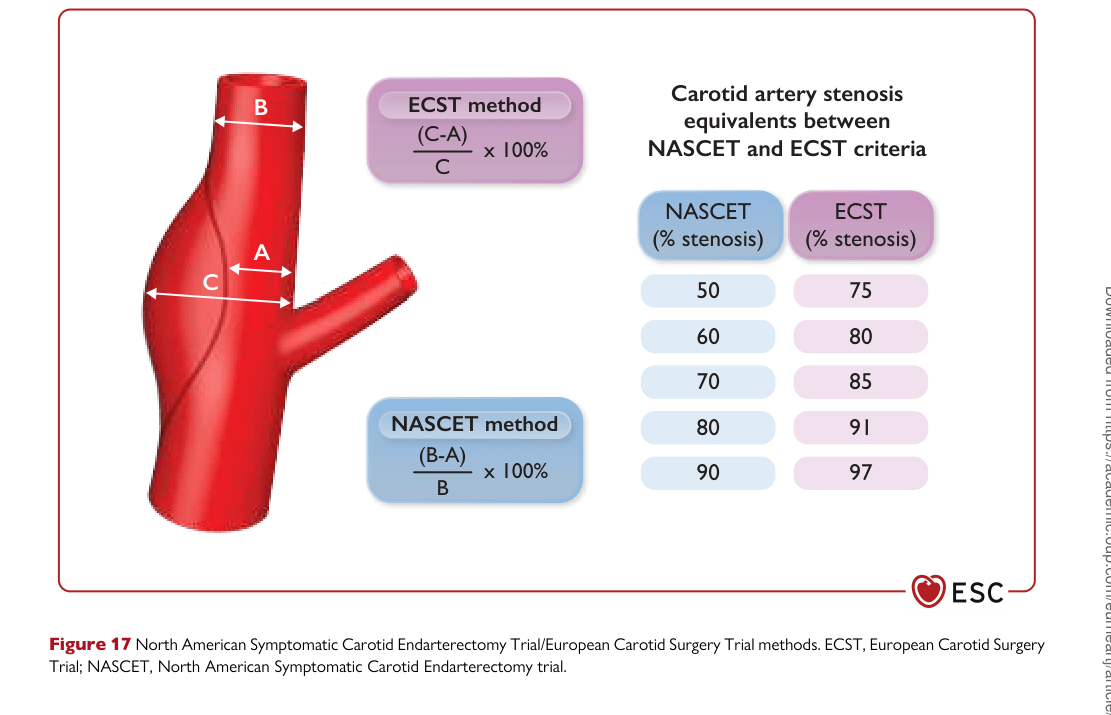
來源:2024 ESC Guidelines for the Management of Peripheral Arterial and Aortic Diseases (Eur Heart J 2024;45:3538-3700, doi:10.1093/eurheartj/ehae179) — 個人教學用,原始版權屬 ESC/EACTS。
🧭 圖表逐步解析:Figure 17(NASCET vs ECST 測量法)
這張圖在回答什麼問題:為什麼同一張 carotid 影像,兩個放射科可能報「狹窄 50%」與「狹窄 70%」?
逐步走完:
容易踩雷的地方:
Carotid stenosis 處置流程
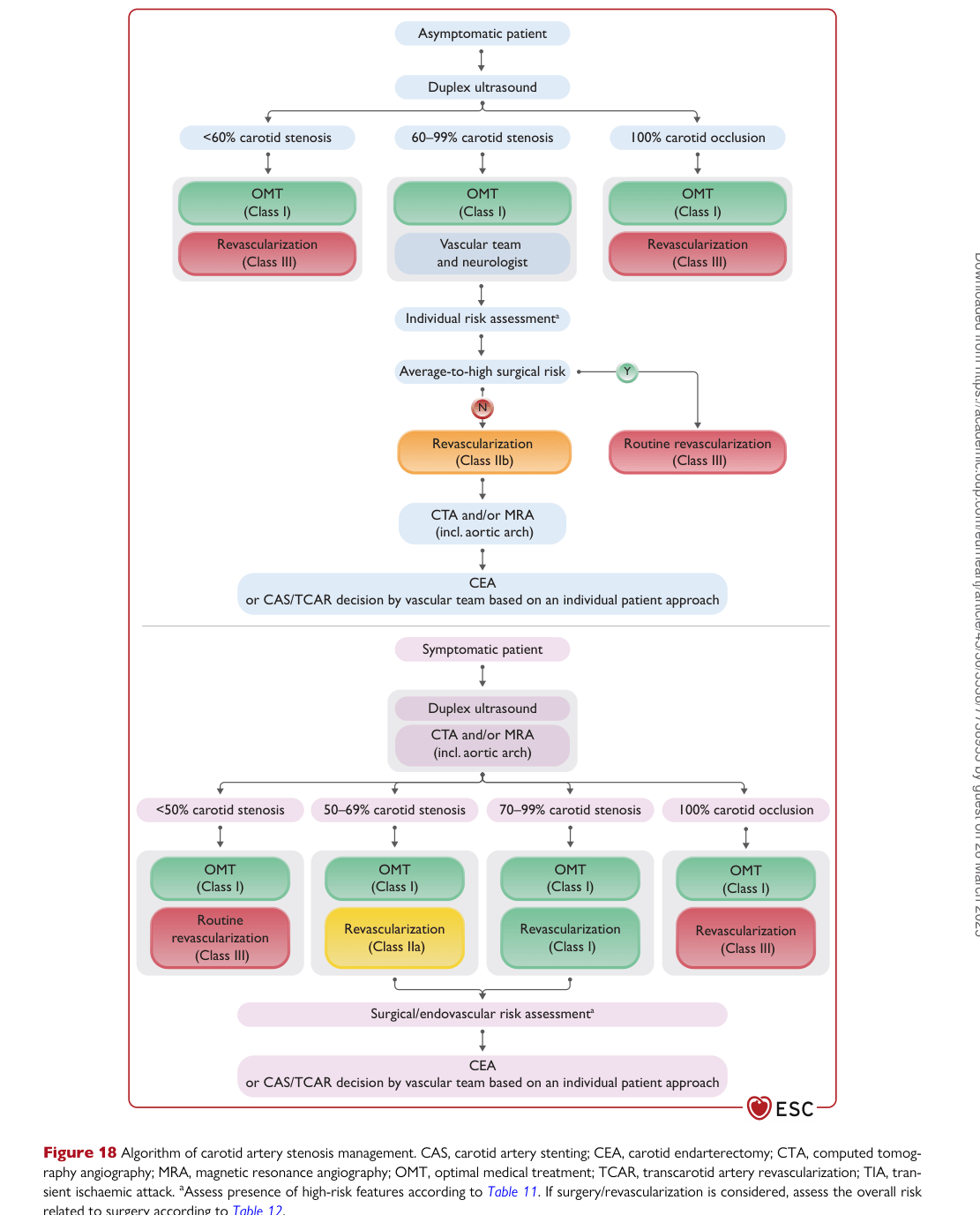
來源:2024 ESC Guidelines for the Management of Peripheral Arterial and Aortic Diseases (Eur Heart J 2024;45:3538-3700, doi:10.1093/eurheartj/ehae179) — 個人教學用,原始版權屬 ESC/EACTS。
🧭 圖表逐步解析:Figure 18(Carotid artery stenosis 治療流程)
這張圖在回答什麼問題:確認 carotid stenosis(NASCET 法)後,何時藥物治療、何時 CEA、何時 CAS?
逐步走完:
- 狹窄 ≥50% NASCET 且預期 procedural risk <6% → 考慮 revascularization。
- 狹窄 70-99% → revascularization 證據最強。
- 近完全 occlusion(>99%):通常不適合 revascularization,OMT 為主。
- 時間窗:症狀發作後 14 天內 revascularize 效益最大;越早越好但 <48 小時若大 stroke 與出血轉化風險仍要評估。
- 狹窄 <70%:OMT only。
- 狹窄 ≥70% + high-risk features(progression of stenosis、silent infarct on MRI、contralateral occlusion、micro-embolic signals on TCD、reduced cerebrovascular reserve、large/echolucent plaque、intraplaque haemorrhage on MRI)+ 預期壽命 >5 年 → 考慮 revascularization(IIa B)。
- ≥70% 無 high-risk features → OMT only(觀念翻轉,過去傾向積極介入)。
- CEA 仍是 standard:absolute benefit 在 symptomatic ≥70% 最高。
- CAS(IIa B) 適合:CEA 高風險解剖(high lesion、prior radiation、tracheostomy、contralateral CEA、再狹窄);CAS 在年輕、stable plaque 表現亦可。
- CAS 的 peri-procedural stroke 略高於 CEA,但 long-term ipsilateral stroke 兩者相當。
容易踩雷的地方:
🧪 CREST(2010, NEJM;10 年數據 2016, NEJM)— CEA 與 CAS 長期相當、但併發症型態不同
設計:2,502 名 symptomatic 或 asymptomatic carotid stenosis 病人,隨機分到 CEA(carotid endarterectomy) 或 CAS(carotid artery stenting,含 embolic protection);主要終點=peri-procedural stroke/MI/death + 之後 ipsilateral stroke;中位追蹤至 10 年。
結果:主要複合終點兩組無顯著差異(CAS 7.2% vs CEA 6.8%)。但型態不同 ── CAS peri-procedural stroke 較高、CEA peri-procedural MI 較高。10 年追蹤 ipsilateral stroke 兩組相當,long-term durability 接近。
臨床意義:支撐「CEA 為 standard、CAS 在 CEA 高風險解剖時為合理替代」IIa B。易踩雷:CAS 的 peri-procedural stroke 風險在 年長者(>70 歲)顯著上升,選 CAS 要看年齡與解剖;MI 偏好則使 CEA 在心臟高風險者要權衡。
🧠 8.3 Vertebral / 8.4 Upper Limb 簡述
Vertebral artery stenosis:
- Asymptomatic vertebral stenosis:OMT only。
- Symptomatic(posterior circulation stroke/TIA)+ stenosis ≥50%(NASCET):OMT 為主;revascularization 證據弱,僅在最佳藥物治療下仍反覆 TIA 時考慮(IIb C)。
Subclavian artery stenosis(含 Subclavian steal syndrome):
- 診斷:上肢血壓不對稱 >15 mmHg、syncope on arm exercise、prior LIMA-LAD graft after PAD ID。
- Symptomatic(vertebrobasilar TIA、arm claudication、coronary subclavian steal post-CABG with LIMA):endovascular(PTA/stent)first-line(I C)。
Upper limb PAD:相對少見;要排除 thoracic outlet syndrome、Buerger disease、vasculitis(Takayasu、giant cell arteritis)。Imaging 以 DUS + CTA/MRA。
🫘 8.6 Renal Artery Stenosis
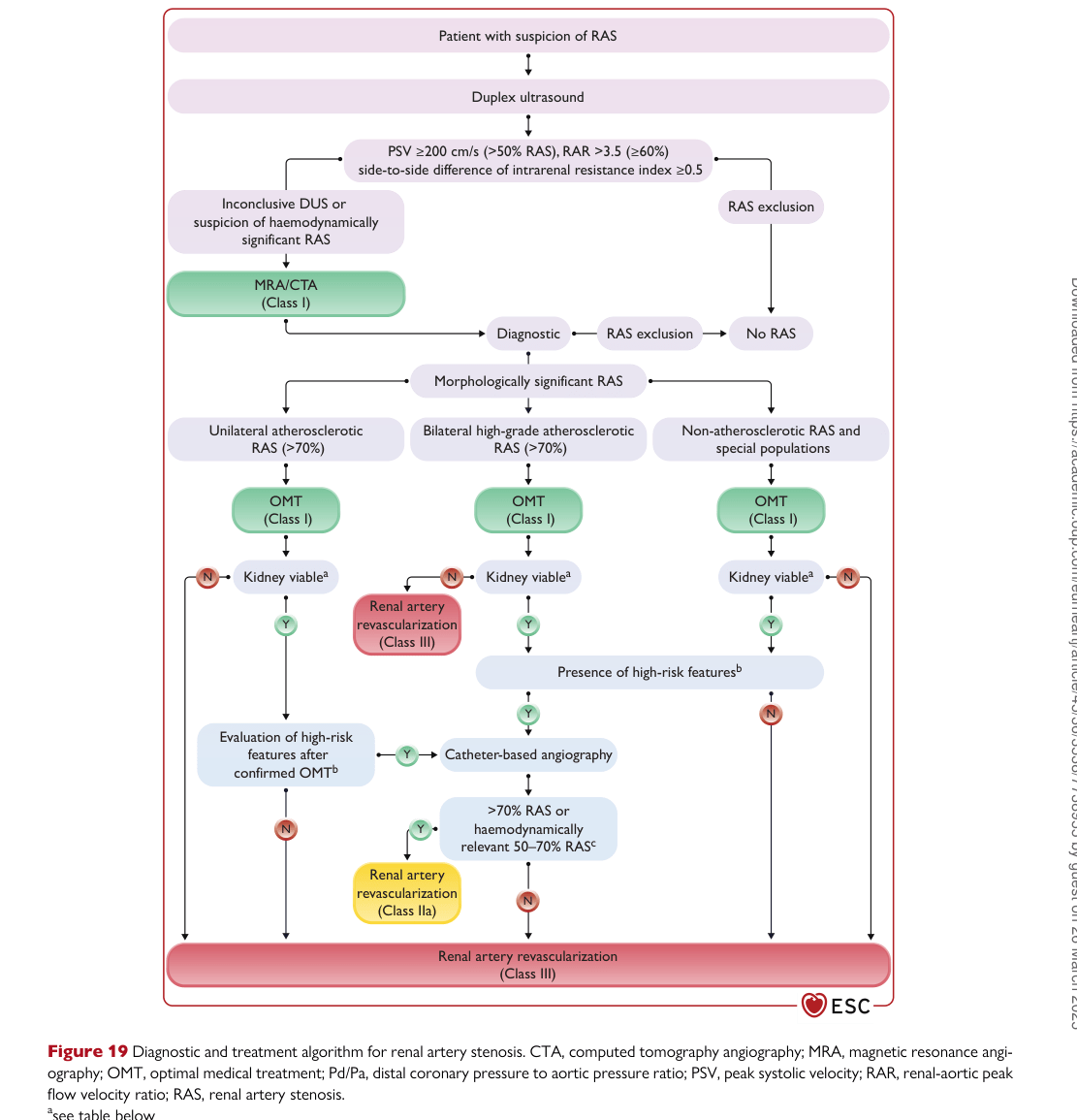
來源:2024 ESC Guidelines for the Management of Peripheral Arterial and Aortic Diseases (Eur Heart J 2024;45:3538-3700, doi:10.1093/eurheartj/ehae179) — 個人教學用,原始版權屬 ESC/EACTS。
🧭 圖表逐步解析:Figure 19(RAS 診斷與治療流程)
這張圖在回答什麼問題:什麼樣的 RAS 病人值得做 revascularization,哪些只該吃藥?
逐步走完:
- Atherosclerotic RAS:典型 ostial/proximal lesion、年長者、有 CV risk factors。
- Fibromuscular dysplasia:mid-distal artery、「string-of-beads」型、年輕女性常見、可能多 vascular bed。
- 單側 >70% + high-risk features(resistant HTN/flash pulmonary oedema/acute renal dysfunction 不解釋)+ kidney viable(remaining cortex thickness >7-8 mm;renal length >7 cm;無嚴重 fibrosis)→ IIa B。
- 雙側 ≥70% 或 solitary kidney + 上述 → IIa B。
- 單純 atherosclerotic 單側 RAS routine revascularization:III A(CORAL、ASTRAL trial 顯示 OMT 不劣)。
容易踩雷的地方:
🧪 CORAL(2014, NEJM)— atherosclerotic RAS 常規 stent「不要做」的關鍵證據
設計:947 名 atherosclerotic renal artery stenosis(≥60%)+ 高血壓或 CKD 病人,隨機分到 renal stent + 強化藥物治療 vs 單純強化藥物治療;主要終點=CV/renal 死亡、stroke、MI、HF 住院、進行性腎功能惡化、需 RRT 之複合;中位追蹤 43 個月。
結果:主要複合終點兩組無差異(stent 35.1% vs 藥物 35.8%;HR 0.94,95% CI 0.76–1.17,p=0.58),各別組成(死亡、stroke、MI、腎功能、RRT)皆無顯著差異;stent 僅讓收縮壓略降約 2 mmHg。
臨床意義:直接撐起「單純 atherosclerotic 單側 RAS 不做 routine revascularization」III A(與 ASTRAL 一致)。易踩雷:CORAL 排除了 flash pulmonary oedema、快速惡化的 resistant HTN 等 high-risk 表現 — 這些「指引仍保留 IIa B 介入空間」的族群並不在 CORAL 的陰性結論之內,不要過度外推成「所有 RAS 都別做」。
🍽️ 8.7 Mesenteric Artery Disease
來源:2024 ESC Guidelines for the Management of Peripheral Arterial and Aortic Diseases (Eur Heart J 2024;45:3538-3700, doi:10.1093/eurheartj/ehae179) — 個人教學用,原始版權屬 ESC/EACTS。
🧭 圖表逐步解析:Figure 20(Chronic mesenteric ischaemia 處置流程)
這張圖在回答什麼問題:什麼樣的腸繫膜動脈狹窄要做介入,怎麼分辨「真 CMI」與「IBS/消化道癌症」?
逐步走完:
- Symptomatic CMI:endovascular first-line(PTA + stent);複雜解剖或失敗 → open bypass。
- Asymptomatic visceral artery stenosis:III C,不要做 revascularization。
容易踩雷的地方:
🌳 Ch 11 — Polyvascular Disease

來源:2024 ESC Guidelines for the Management of Peripheral Arterial and Aortic Diseases (Eur Heart J 2024;45:3538-3700, doi:10.1093/eurheartj/ehae179) — 個人教學用,原始版權屬 ESC/EACTS。
Figure 45 把「有一處 atherosclerosis 就要警覺其他血管床」的數據量化:
- 有 PAD:CAD 共病率 60-80%、carotid stenosis 約 30-40%。
- 有 carotid stenosis:CAD 共病率約 50-60%、PAD 30%。
- 有 CAD:PAD 約 20-30%、carotid stenosis 10-15%。
- 有 AAA:CAD 共病率高達 50-60%、femoro-popliteal aneurysm 約 10%。
Polyvascular disease 核心建議
| 主題 | 建議 | Class / LOE | vs 舊版 |
|---|---|---|---|
| LDL-C 目標 | <55 mg/dL + ≥50% 降幅 | I A | 新(過去 PAD 是 <70) |
| 抗血栓(stable + symptomatic ≥1 territory + 非高 bleeding) | rivaroxaban 2.5 mg b.i.d. + ASA 100 mg o.d. | IIa A | 新(COMPASS PAD subgroup + polyvascular 數據) |
| BP target | <130/80(一般) | I A | 不變 |
| AAA 篩檢於 symptomatic/asymptomatic PAD | opportunistic DUS | IIa B | 新 |
| asymptomatic carotid stenosis 篩檢 ≥2 CVRFs | 可考慮 | IIb C | 新 |
| 整合 vascular work-up | 對所有 PAAD 採全身視角 | B | 新(合併指引的核心理念) |
實務做法:polyvascular work-up template
- 確診 1 處 PAAD 後,主動評估:(a) 兩側 carotid DUS;(b) ECG ± stress test(cardiac silent ischaemia);(c) AAA DUS(>65 歲、男性、smoker);(d) ABI(若主訴為主動脈)。
- LDL-C:30 天內 retest;未達 <55 加 ezetimibe → 仍未達加 PCSK9i。
- 抗血栓:依「ischaemic vs bleeding risk」雙軸決策;non-AF stable polyvascular + symptomatic → 考慮 COMPASS regimen。
- annual follow-up:QoL、ABI、DUS(若有 known stenosis)、medication adherence。
- Carotid:用 NASCET 法;symptomatic ≥50% / asymptomatic ≥70% + high-risk features 才介入;CEA 為 standard,CAS 在 CEA 高風險解剖時考慮;14 天內 revascularize 效益最大。
- RAS:純 atherosclerotic 單側不要 routine revascularize(III A);要 >70% + high-risk features + kidney viable 才考慮;FMD 用 balloon + bailout stent。
- Mesenteric:CMI 三聯 + 2 條 visceral artery 嚴重狹窄;acute mesenteric ischaemia 升級為 endovascular first-line(I B)。
- Polyvascular(Ch 11):LDL <55、COMPASS regimen 為核心;診斷 1 處就主動評估其他血管床;annual follow-up 整合 cardiac + vascular。
📖 References
- Mazzolai L, Teixido-Tura G, Lanzi S, et al. 2024 ESC Guidelines for the management of peripheral arterial and aortic diseases. Eur Heart J 2024;45(36):3538-3700. doi:10.1093/eurheartj/ehae179. PMID: 39210710.
- Aboyans V, Ricco JB, Bartelink ME, et al. 2017 ESC Guidelines on the Diagnosis and Treatment of Peripheral Arterial Diseases. Eur Heart J 2018;39(9):763-816.
- Erbel R, Aboyans V, Boileau C, et al. 2014 ESC Guidelines on the diagnosis and treatment of aortic diseases. Eur Heart J 2014;35(41):2873-2926.
- Anand SS, Bosch J, Eikelboom JW, et al. Rivaroxaban with or without aspirin in patients with stable peripheral or carotid artery disease (COMPASS). Lancet 2018;391(10117):219-29.
- Bonaca MP, Bauersachs RM, Anand SS, et al. Rivaroxaban in Peripheral Artery Disease after Revascularization (VOYAGER PAD). N Engl J Med 2020;382(21):1994-2004.
- Bonaca MP, Nault P, Giugliano RP, et al. Low-Density Lipoprotein Cholesterol Lowering With Evolocumab and Outcomes in Patients With Peripheral Artery Disease (FOURIER subanalysis). Circulation 2018;137(4):338-50.
- Brott TG, Hobson RW 2nd, Howard G, et al. Stenting versus Endarterectomy for Treatment of Carotid-Artery Stenosis (CREST). N Engl J Med 2010;363(1):11-23. doi:10.1056/NEJMoa0912321.
- Cooper CJ, Murphy TP, Cutlip DE, et al. Stenting and Medical Therapy for Atherosclerotic Renal-Artery Stenosis (CORAL). N Engl J Med 2014;370(1):13-22. doi:10.1056/NEJMoa1310753.
本文以教學為目的整理 2024 ESC Guidelines for the management of peripheral arterial and aortic diseases,所有原文 Figure 之版權屬 ESC/EACTS;商業使用請洽 ESC 取得授權。