- 抗凝決策圍繞三件事:CHA2DS2-VA(不再有 Sex)、DOAC 為首選(除 mechanical valve、中重度 MS 用 VKA)、HCM 與 cardiac amyloidosis 不看分數一律抗凝(I B)。
- 「劑量」是 2024 版的高頻陷阱:非適應症減量是 III B(不能因為「年紀大」「腎差一點」就減;要符合各 DOAC 的明確 criteria);≥75 歲穩定 VKA + polypharmacy 可以維持 VKA IIb B;DOAC 之間或從 DOAC 換 VKA 沒有明確理由不要換 III。
- 抗血小板與抗凝的整合大改:OAC + antiplatelet 純為預防中風是 III B 禁止;ACS/PCI 三聯療法 (TAT) 嚴格限縮在第 1 個月(高 ischaemic 風險可延長),然後 OAC + 單一 P2Y12(首選 clopidogrel)至 12 個月,1 年後只留 OAC。Figure 14 把這套邏輯展開成 5 種臨床情境矩陣。
- 出血管理:HAS-BLED 不是 binary gatekeeper,是輔助識別可改善因子的工具;DOAC 出血優先用特異性 antidote(idarucizumab / andexanet alfa)IIa B;surgical LAA closure 在 cardiac surgery 順帶時升為 I B(LAAOS III)。
- 中風從哪來:AF 失去有效心房收縮 → 血液在左心耳(LAA)停滯(Virchow 的血流停滯)→ 形成凝血酶/纖維蛋白紅血栓 → 脫落造成大範圍心源性栓塞中風。所以要抗凝(抑制凝血瀑布)而非抗血小板,且 LAA 是封堵術的標的。
- 為什麼用 DOAC 優先(除機械瓣/中重度二尖瓣狹窄外):劑效可預測、不需驗 INR、交互作用少、顱內出血較低。
- 名稱改變的邏輯——CHA2DS2-VA:2024 ESC 把性別(Sex category, Sc)從計分中拿掉,改稱 CHA2DS2-VA(滿分 8 分,非 9)。原因:性別是風險的調節因子(modifier)而非獨立驅動因子——女性的中風風險增加主要在「已有其他危險因子」時才顯現;把性別納入計分會讓決策複雜化且有爭議。拿掉後讓決策更聚焦在真正的危險因子上,並對跨性別/性別多元族群更友善。計分時務必逐項相加驗證:age ≥75 給 2 分、65–74 給 1 分(兩者互斥擇一),別重複計。
📐 §6.1 抗凝啟動 — CHA2DS2-VA 怎麼用
新版風險分數定義
| 項目 | 分數 | 說明 |
|---|---|---|
| Congestive HF(含 HFrEF/HFmrEF/HFpEF) | 1 | 有臨床診斷或結構/功能 HF |
| Hypertension | 1 | 確診或目前治療中 |
| Age ≥75 歲 | 2 | 注意是 2 分 |
| Diabetes mellitus | 1 | type 1 或 2 |
| Stroke / TIA / 系統性血栓栓塞 | 2 | 強烈獨立風險因子 |
| Vascular disease | 1 | 含 MI 病史、PAD、aortic plaque |
| Age 65-74 歲 | 1 | 取代 VASc 的 Age category |
| 滿分 8 分(age ≥75 與 65-74 互斥擇一計分);Sex(VASc 中的 Sc)已從 2024 版完全移除 | ||
決策分層
| CHA2DS2-VA | 建議 | COR/LOE |
|---|---|---|
| ≥2 | OAC(DOAC 為主,mechanical valve / 中重度 MS 用 VKA) | I C |
| =1 | OAC 應該考慮 | IIa C |
| =0 | 不需常規抗凝 | — |
| HCM / cardiac amyloidosis(任何 AF) | OAC 一律 | I B |
| Device-detected subclinical AF(AHRE/SCAF)+ elevated risk + 不高出血風險 | DOAC may be considered | IIb B |
| ESUS 無 documented AF | 不建議 empiric OAC | III A |
| 抗凝病人定期 reassessment 評估 | 建議 | I B |
Device-detected subclinical AF(AHRE/SCAF)為何只給 IIb B
植入式裝置偵測到的 atrial high-rate episodes(AHRE)/ subclinical AF 與 clinical AF 不完全等價:其中風絕對風險明顯較低。兩個 2023 年的關鍵 RCT 給了「中性偏出血增加」的訊號,這也是 2024 版把抗凝定在 IIb B(個別評估、排除高出血風險)而非常規抗凝的原因。
🧪 NOAH-AFNET 6 + ARTESiA(2023–2024, N Engl J Med)— subclinical AF 抗凝的兩個誠實結果
設計:NOAH-AFNET 6:2,536 名 ≥65 歲、有裝置記錄 AHRE ≥6 分鐘(中位 2.8 小時)且有 ≥1 中風風險因子者,edoxaban vs placebo,因安全性/無效提前停止(中位追蹤 21 個月)。ARTESiA:4,012 名裝置偵測 subclinical AF(6 分鐘–24 小時)+ CHA2DS2-VASc ≥3,apixaban vs aspirin,中位追蹤 3.5 年。
結果:NOAH-AFNET 6:CV 死亡/stroke/systemic embolism composite 未顯著降低,而 death-or-major-bleeding 反而增加(5.9% vs 4.5%/患者年)。ARTESiA:stroke/systemic embolism apixaban vs aspirin HR 0.63(95% CI 0.45–0.88)——相對降 37%,但絕對事件率低(0.78% vs 1.24%/患者年),且 major bleeding 顯著增加 HR 1.80(95% CI 1.26–2.57)。
臨床意義:兩者合看=抗凝對 subclinical AF「中風絕對獲益小、出血代價明確」,故 2024 版定為 IIb B、需逐案權衡。易踩雷:不要把「裝置偵測到一陣 AHRE」直接當 clinical AF 抗凝;也不要把 ARTESiA 的「相對降 37%」當成強適應症——它的對照是 aspirin、且 NNT 大、出血 NNH 小。
📐 §6.2 OAC 選擇 — DOAC vs VKA
DOAC vs VKA 的選擇邏輯
| 情境 | 選擇 |
|---|---|
| 絕大多數非瓣膜性 AF | DOAC(首選) |
| Mechanical heart valve | VKA(強制) — RE-ALIGN 試驗 dabigatran 失敗 |
| 中重度 mitral stenosis(rheumatic) | VKA(強制) — INVICTUS 試驗 rivaroxaban 失敗 |
| 嚴重 CKD(CrCl <15 mL/min)/ dialysis | VKA 或選擇性 DOAC(apixaban/rivaroxaban,依各國 label) |
| 抗磷脂抗體症候群(triple positive) | VKA — TRAPS trial rivaroxaban 失敗 |
| ≥75 歲穩定 VKA + polypharmacy | 可不切換到 DOAC IIb B |
| 沒明確理由 → DOAC 之間互換 / DOAC 換 VKA | III |
DOAC 標準劑量速覽(Table 11)
| 藥物 | 標準劑量 | 減量條件 | 常見 reduced 劑量 |
|---|---|---|---|
| Apixaban | 5 mg BID | 符合 ≥2 項:age ≥80、體重 ≤60 kg、Cr ≥1.5 mg/dL | 2.5 mg BID |
| Dabigatran | 150 mg BID | age ≥80 或 高出血風險或同用 verapamil | 110 mg BID |
| Edoxaban | 60 mg QD | CrCl 15-50 mL/min、體重 ≤60 kg、同用 P-gp inhibitor | 30 mg QD |
| Rivaroxaban | 20 mg QD(隨餐) | CrCl 15-49 mL/min | 15 mg QD |
🖼️ Figure 9 — Common drug interactions with OAC
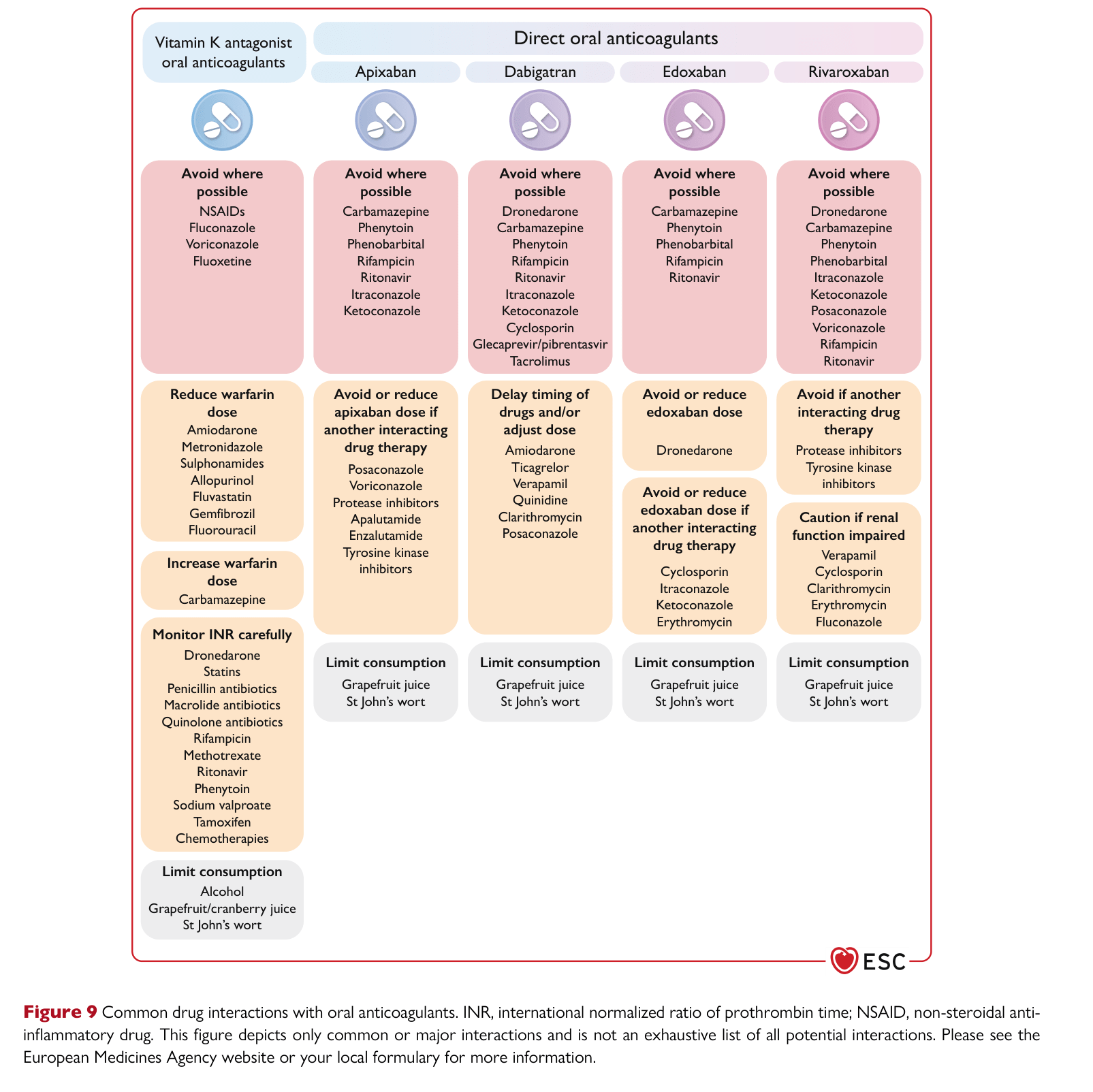
來源:2024 ESC Guidelines for the management of atrial fibrillation (Eur Heart J, doi:10.1093/eurheartj/ehae176) — 個人教學使用,原始版權屬 ESC/EACTS。
🧭 圖表逐步解析:Figure 9
這張圖在回答什麼問題:VKA 和四個 DOAC 各自要避免、減量、監測哪些併用藥物?
逐步走完(橫向看欄、縱向看列):
容易踩雷的地方:
📐 §6.3 – 6.4 抗血小板、ESUS 與 ablation 後
| 情境 | 建議 | COR/LOE |
|---|---|---|
| OAC 上加抗血小板僅為預防中風 | 禁止 | III B |
| OAC 病人發生 ischaemic stroke / 血栓 → 加抗血小板 | 不建議 | III B |
| OAC 病人發生 ischaemic stroke → 無理由換 DOAC 或換 VKA | 不建議 | III |
| OAC 病人發生 ischaemic stroke → 完整 work-up(非心因性、血管、劑量、順從性) | 應該考慮 | IIa B |
| ESUS 無 documented AF | empiric OAC 不建議 | III A |
實務情境:常見問題「病人 OAC 上發生中風要換藥嗎?」答案是先做完整 work-up(非心因性中風?vascular risk factor?劑量正確?病人吃藥嗎?),不要直接換 DOAC 或加 antiplatelet。
📐 §6.5-6.6 LAA Occlusion(percutaneous 與 surgical)
| 情境 | 建議 | COR/LOE |
|---|---|---|
| Percutaneous LAA closure:長期 OAC 禁忌 + AF | 應該考慮 | IIa B |
| Surgical LAA closure:順帶 cardiac surgery 為 OAC 補強 | 建議 | I B(升級) |
| Surgical LAA closure:順帶 endoscopic / hybrid AF ablation | 應該考慮 | IIa C |
| Stand-alone endoscopic LAA closure:長期 OAC 禁忌 | 可以考慮 | IIb C |
🧪 LAAOS III(2021, N Engl J Med)— surgical LAA occlusion 升 Class I 的關鍵
設計:4,770 名 AF(CHA2DS2-VASc ≥2)且因其他適應症接受 open cardiac surgery 的病人,隨機分「手術中順帶 surgical LAA occlusion」vs「不做」;兩組均依臨床需要持續 OAC(>75% 在追蹤期持續抗凝)。中位追蹤 3.8 年。
結果:主要終點 ischaemic stroke 或 systemic embolism 4.8% vs 7.0%,HR 0.67(95% CI 0.53–0.85, p=0.001);30 天後的事件降幅更大(約 42%)。安全性:perioperative bleeding、HF 住院、死亡兩組相當,未增加手術風險。
臨床意義:支撐「cardiac surgery 順帶 surgical LAA closure」由 IIb C 升為 I B。限制/易踩雷:這是「OAC 之上的補強」,不是替代抗凝——試驗中兩組都持續 OAC,不能用本結果支持「關了 LAA 就停 OAC」。亦不適用於 percutaneous 裝置(那走 PROTECT-AF/PREVAIL 證據體系)。
🖼️ Figure 10 — Modifying the risk of bleeding associated with OAC
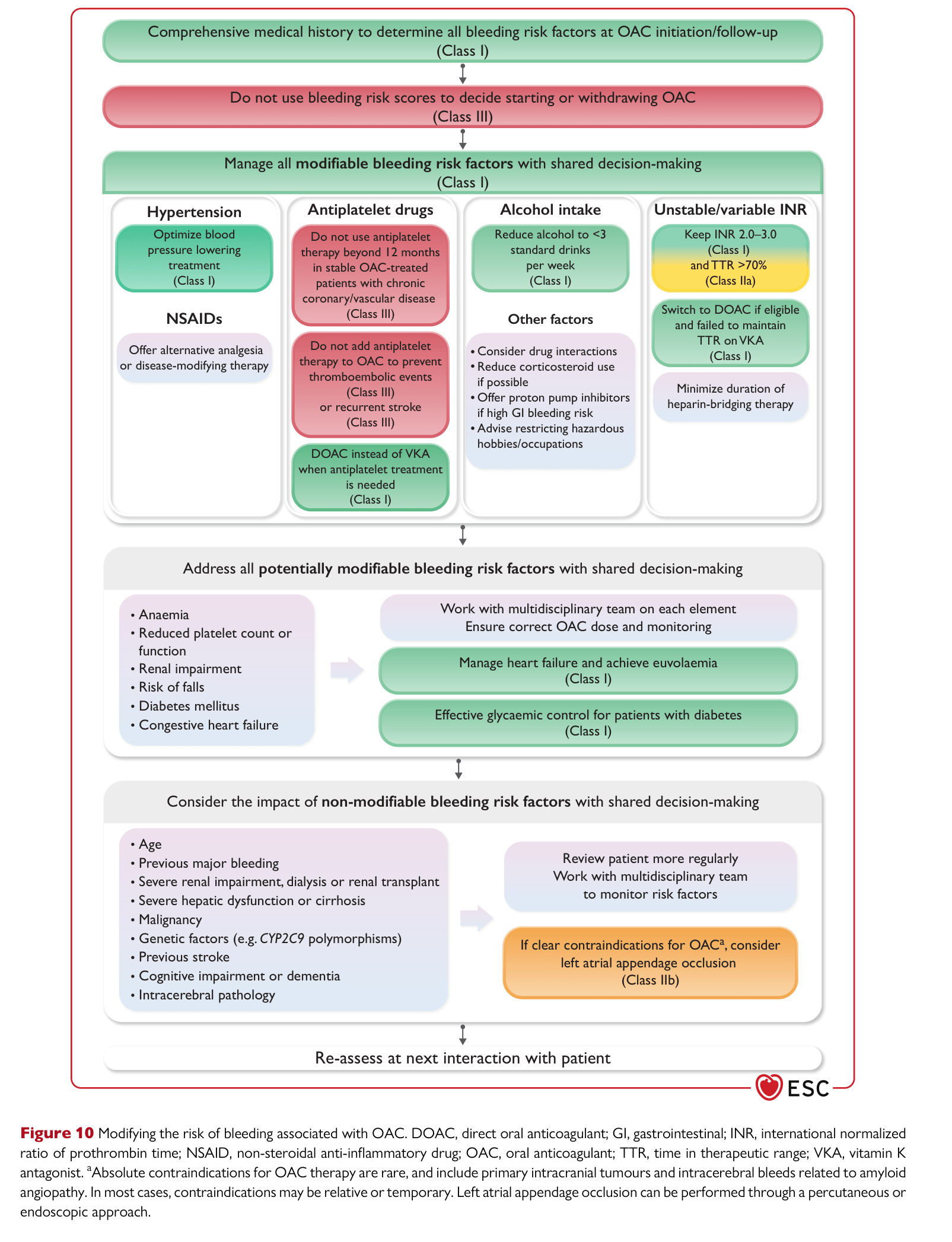
來源:2024 ESC Guidelines for the management of atrial fibrillation (Eur Heart J, doi:10.1093/eurheartj/ehae176) — 個人教學使用,原始版權屬 ESC/EACTS。
🧭 圖表逐步解析:Figure 10
這張圖在回答什麼問題:OAC 的出血風險高低不是命定的,哪些因子可改、要怎麼改?
逐步走完(從上到下三大塊):
容易踩雷的地方:
🖼️ Figure 11 — OAC-related bleeding management
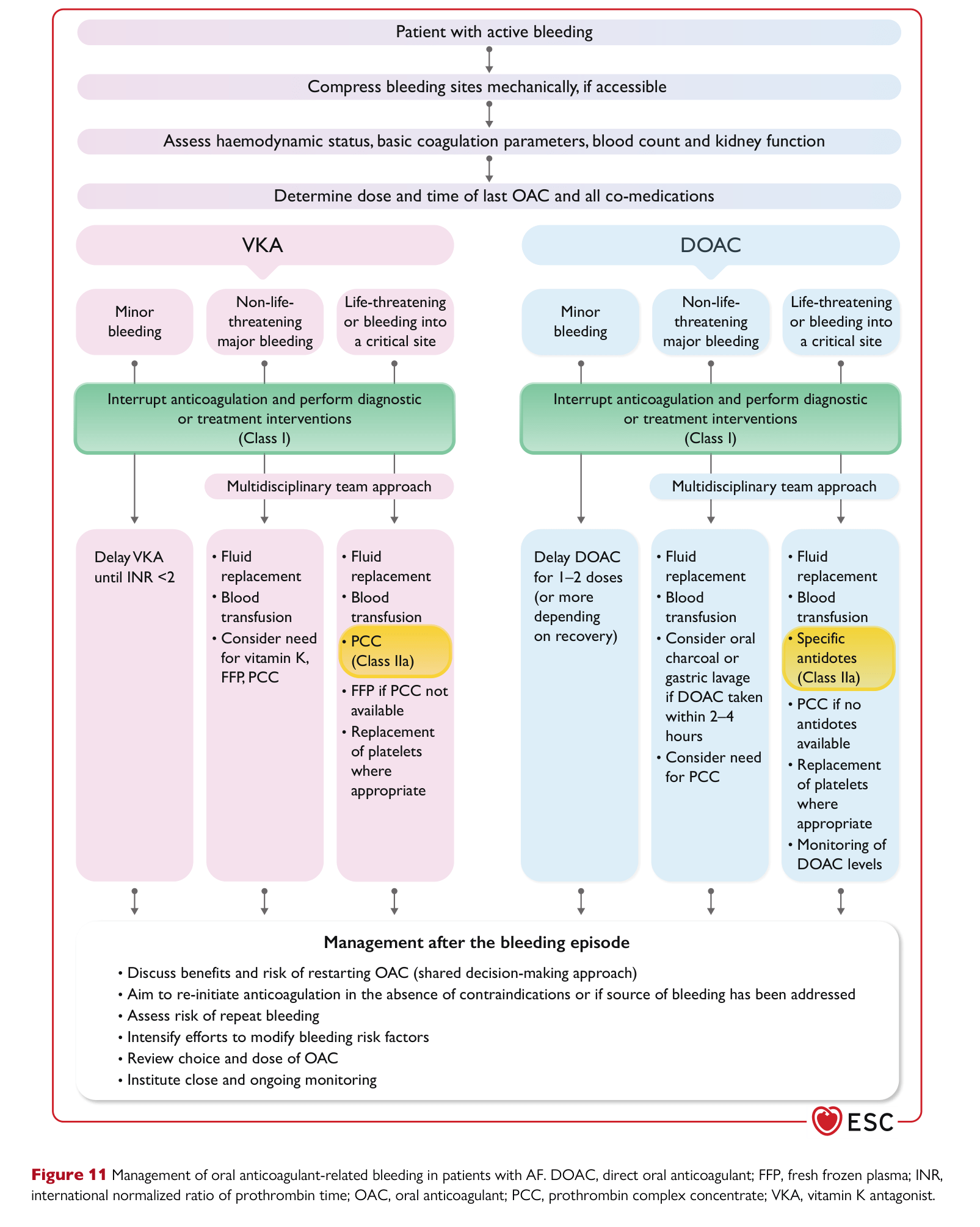
來源:2024 ESC Guidelines for the management of atrial fibrillation (Eur Heart J, doi:10.1093/eurheartj/ehae176) — 個人教學使用,原始版權屬 ESC/EACTS。
🧭 圖表逐步解析:Figure 11
這張圖在回答什麼問題:OAC 病人出血了,怎麼分流處理?
逐步走完:
容易踩雷的地方:
📐 §6.7 出血風險評估 — HAS-BLED 的正確用法
| 項目 | 分數 |
|---|---|
| Hypertension(SBP >160) | 1 |
| Abnormal renal/liver(dialysis、Cr >2.26 mg/dL、cirrhosis、ALT >3x ULN) | 各 1 |
| Stroke | 1 |
| Bleeding tendency / 病史 | 1 |
| Labile INR(TTR <60%) | 1 |
| Elderly(≥65) | 1 |
| Drugs / alcohol(NSAID/抗血小板、>8 drinks/週) | 各 1 |
正確用法:(a) ≥3 分 → 更密集追蹤、識別可改善因子;(b) 不用 HAS-BLED 決定該不該抗凝;(c) 與 CHA2DS2-VA 並用 — 多數高 HAS-BLED 同時高 CHA2DS2-VA,淨獲益仍偏抗凝。
🖼️ Figure 14 — Antithrombotic therapy in AF + ACS/CCS/PCI
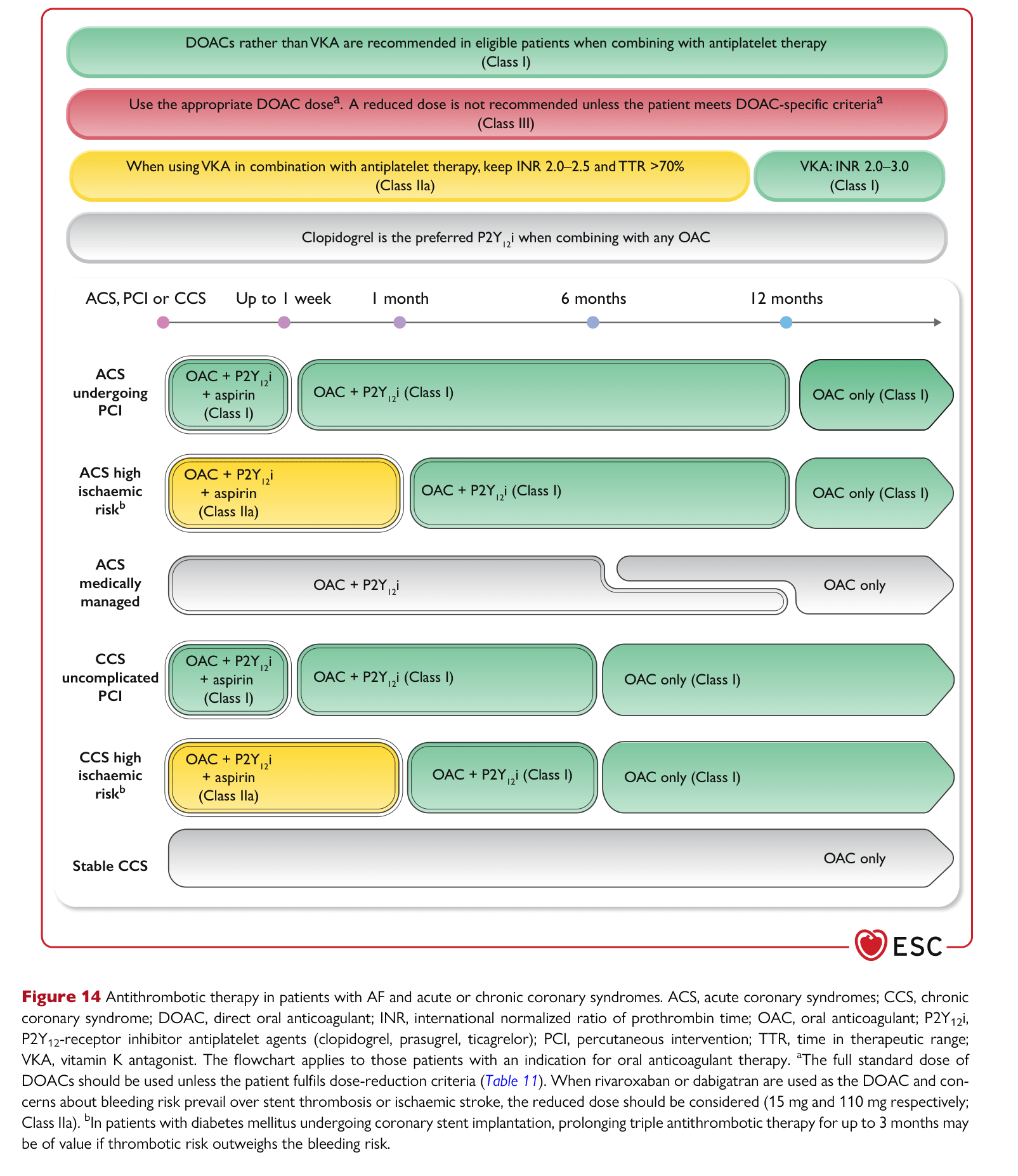
來源:2024 ESC Guidelines for the management of atrial fibrillation (Eur Heart J, doi:10.1093/eurheartj/ehae176) — 個人教學使用,原始版權屬 ESC/EACTS。
🧭 圖表逐步解析:Figure 14
這張圖在回答什麼問題:AF 病人發生 ACS 或要做 PCI(CCS)時,OAC + antiplatelet 怎麼組合、組合多久?
逐步走完(上半部 4 條原則 + 下半部 5 種臨床情境):
容易踩雷的地方:
📋 §6 重點 Recommendations 表
| 主題 | 2024 建議 | COR/LOE | vs 2020 |
|---|---|---|---|
| OAC 啟動 | CHA2DS2-VA ≥2 | I C | VASc → VA |
| OAC 啟動 | CHA2DS2-VA = 1(應該考慮) | IIa C | 新加 IIa 層 |
| HCM / amyloidosis | 不論分數一律 OAC | I B | 新加(明確) |
| OAC 選擇 | DOAC 為首選(非 mechanical valve、非中重度 MS) | I A | 延續 |
| DOAC 減量 | 不符 label criteria 不可減量 | III B | 新加 |
| ≥75 歲穩定 VKA | 可繼續 VKA(不必硬切到 DOAC) | IIb B | 新加 |
| Subclinical AF | elevated risk + 非高出血風險 → DOAC 可考慮 | IIb B | 新加 |
| 抗血小板 + OAC | 純為預防中風 → 禁止 | III B | 明確化 |
| OAC 上中風 → 加抗血小板 | 不建議 | III B | 新加 |
| OAC 上中風 → 無理由換藥 | 不建議 | III | 新加 |
| OAC 上中風 → 完整 work-up | 應該考慮 | IIa B | 新加 |
| Surgical LAAO(順帶 cardiac surgery) | 建議 | I B | 升 IIb → I |
| Surgical LAAO(順帶 endoscopic/hybrid ablation) | 應該考慮 | IIa C | 新加 |
| Stand-alone endoscopic LAAO(OAC 禁忌) | 可以考慮 | IIb C | 新加 |
| Percutaneous LAAO(OAC 禁忌) | 應該考慮 | IIa B | 延續 |
| DOAC 出血 → specific antidote | 應該考慮 | IIa B | 新加 |
| HAS-BLED:modifiable factors 處理 | 建議 | I B | 延續 |
🔬 ACS / PCI 場景的試驗證據
| 試驗 | 設計 | 主要結果 |
|---|---|---|
| PIONEER AF-PCI(NEJM 2016) | 2,124 名 AF + PCI;rivaroxaban-based vs VKA-based | Rivaroxaban 組 TIMI bleeding 顯著降低(HR 0.59) |
| RE-DUAL PCI(NEJM 2017) | 2,725 名 AF + PCI;dabigatran + P2Y12 vs warfarin TAT | Dabigatran dual therapy 出血 HR 0.52-0.72 |
| AUGUSTUS(NEJM 2019) | 4,614 名 AF + ACS or PCI;apixaban vs VKA + aspirin vs placebo(2×2 design) | Apixaban + P2Y12(無 aspirin)的 ISTH major + CRNM bleeding 最低 |
| ENTRUST-AF PCI(Lancet 2019) | 1,506 名 AF + PCI;edoxaban + P2Y12 vs VKA TAT | Edoxaban 組非劣於 VKA + 出血趨勢降低 |
| AFIRE(NEJM 2019) | 2,236 名 AF + stable CAD >1y;rivaroxaban only vs rivaroxaban + antiplatelet | Rivaroxaban monotherapy 對 CV/all-cause death + ischaemic event 非劣,且出血顯著低(提前停止) |
這 5 個試驗一致支持:(1) DOAC + 單一 P2Y12(clopidogrel 首選)優於 VKA + TAT;(2) 短期 TAT(<1 週至 1 月)足以;(3) 穩定 CCS >1 年只用 OAC。
🧪 AUGUSTUS(2019, N Engl J Med)— 拆解「DOAC vs VKA」與「要不要 aspirin」兩個問題
設計:4,614 名 AF 合併 ACS 和/或接受 PCI、計畫用 P2Y12 抑制劑者,採 2×2 factorial 同時隨機:apixaban vs VKA、aspirin vs placebo(所有人均用 P2Y12,多為 clopidogrel);追蹤 6 個月。
結果:主要安全終點 ISTH major 或 CRNM bleeding:apixaban vs VKA HR 0.69(95% CI 0.58–0.81, p<0.001);aspirin vs placebo HR 1.89(95% CI 1.59–2.24, p<0.001)。死亡或住院 apixaban 組亦較低;缺血事件(death/MI/stroke/stent thrombosis)各組無顯著增加。
臨床意義:確立 AF+PCI/ACS 的「double therapy(OAC + 單一 P2Y12,省去 aspirin)」為主流,撐起 DOAC 優先 I A、短 TAT 與「純為中風預防不加 antiplatelet」III B。限制/易踩雷:主要終點是「出血」非缺血,且追蹤僅 6 個月——對極高 stent thrombosis 風險者,指引仍允許 TAT(含 aspirin)延長到 1 個月,不是「一律完全不給 aspirin」。
- 抗凝決策:CHA2DS2-VA(無 Sex)≥2 給 OAC(I C);=1 應考慮(IIa C);HCM/amyloidosis 不看分數一律抗凝(I B)。
- DOAC 為首選(mechanical valve、中重度 MS 用 VKA);非適應症減量 III B 禁止;不要無理由 swap。
- 抗血小板 + OAC 共處方策略:純為預防中風的組合是 III B 禁止;ACS/PCI 短 TAT(1 週為主,高 ischaemic 1 月)後 OAC + clopidogrel 12 個月,再降為 OAC only。CCS uncomplicated 6 個月後就降為 OAC only。Stable CCS >1 年不加 antiplatelet。
- Surgical LAA closure 在 cardiac surgery 順帶時 升為 I B(LAAOS III);OAC 仍要繼續。
- 出血管理:HAS-BLED 是工具不是 gatekeeper;DOAC 出血用 idarucizumab / andexanet alfa(IIa B),否則 PCC;多數出血後可以重啟 OAC。
📖 References
- Van Gelder IC, Rienstra M, Bunting KV, et al. 2024 ESC Guidelines for the management of atrial fibrillation. Eur Heart J 2024;45(36):3314–3414. doi:10.1093/eurheartj/ehae176
- Whitlock RP, Belley-Cote EP, Paparella D, et al. Left Atrial Appendage Occlusion during Cardiac Surgery (LAAOS III). N Engl J Med 2021;384:2081–2091. doi:10.1056/NEJMoa2101897
- Gibson CM, Mehran R, Bode C, et al. Prevention of Bleeding in Patients with AF Undergoing PCI (PIONEER AF-PCI). N Engl J Med 2016;375:2423–2434. doi:10.1056/NEJMoa1611594
- Cannon CP, Bhatt DL, Oldgren J, et al. Dual Antithrombotic Therapy with Dabigatran after PCI in Atrial Fibrillation (RE-DUAL PCI). N Engl J Med 2017;377:1513–1524. doi:10.1056/NEJMoa1708454
- Lopes RD, Heizer G, Aronson R, et al. Antithrombotic Therapy after Acute Coronary Syndrome or PCI in Atrial Fibrillation (AUGUSTUS). N Engl J Med 2019;380:1509–1524. doi:10.1056/NEJMoa1817083
- Vranckx P, Valgimigli M, Eckardt L, et al. Edoxaban-based versus VKA-based Antithrombotic Regimen after Successful Coronary Stenting in Patients with AF (ENTRUST-AF PCI). Lancet 2019;394:1335–1343. doi:10.1016/S0140-6736(19)31872-0
- Yasuda S, Kaikita K, Akao M, et al. Antithrombotic Therapy for AF with Stable CAD (AFIRE). N Engl J Med 2019;381:1103–1113. doi:10.1056/NEJMoa1904143
- Connolly SJ, Ezekowitz MD, Yusuf S, et al. Dabigatran versus Warfarin in Patients with Atrial Fibrillation (RE-LY). N Engl J Med 2009;361:1139–1151. doi:10.1056/NEJMoa0905561
- Patel MR, Mahaffey KW, Garg J, et al. Rivaroxaban versus Warfarin in Nonvalvular Atrial Fibrillation (ROCKET-AF). N Engl J Med 2011;365:883–891. doi:10.1056/NEJMoa1009638
- Granger CB, Alexander JH, McMurray JJV, et al. Apixaban versus Warfarin in Patients with Atrial Fibrillation (ARISTOTLE). N Engl J Med 2011;365:981–992. doi:10.1056/NEJMoa1107039
- Giugliano RP, Ruff CT, Braunwald E, et al. Edoxaban versus Warfarin in Patients with Atrial Fibrillation (ENGAGE AF-TIMI 48). N Engl J Med 2013;369:2093–2104. doi:10.1056/NEJMoa1310907
- Kirchhof P, Toennis T, Goette A, et al. Anticoagulation with Edoxaban in Patients with Atrial High-Rate Episodes (NOAH-AFNET 6). N Engl J Med 2023;389:1167–1179. doi:10.1056/NEJMoa2303062
- Healey JS, Lopes RD, Granger CB, et al. Apixaban for Stroke Prevention in Subclinical Atrial Fibrillation (ARTESiA). N Engl J Med 2024;390:107–117. doi:10.1056/NEJMoa2310234
- Eikelboom JW, Connolly SJ, Brueckmann M, et al. Dabigatran versus Warfarin in Patients with Mechanical Heart Valves (RE-ALIGN). N Engl J Med 2013;369:1206–1214. doi:10.1056/NEJMoa1300615
本文以教學為目的整理 2024 ESC Guidelines for the management of atrial fibrillation;所有原文 Figure 之版權屬 ESC/EACTS。商業使用請洽 ESC 取得授權。