- 診斷:ABI 仍是第一線(abnormal = ≤0.90 或 >1.40),但 incompressible artery、diabetic、CKD 改用 TBI 或 toe pressure;活動症狀疑似但 ABI 正常 → exercise ABI。
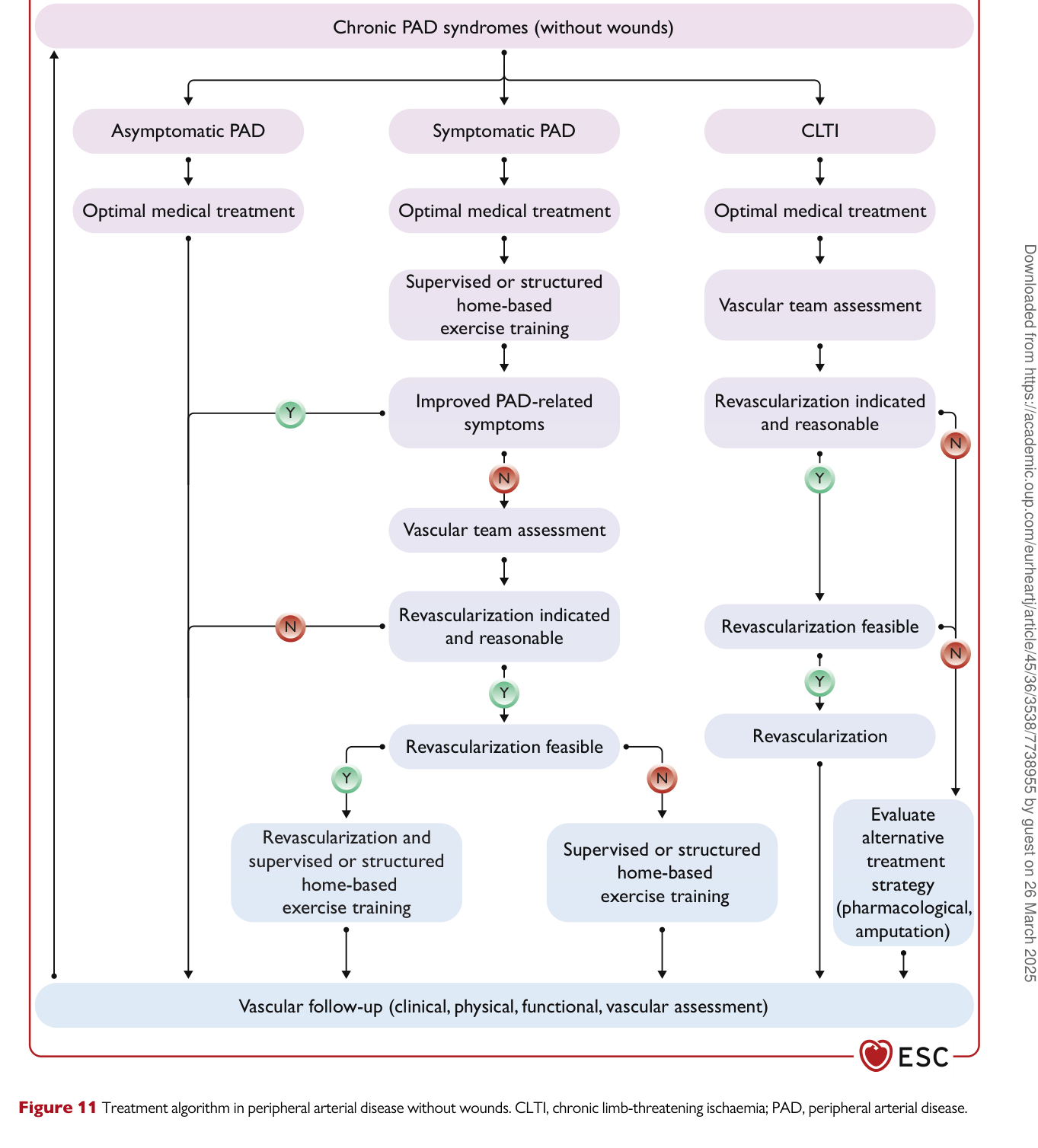
- 治療三段式:所有人都先 OMT + SET 3 個月;QoL 仍差 → revascularization;asymptomatic → 不要做 revascularization(III C,重要禁忌)。
- 抗血栓三線分層:症狀 PAD → SAPT;高 ischaemic 非高 bleeding → COMPASS regimen(rivaroxaban 2.5 mg b.i.d. + ASA 100 mg o.d.,IIa A);endovascular 術後 → 1-6 個月 DAPT 再回到 SAPT 或 COMPASS。
- CLTI:Limb salvage 比一切都重要 → 24-72 小時內 vascular team 評估、第一線 endovascular(IIa A)、autologous vein bypass(I B);exercise training 在有 wound 時禁止(III C)。
- ALI:6P(pain, pulselessness, pallor, paresthesia, paralysis, poikilothermia);Rutherford I/IIa → 影像 + revascularization;IIb → 立即取栓;III → 截肢;6 小時是 muscle 不可逆的時間窗。
🗺️ 章節對應
本篇對應原文 Chapter 8.1 — Lower-extremity peripheral arterial disease(包含 8.1.1 PAD syndromes、8.1.2 CLTI、8.1.3 ALI),共嵌入 Figure 8-16(9 張)。
🩺 8.1.1 Lower-Extremity PAD:診斷
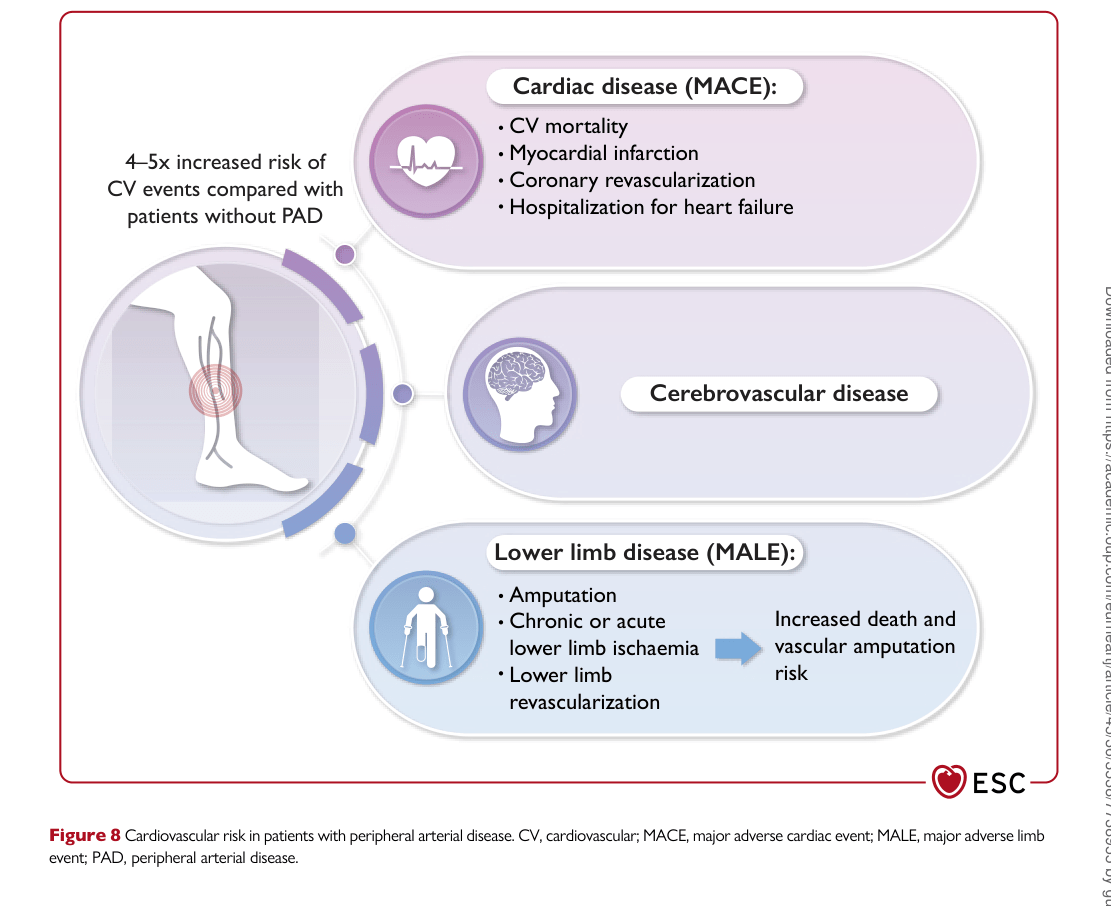
整體 cardiovascular 風險的位階
來源:2024 ESC Guidelines for the Management of Peripheral Arterial and Aortic Diseases (Eur Heart J 2024;45:3538-3700, doi:10.1093/eurheartj/ehae179) — 個人教學用,原始版權屬 ESC/EACTS。
Figure 8 提醒一件容易被忽略的事——PAD 是 cardiovascular risk equivalent。下肢 PAD 病人的 5 年 MACE 率與已發生過 MI 的病人接近,而 5 年 MALE(截肢/重大下肢手術/死亡)率則隨 Rutherford 分級顯著上升。換句話說:當你在門診看到 claudication,該下的醫令不是只有「ABI + ultrasound」,還包含整套 secondary prevention(LDL <55、antithrombotic、BP <130/80、戒菸)。
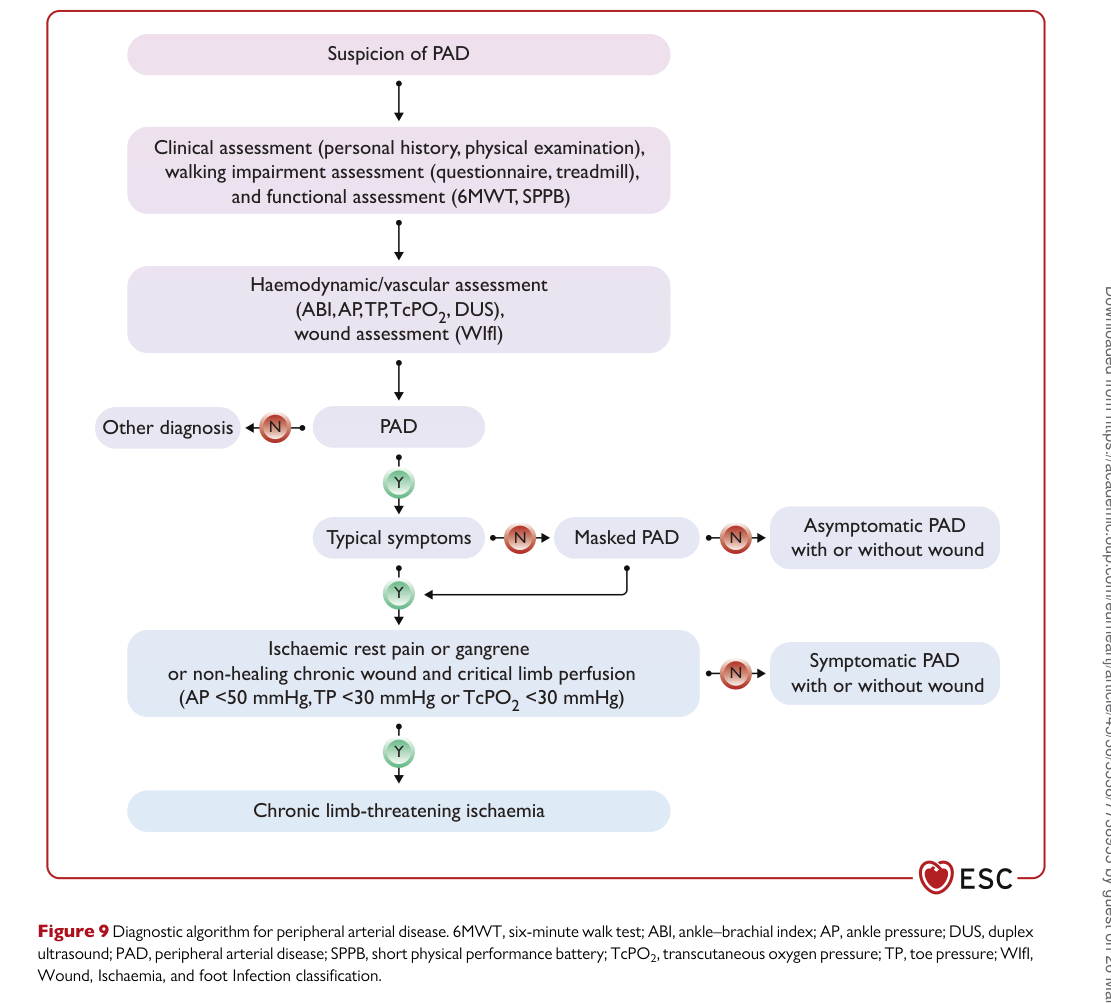
診斷流程(Figure 9)
來源:2024 ESC Guidelines for the Management of Peripheral Arterial and Aortic Diseases (Eur Heart J 2024;45:3538-3700, doi:10.1093/eurheartj/ehae179) — 個人教學用,原始版權屬 ESC/EACTS。
🧭 圖表逐步解析:Figure 9(PAD 診斷流程)
這張圖在回答什麼問題:門診來了一位疑似下肢 PAD 的病人,從第一個檢查到確診應該怎麼走?
逐步走完:
容易踩雷的地方:
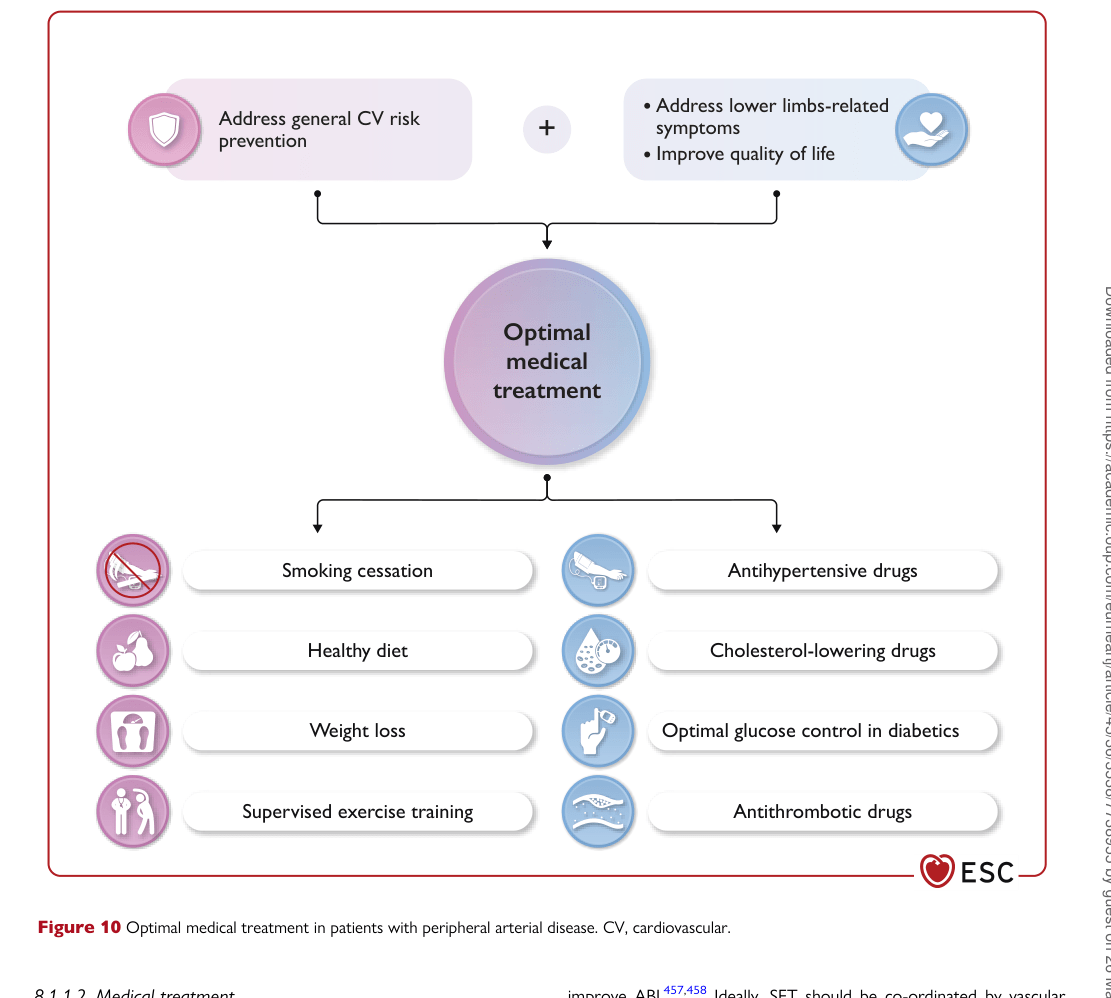
💊 8.1.1.2 Medical Treatment(一般 PAD)
來源:2024 ESC Guidelines for the Management of Peripheral Arterial and Aortic Diseases (Eur Heart J 2024;45:3538-3700, doi:10.1093/eurheartj/ehae179) — 個人教學用,原始版權屬 ESC/EACTS。
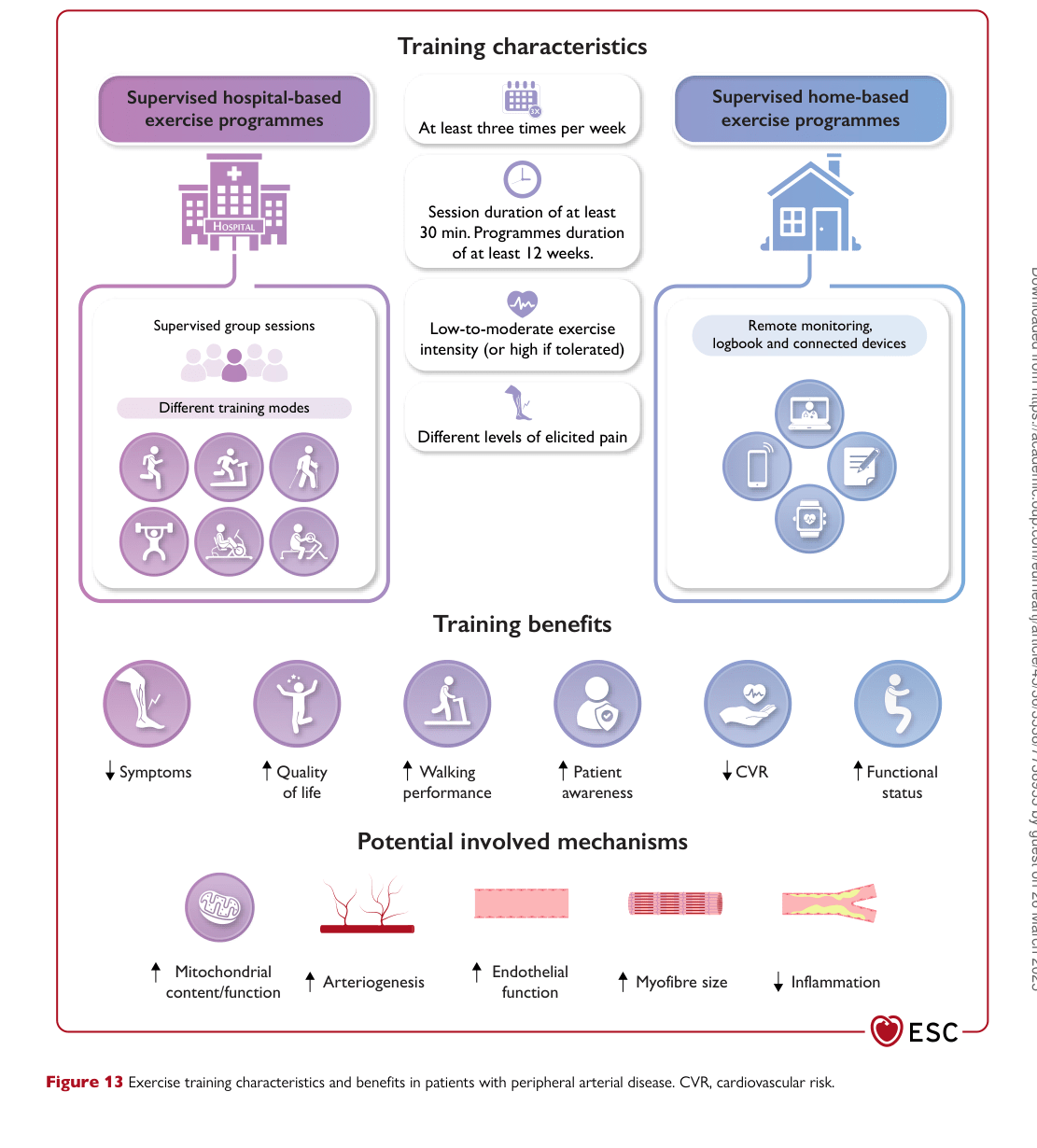
Figure 10 把 OMT 的 5 大塊整合成一張圖。重點:每一位 PAD 病人都該同時擁有這 5 塊,不是擇一。
🏃 Exercise Therapy:SET 與 HBET 的分層
來源:2024 ESC Guidelines for the Management of Peripheral Arterial and Aortic Diseases (Eur Heart J 2024;45:3538-3700, doi:10.1093/eurheartj/ehae179) — 個人教學用,原始版權屬 ESC/EACTS。
🧭 圖表逐步解析:Figure 13(Exercise training characteristics 與 benefits)
這張圖在回答什麼問題:對一位 IC(intermittent claudication)病人,運動處方應該怎麼開?
逐步走完:
容易踩雷的地方:
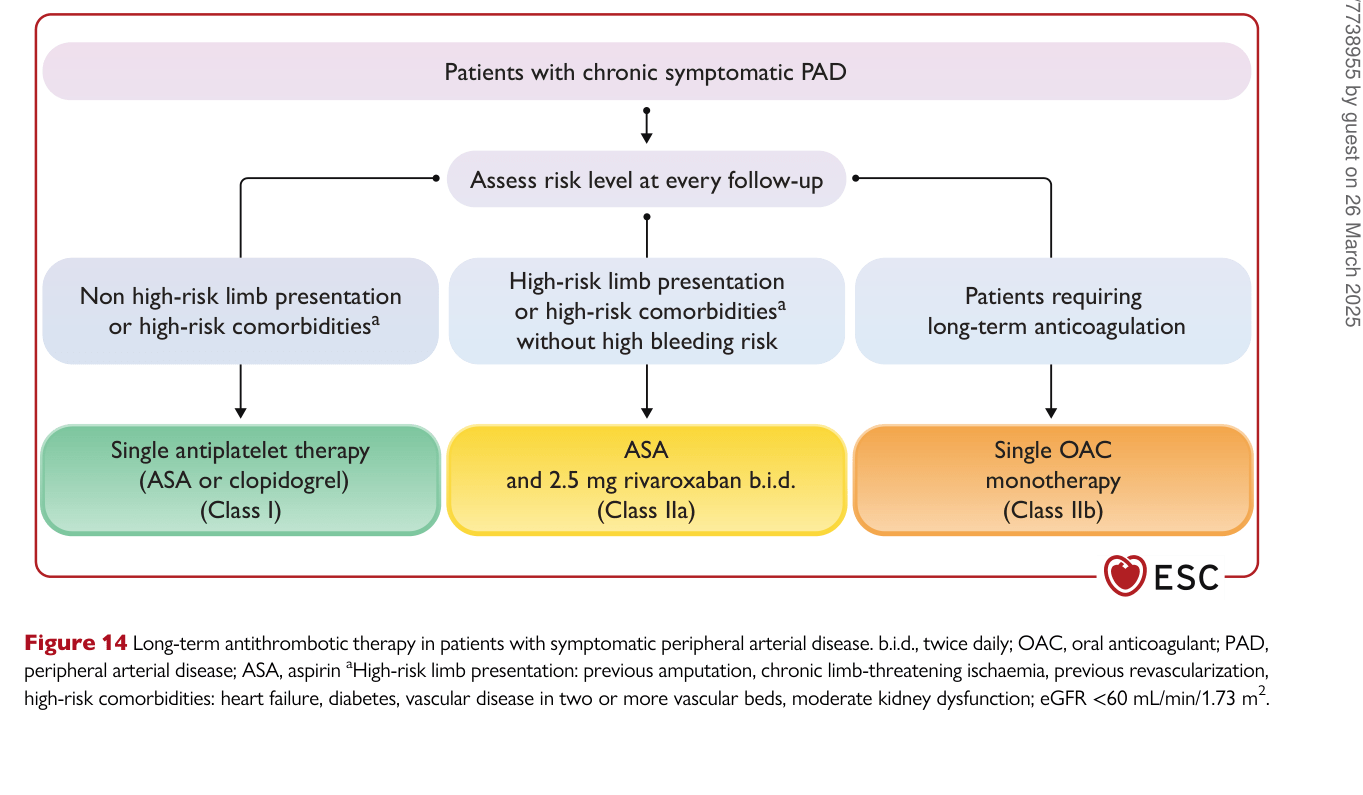
💊 抗血栓治療三層分層
來源:2024 ESC Guidelines for the Management of Peripheral Arterial and Aortic Diseases (Eur Heart J 2024;45:3538-3700, doi:10.1093/eurheartj/ehae179) — 個人教學用,原始版權屬 ESC/EACTS。
🧭 圖表逐步解析:Figure 14(Long-term antithrombotic therapy in symptomatic PAD)
這張圖在回答什麼問題:一位 stable symptomatic PAD 病人(無 AF、無近期介入),要長期吃什麼抗血栓藥?
逐步走完:
- High ischaemic risk 定義(其中之一):polyvascular disease(≥2 vascular bed)、prior MACE/MALE、HF、CKD eGFR 15-60、DM with target-organ damage。
- High bleeding risk 定義:prior bleeding、severe anaemia、active malignancy、severe CKD(eGFR <30)、需 OAC for AF。
容易踩雷的地方:
🧪 COMPASS — PAD subgroup(2018, Lancet)— 撐起穩定 PAD 的 COMPASS regimen
設計:COMPASS 主試驗 27,395 名 stable atherosclerosis 病人,PAD/carotid 次族群 6,391 人;3 臂 ── rivaroxaban 2.5 mg b.i.d. + ASA 100 mg o.d.|rivaroxaban 5 mg b.i.d. 單用|ASA 100 mg o.d. 單用;因 efficacy 提前中止,平均追蹤約 21 個月。
結果:rivaroxaban + ASA vs ASA 使 MACE 顯著下降,MALE HR 0.57(95% CI 0.37–0.88)=降 43%;ISTH major bleeding 上升(主試驗 HR 約 1.7),但 fatal/顱內出血未顯著增加。值得注意:rivaroxaban 5 mg 單用未優於 ASA — 證明 ASA 仍是骨幹,rivaroxaban 是「加上去」而非「換掉」。
臨床意義:撐起「高 ischaemic、非高 bleeding 的症狀 PAD → rivaroxaban 2.5 mg b.i.d. + ASA」IIa A。易踩雷:排除 high bleeding risk 與需 full-dose OAC(AF)者;2.5 mg 為 vascular dose b.i.d.,不可取代 AF 中風預防劑量。
🧪 VOYAGER PAD(2020, NEJM)— 撐起「術後也用 COMPASS regimen」
設計:6,564 名症狀 PAD 在 下肢 revascularization(endovascular 或 surgical)後 10 天內 隨機分組 ── rivaroxaban 2.5 mg b.i.d. + ASA 100 mg vs placebo + ASA;多數同時短期用 clopidogrel;中位追蹤 28 個月。
結果:主要複合終點(ALI/血管性大截肢/MI/ischaemic stroke/CV death)HR 0.85(95% CI 0.76–0.96)=降 15%,3 年累積 17.3% vs 19.9%;其中 ALI 下降最明顯。TIMI major bleeding 未顯著上升,但 ISTH major bleeding 顯著較多。合併 clopidogrel >30 天不增效益、反而增出血傾向。
臨床意義:撐起「endovascular revascularization 後 → 短期 DAPT 後接 rivaroxaban 2.5 b.i.d. + ASA」IIa B。易踩雷:術後不要把 clopidogrel 拉長到 >1 個月;rivaroxaban 是接在 DAPT 之後、不是與長期 DAPT 疊加。
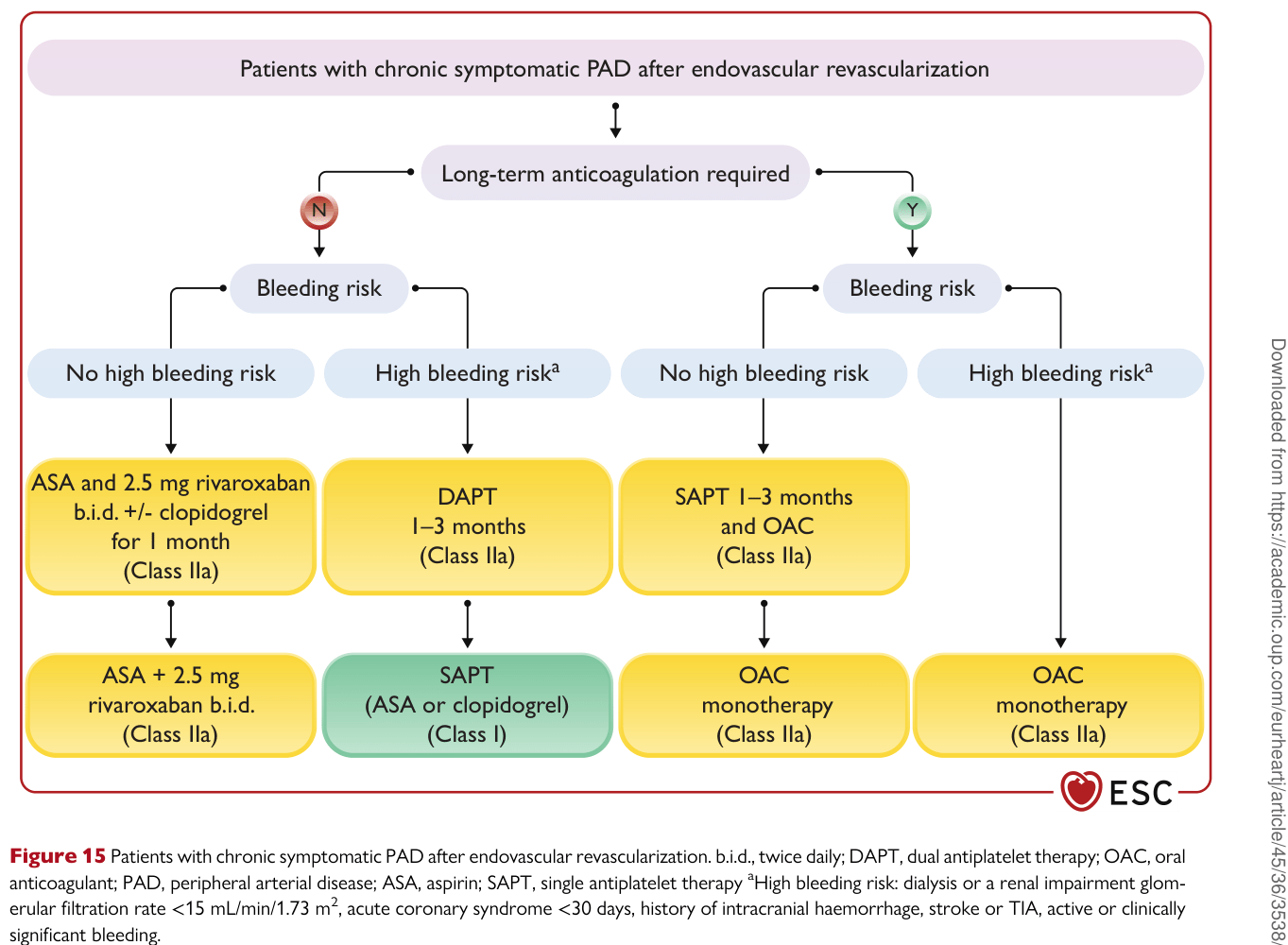
術後抗血栓細節
來源:2024 ESC Guidelines for the Management of Peripheral Arterial and Aortic Diseases (Eur Heart J 2024;45:3538-3700, doi:10.1093/eurheartj/ehae179) — 個人教學用,原始版權屬 ESC/EACTS。
Figure 15 進一步把 endovascular revascularization 後的抗血栓決策展開:
- 無高 bleeding risk + 無高 ischaemic risk:DAPT 1 個月後 → ASA 單藥
- 無高 bleeding risk + 高 ischaemic risk:DAPT 1 個月後 → rivaroxaban 2.5 b.i.d. + ASA(COMPASS regimen)
- 高 bleeding risk:直接 ASA 單藥(不做 DAPT)
- 有 OAC 適應症(如 AF):full-dose DOAC + 短期 SAPT(1 個月)→ DOAC 單藥
🏥 8.1.1.2.3-2.5 Revascularization:依解剖分層
不同解剖部位的處置原則
來源:2024 ESC Guidelines for the Management of Peripheral Arterial and Aortic Diseases (Eur Heart J 2024;45:3538-3700, doi:10.1093/eurheartj/ehae179) — 個人教學用,原始版權屬 ESC/EACTS。
🧭 圖表逐步解析:Figure 11(無 wound 的 PAD 治療路徑)
這張圖在回答什麼問題:一位 IC、無 wound、藥物治療 3 個月後仍有症狀,下一步該怎麼決策?
逐步走完:
- Aorto-iliac:endovascular(stent)為主,extensive disease → open bypass。
- Femoro-popliteal:drug-eluting(DCB/DES)為第一線(IIa A,新建議);low surgical risk + 有 GSV → open surgery(IIa C)。
- BTK:嚴重 IC 接受 femoro-popliteal endovascular 時可順便處理(IIb C)。
容易踩雷的地方:
🦶 8.1.2 Chronic Limb-Threatening Ischaemia (CLTI)
有 wound 的 PAD 路徑
來源:2024 ESC Guidelines for the Management of Peripheral Arterial and Aortic Diseases (Eur Heart J 2024;45:3538-3700, doi:10.1093/eurheartj/ehae179) — 個人教學用,原始版權屬 ESC/EACTS。
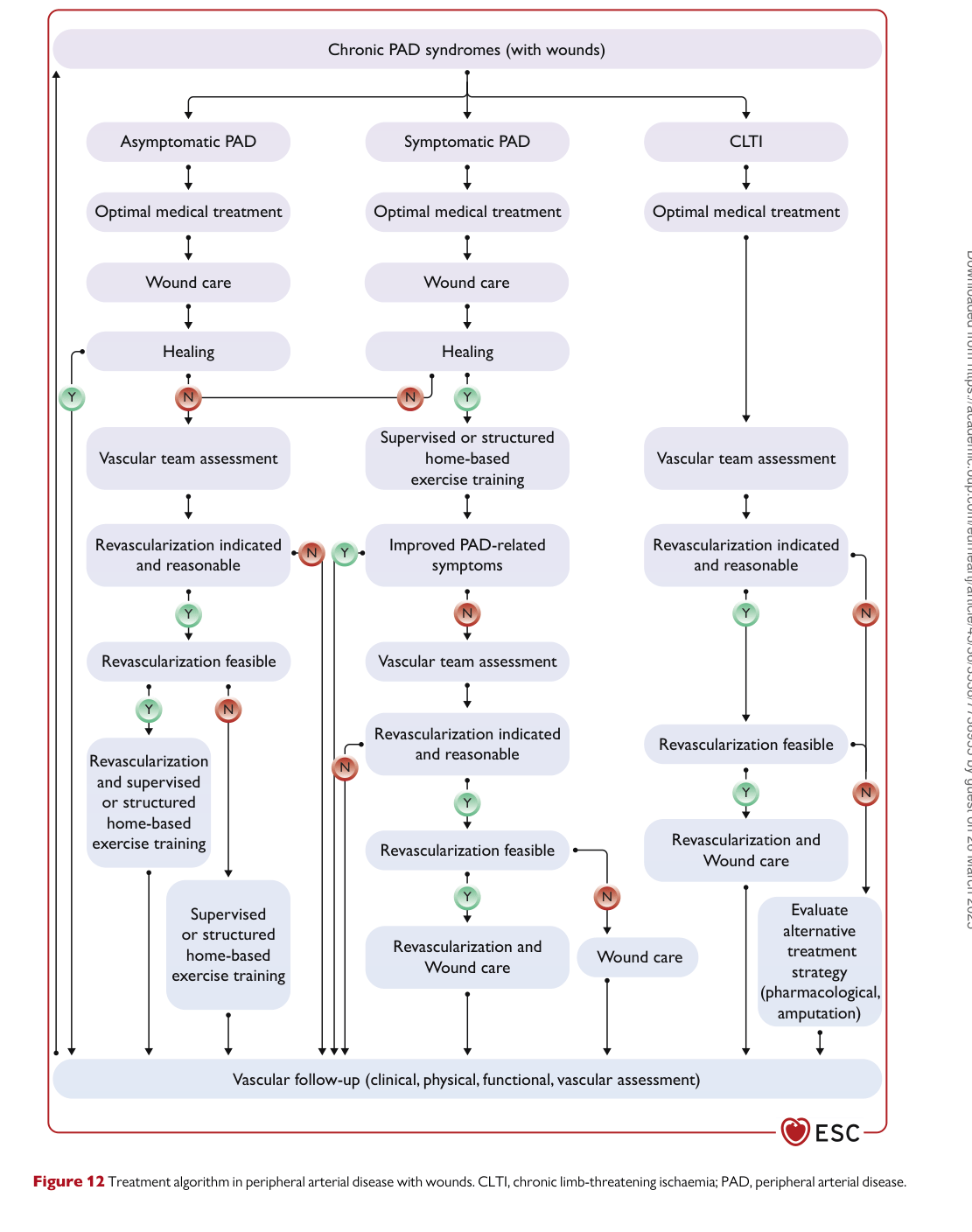
🧭 圖表逐步解析:Figure 12(有 wound 的 PAD 治療路徑 = CLTI 路徑)
這張圖在回答什麼問題:一位 PAD 病人來門診時已經有 ulcer 或 gangrene,該怎麼立刻動起來?
逐步走完:
- 第一線 endovascular(IIa B 為 first-line therapy)—— BASIL-2 與 BEST-CLI 數據(後者顯示 GSV bypass 在 good vein + low surgical risk 族群仍有優勢)。
- Autologous vein(GSV)為 first-choice conduit(I B)—— prosthetic graft 在 below-knee 通暢率較差。
- Multilevel disease:先處理 inflow(如 iliac),再處理 outflow。
容易踩雷的地方:
🧪 CLTI 兩大關鍵 RCT:BEST-CLI vs BASIL-2 — 為什麼結論看似相反?
2024 指引對 CLTI revascularization 採取「case-by-case、由 vascular team 決定 endovascular 或 vein bypass」而非一刀切,正是因為這兩個同年發表的大型 RCT 給出表面相反、實則互補的訊息。
🧪 BEST-CLI(2022, NEJM)— good vein + 可承受手術者,bypass 較佳
設計:1,830 名 CLTI 病人;依是否有 適當單段大隱靜脈(single-segment GSV) 分兩 cohort,各自隨機分到 surgical bypass 或 endovascular。Cohort 1(有 GSV,n=1,434)為主要分析;中位追蹤 2.7 年。主要終點=MALE 或 all-cause death 複合。
結果:Cohort 1 中 bypass 優於 endovascular ── 主要終點 42.6% vs 57.4%,HR 0.68(95% CI 0.59–0.79)=降 32%,主要由 大幅減少 major reintervention(HR≈0.35)與 above-ankle amputation 驅動。Cohort 2(無適當 GSV)兩者無顯著差異。
臨床意義:支持「autologous(GSV)vein 為 first-choice bypass conduit」I B,且在 good-vein + low surgical risk 族群 bypass 仍有一席之地。易踩雷:結論只適用於「有適當 GSV」者;沒有 good vein 時優勢消失。
🧪 BASIL-2(2023, Lancet)— 需 infrapopliteal 重建者,endovascular-first 較佳
設計:345 名 CLTI 且需 膝下(infrapopliteal)±更近端 重建者,隨機分到 vein bypass-first vs best endovascular-first;中位追蹤約 40 個月。主要終點=amputation-free survival(大截肢或死亡)。
結果:vein bypass-first 的 amputation-free survival 較差 ── 主要終點事件 63% vs 53%,adjusted HR 1.35(95% CI 1.02–1.80, p=0.037),主要由 endovascular 組死亡較少驅動(兩組大截肢相近)。
臨床意義:支持在 以膝下病灶為主 的族群採 endovascular-first,與 ESC「第一線 endovascular」角度一致。易踩雷/如何與 BEST-CLI 並讀:BASIL-2 偏 infrapopliteal、且 bypass 組多用人工或拼接 conduit、死亡較多;BEST-CLI 則偏 femoropopliteal/有好 GSV。兩者不矛盾——關鍵是「病灶位置 + 是否有 good GSV + 手術風險」,這也是 2024 指引不一刀切、交給 vascular team 的原因。
🚨 8.1.3 Acute Limb Ischaemia (ALI)
來源:2024 ESC Guidelines for the Management of Peripheral Arterial and Aortic Diseases (Eur Heart J 2024;45:3538-3700, doi:10.1093/eurheartj/ehae179) — 個人教學用,原始版權屬 ESC/EACTS。
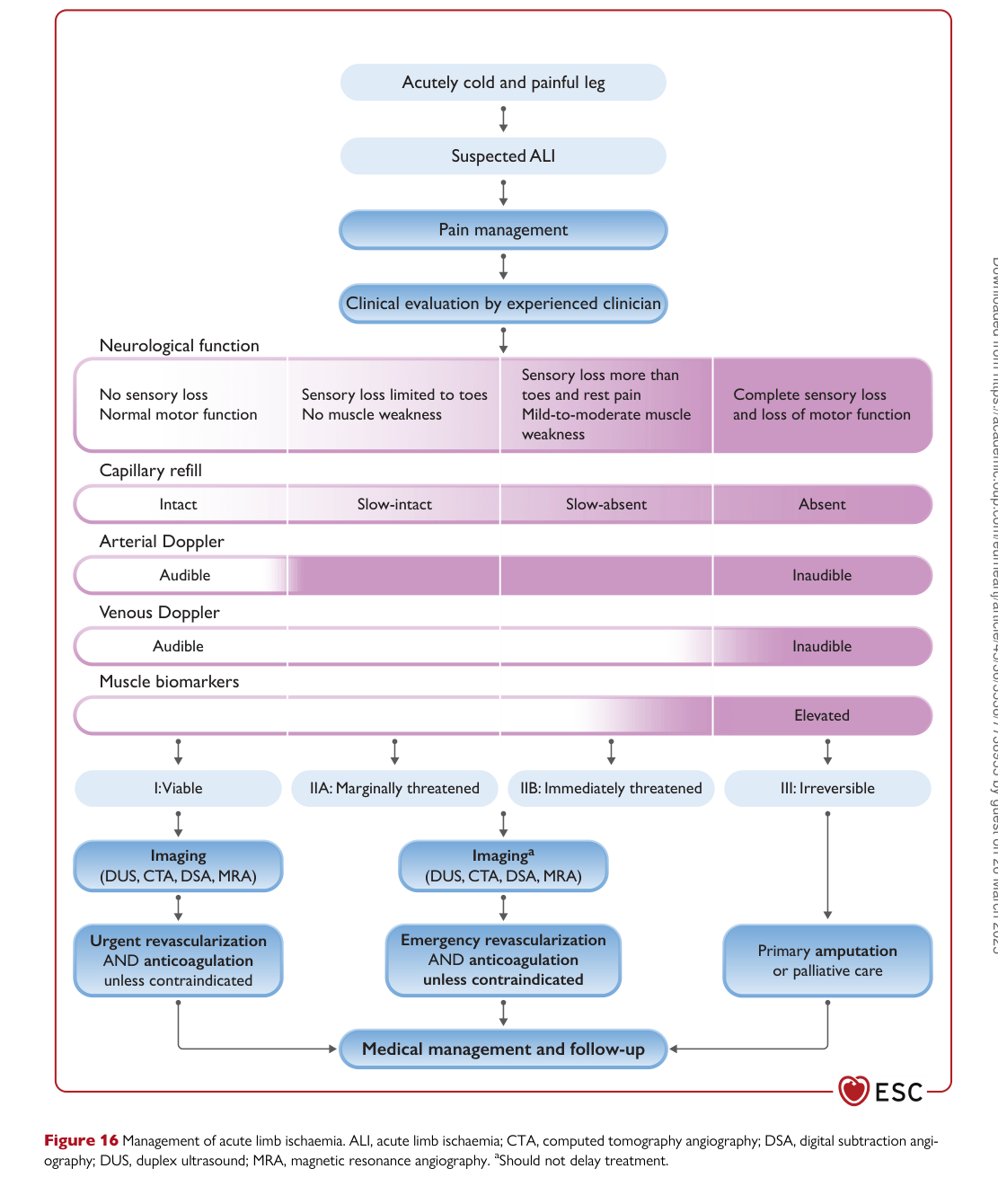
🧭 圖表逐步解析:Figure 16(ALI 管理流程)
這張圖在回答什麼問題:急診來了一位「下肢突然劇痛 + 蒼白」的病人,6 小時內要做什麼決定?
逐步走完:
- Class I(viable):無 motor 缺損、Doppler 仍可聽到動脈聲 → 影像 + revascularization 可從容安排
- Class IIa(marginally threatened):mild sensory loss、minimal motor loss → 立即 revascularization
- Class IIb(immediately threatened):profound sensory loss、moderate motor loss → 立刻送 OR/cath lab,等不及 CT
- Class III(irreversible):anesthesia、paralysis、Doppler 完全 silence → primary amputation
- Catheter-directed thrombolysis(CDT):適合 Class I-IIa、症狀 ≤14 天、無 contraindication(recent surgery、stroke、active bleed)
- Mechanical thrombectomy(aspiration / rheolytic):CDT 不適合或要更快疏通時
- Open surgical embolectomy(Fogarty):classical embolic occlusion、IIb 病人首選
- Bypass surgery:thrombus 移除後仍有 underlying stenosis
容易踩雷的地方:
📋 關鍵 Recommendations 對照表
| 主題 | 建議 | 2024 Class / LOE | vs 舊版(2017) |
|---|---|---|---|
| SAPT in symptomatic PAD | aspirin 或 clopidogrel | I A | 不變 |
| COMPASS regimen(高 ischaemic 非高 bleeding) | rivaroxaban 2.5 mg b.i.d. + ASA 100 mg o.d. | IIa A | 新 |
| 術後 COMPASS regimen | endovascular 後抗血栓 | IIa B | 新(基於 VOYAGER PAD) |
| SET | 所有 symptomatic PAD | I A | 不變 |
| HBET(無 SET 時) | structured + monitored | IIa A | 新 |
| 術後 SET | endovascular 後 adjuvant | I A | 新 |
| QoL assessment 3 個月後 | 正式工具 | I B | 新 |
| asymptomatic 不 revascularize | 勿 prophylactic | III C | 強化 |
| femoro-popliteal drug-eluting 首選 | DCB/DES first-line | IIa A | 新 |
| CLTI 第一線 endovascular | first-line therapy | IIa B | 新角度(BEST-CLI 後重新定位) |
| CLTI autologous vein bypass | GSV 為 preferred conduit | I B | 不變 |
| CLTI 不做 weight-bearing exercise | with wound | III C | 新明文 |
| ALI 立即 anticoagulation | IV UFH 即啟動 | C | 不變 |
- 診斷:ABI 第一線;>1.40 或 diabetic → TBI/toe pressure;症狀疑似 ABI 正常 → exercise ABI;DUS 為 confirmation imaging。
- 治療順序:所有 IC 先 OMT + SET 3 個月 → 3 個月後正式 QoL 評估 → QoL 仍差才談 revascularization。Asymptomatic 不 revascularize(III C)。
- 抗血栓:SAPT 起步 → 高 ischaemic 非高 bleeding 升 COMPASS regimen;術後短期 DAPT 再回到 SAPT/COMPASS。
- femoro-popliteal:DCB/DES 為新 first-line。CLTI:第一線 endovascular;autologous vein 為 bypass conduit;有 wound 禁 exercise。
- ALI:6P → Rutherford 分級 → IIb 跳過 CT 直接送介入;Class III 截肢救命;術後警惕 reperfusion injury/compartment syndrome;找 embolic source。
📖 References
- Mazzolai L, Teixido-Tura G, Lanzi S, et al. 2024 ESC Guidelines for the management of peripheral arterial and aortic diseases. Eur Heart J 2024;45(36):3538-3700. doi:10.1093/eurheartj/ehae179. PMID: 39210710.
- Aboyans V, Ricco JB, Bartelink ME, et al. 2017 ESC Guidelines on the Diagnosis and Treatment of Peripheral Arterial Diseases. Eur Heart J 2018;39(9):763-816.
- Erbel R, Aboyans V, Boileau C, et al. 2014 ESC Guidelines on the diagnosis and treatment of aortic diseases. Eur Heart J 2014;35(41):2873-2926.
- Anand SS, Bosch J, Eikelboom JW, et al. Rivaroxaban with or without aspirin in patients with stable peripheral or carotid artery disease (COMPASS): an international, randomised, double-blind, placebo-controlled trial. Lancet 2018;391(10117):219-29. doi:10.1016/S0140-6736(17)32409-1.
- Bonaca MP, Bauersachs RM, Anand SS, et al. Rivaroxaban in Peripheral Artery Disease after Revascularization (VOYAGER PAD). N Engl J Med 2020;382(21):1994-2004. doi:10.1056/NEJMoa2000052.
- Bonaca MP, Nault P, Giugliano RP, et al. Low-Density Lipoprotein Cholesterol Lowering With Evolocumab and Outcomes in Patients With Peripheral Artery Disease (FOURIER subanalysis). Circulation 2018;137(4):338-50.
- Farber A, Menard MT, Conte MS, et al. Surgery or Endovascular Therapy for Chronic Limb-Threatening Ischemia (BEST-CLI). N Engl J Med 2022;387(25):2305-16. doi:10.1056/NEJMoa2207899.
- Bradbury AW, Moakes CA, Popplewell M, et al. A vein bypass first versus a best endovascular treatment first revascularisation strategy for patients with chronic limb threatening ischaemia who required an infra-popliteal, with or without an additional more proximal infra-inguinal revascularisation procedure to restore limb perfusion (BASIL-2): an open-label, randomised, multicentre, phase 3 trial. Lancet 2023;401(10390):1798-809. doi:10.1016/S0140-6736(23)00462-2.
本文以教學為目的整理 2024 ESC Guidelines for the management of peripheral arterial and aortic diseases,所有原文 Figure 之版權屬 ESC/EACTS;商業使用請洽 ESC 取得授權。