- 5 型 MI 的本質可以用一句話記:(1) Type 1 = 血栓性(plaque rupture/erosion + athero-thrombosis);(2) Type 2 = 失衡性(oxygen supply/demand imbalance,沒有急性 athero-thrombosis);(3) Type 3 = 來不及驗 troponin 就死亡的疑似 MI;(4) Type 4 = PCI 相關(4a 手術全期 / 4b 支架血栓 / 4c 再狹窄);(5) Type 5 = CABG 相關。
- Type 4a / Type 5 的「兩道閘門」:純 cTn 超標不夠。必須同時符合:(i) cTn 門檻 — PCI: > 5× URL;CABG: > 10× URL(baseline 升高且 stable/falling 者,須額外有 > 20% 上升);(ii) 至少一項缺血證據 — new ischaemic ECG / new pathological Q / new viable myocardium loss on imaging / angiographic flow-limiting complication。
- Type 2 MI 是「缺血 MI」,不是「troponin 升高」。它要求 supply-demand imbalance + 缺血臨床證據;只有 cTn 升高、沒缺血證據 = injury,不是 Type 2 MI。Type 2 MI 的有無 CAD 嚴重影響預後(有 CAD 顯著較差),決策上要考慮影像或冠狀動脈評估。
- Type 4b stent thrombosis / Type 4c restenosis 本質上都是 athero-thrombotic,所以條件是同時符合 Type 1 MI 標準,只是病因從原生 plaque 換成支架 / 再狹窄。
- Recurrent MI vs Re-infarction:> 28 天 = recurrent;≤ 28 天 = re-infarction。re-infarction 的診斷需注意 ECG 上 evolutionary changes 的干擾,cTn delta > 20% 是定義要素。
🌟 為什麼要分 5 型?
同樣是「troponin 升高 + 缺血」,背後的機轉、治療策略、預後可以截然不同。分型讓臨床醫師、研究者、流行病學家用同一個語言溝通,並決定要不要走 angiogram、要不要再灌流、要不要強化抗血栓 — 也讓 trial endpoint、品質指標、注冊資料能準確分母。
2007 年 First UDMI 就奠定了 5 型分類,2012、2018 兩次修訂的重點都是「每一型的判定條件更精細、與 myocardial injury 區隔更乾淨」。第四版的最大進展,是要求 Type 4a/4b/4c/5 必須同時跨過 cTn 門檻 和 缺血證據門檻 — 終結了「PCI 後 troponin 升 = type 4a MI」的過度標籤。
📘 Type 1 MI — 血栓性的 spontaneous MI
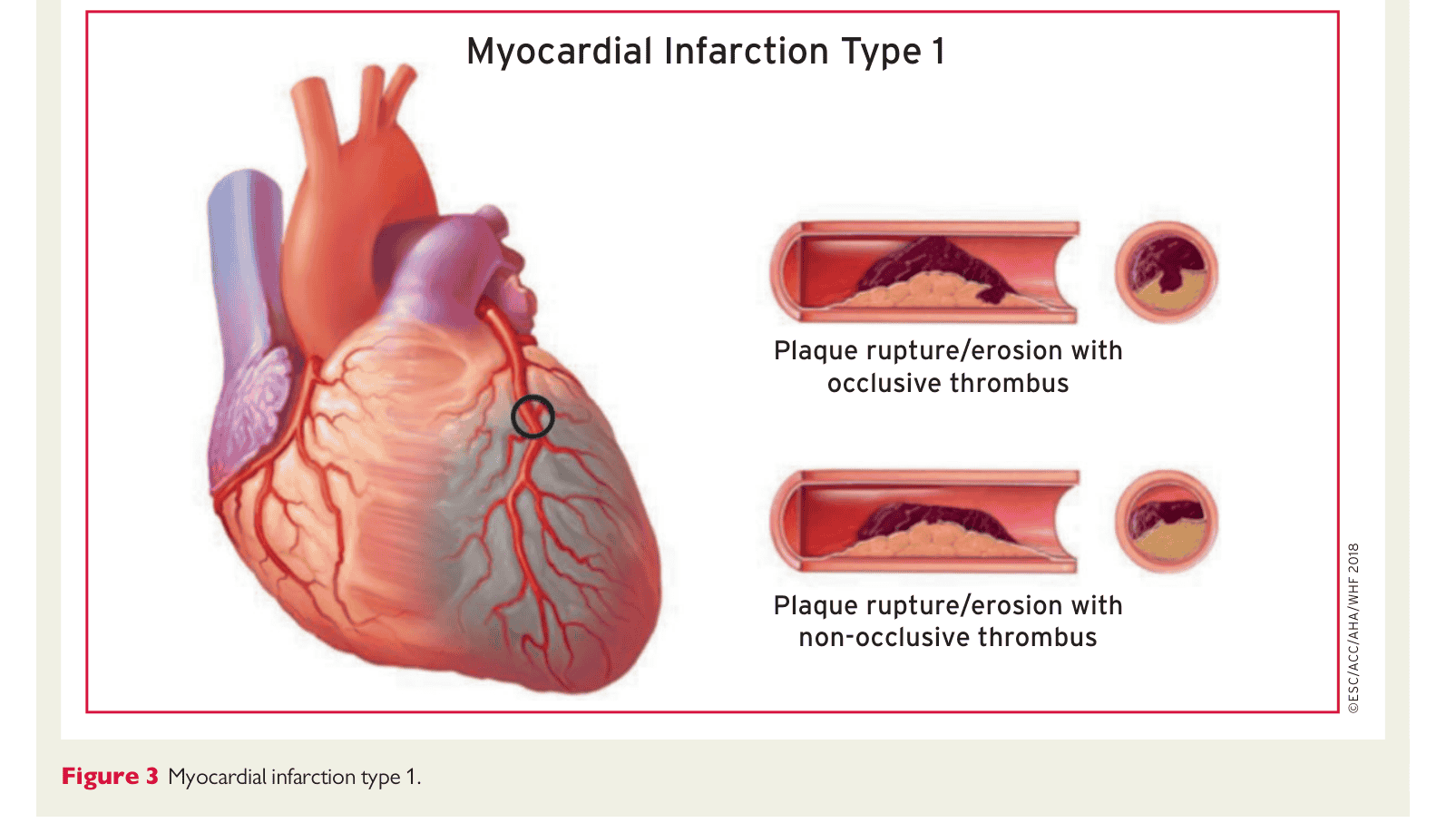
來源:Fourth universal definition of myocardial infarction (2018), Eur Heart J 2019;40:237–269(doi:10.1093/eurheartj/ehy462)— 個人教學使用,原始版權屬 ESC/ACC/AHA/WHF 2018。
定義
Type 1 MI 是因 atherothrombotic plaque disruption 直接導致缺血的 spontaneous MI — 即傳統意義上的「心肌梗塞」。其判定標準與所有 MI 的共同骨幹相同,並把冠狀動脈血栓列為一個獨立的確認證據:
Criteria for type 1 MI
偵測到 cTn rise and/or fall,至少一個值 > 99th percentile URL,而且至少一項:解剖後若在 infarct-related artery 發現 atherothrombus,或大範圍 circumscribed necrosis(不論 cTn 值),即符合 Type 1。
- 急性心肌缺血症狀;
- 新發缺血性 ECG 變化;
- 新發病理性 Q wave;
- 影像顯示新發 viable myocardium loss 或 regional wall motion abnormality,pattern 符合缺血;
- Angiography(含 intracoronary imaging)或解剖看到 coronary thrombus。
機轉與分流
Type 1 的核心是 plaque disruption(rupture 或 erosion)誘發 athero-thrombosis。臨床上會根據 ECG 分流:
- STEMI(持續 ST elevation、新發 LBBB 等 STEMI equivalent):通常對應 occlusive thrombus,需要 primary PCI 或 fibrinolysis。
- NSTEMI:通常對應 non-occlusive thrombus 或 transient occlusion,需依風險分層決定 invasive 時機(依 2023/2020 ESC ACS guidelines)。
意義:Type 1 一旦確診,後續治療路徑非常清楚(DAPT、抗凝、再灌流、二級預防)。臨床上最需要釐清的反而是「這真的是 Type 1 嗎?」— 因為治療強度差很多。
📘 Type 2 MI — 失衡性的 demand-supply MI
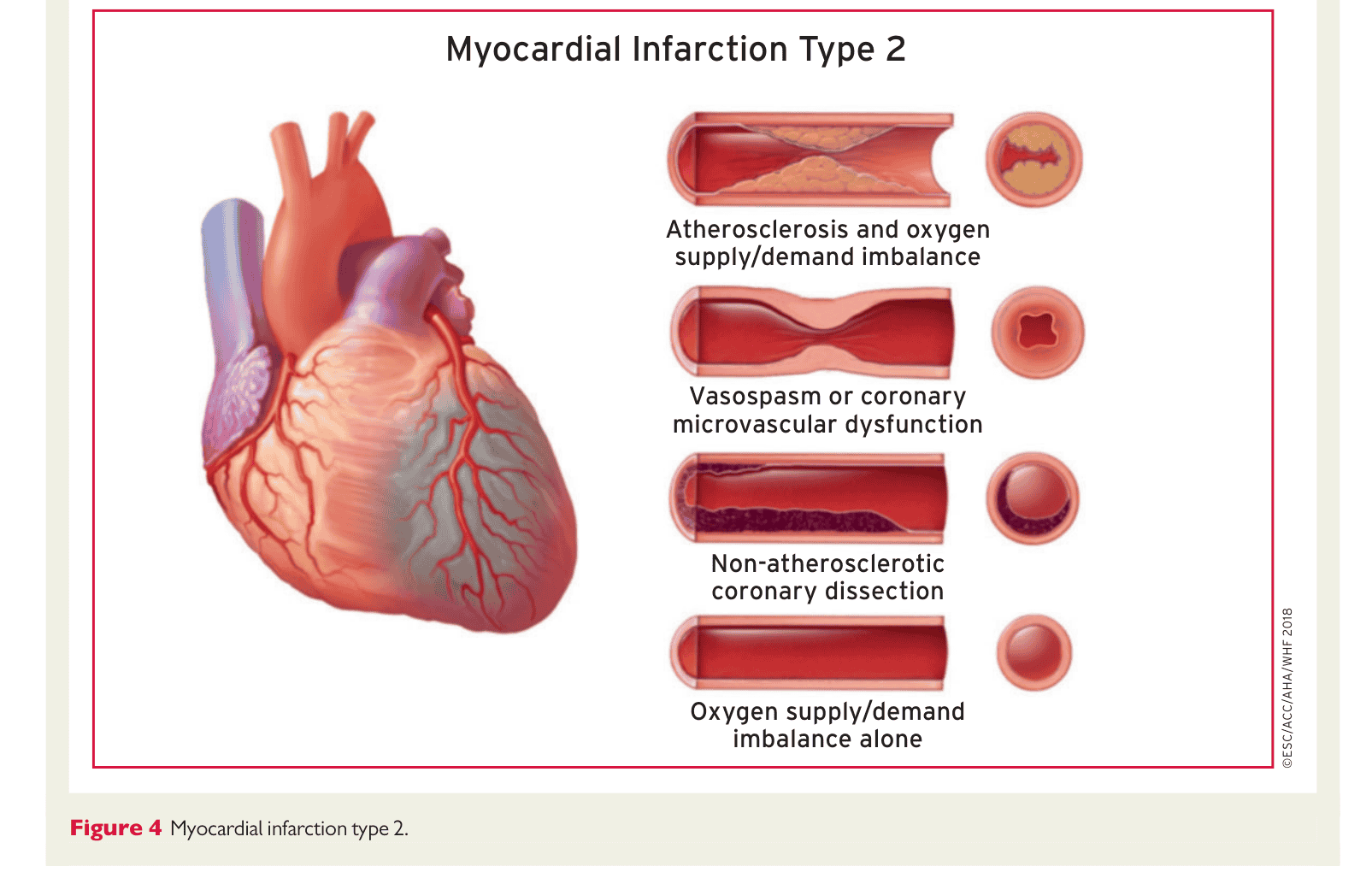
來源:Fourth universal definition of myocardial infarction (2018), Eur Heart J 2019;40:237–269(doi:10.1093/eurheartj/ehy462)— 個人教學使用,原始版權屬 ESC/ACC/AHA/WHF 2018。
定義
Criteria for type 2 MI
偵測到 cTn rise and/or fall(至少一個值 > 99th percentile URL);而且有 oxygen supply/demand imbalance 的證據(與 acute athero-thrombosis 無關);而且至少一項:注意:coronary thrombus 不在 Type 2 的判定要件 — 那是 Type 1 的事。
- 急性心肌缺血症狀;
- 新發缺血性 ECG 變化;
- 新發病理性 Q wave;
- 影像顯示新發 viable myocardium loss / wall motion abnormality,pattern 符合缺血。
🧭 圖表逐步解析:Figure 5(Type 2 MI 的 Context + Mechanism 雙軸框架)
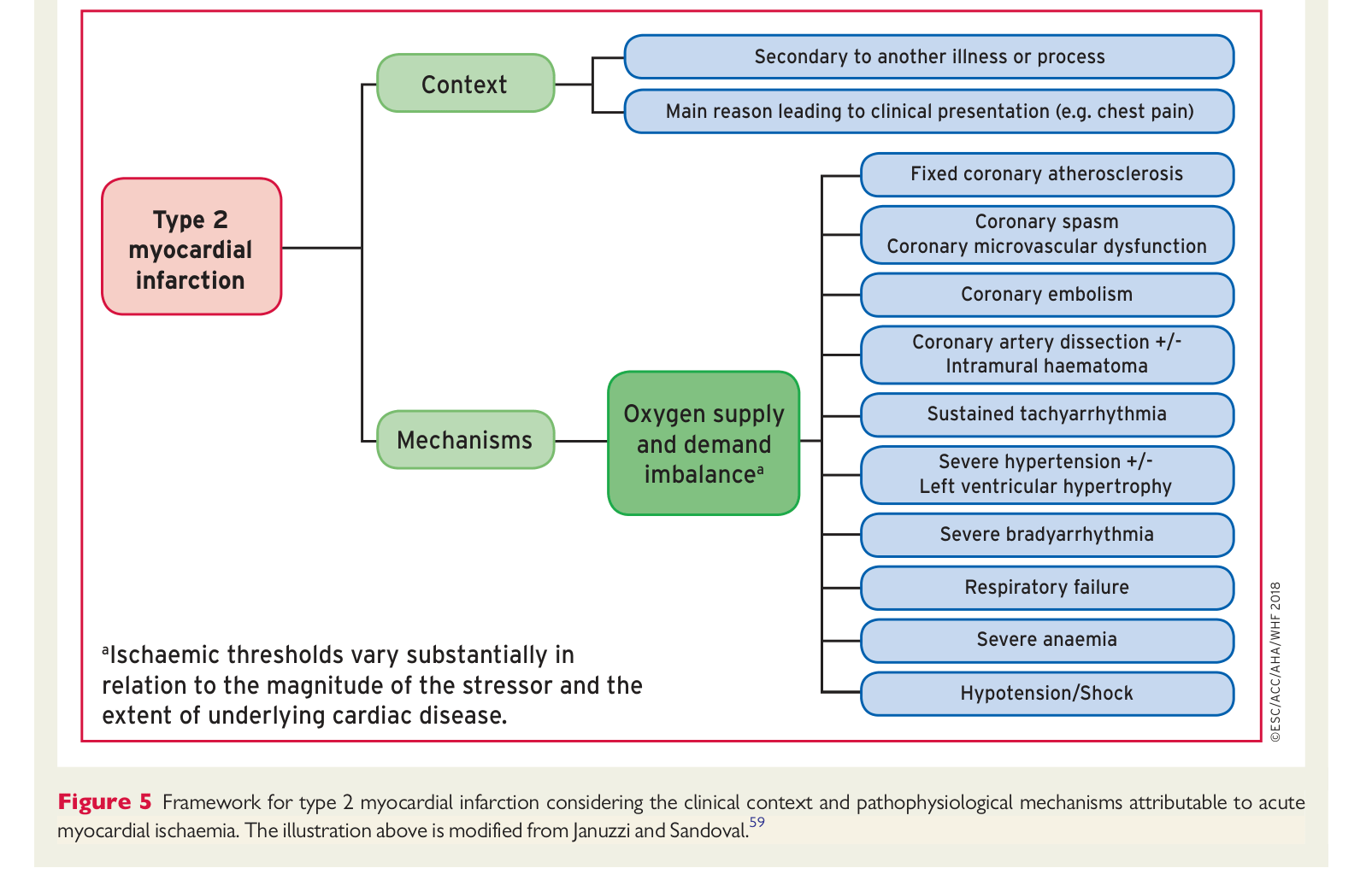
來源:Fourth universal definition of myocardial infarction (2018), Eur Heart J 2019;40:237–269(doi:10.1093/eurheartj/ehy462)— 個人教學使用,原始版權屬 ESC/ACC/AHA/WHF 2018。
這張圖在回答什麼問題:不是所有「不是 Type 1 就 Type 2」。Figure 5 強制臨床端從兩個維度確認 Type 2 — 缺一不可:(1) Context(背景) — 這個 MI 是別的疾病引起的,還是患者主訴本身就是 MI?(2) Mechanism(機轉) — 是哪一條 supply-demand 失衡途徑?
逐步走完:
• Secondary to another illness or process — 例如 GI bleed → Hb drop → 心肌氧供不足;sustained SVT → 氧需求暴增;severe pneumonia → hypoxaemia;septic shock → hypotension。患者主訴可能是原本的病(不是胸痛)。
• Main reason leading to clinical presentation — 患者直接以缺血表現就醫(e.g., chest pain),背後是 vasospasm、SCAD、coronary embolism、microvascular dysfunction 等非 plaque rupture 的機轉。
A. 供應↓(Reduced oxygen supply)
• Fixed coronary atherosclerosis(穩定 CAD 在 stressor 下失補償)
• Coronary spasm(Prinzmetal、cocaine-induced)
• Coronary microvascular dysfunction(含 endothelial dysfunction、smooth muscle dysfunction、sympathetic dysregulation)
• Coronary embolism(AF/LV thrombus/IE vegetation/aortic dissection 等)
• Coronary artery dissection(SCAD — 年輕女性、產後常見)
• Severe bradyarrhythmia
• Respiratory failure with severe hypoxaemia
• Severe anaemia(如 GI bleed 後 Hb < 7-8)
• Hypotension/shock
B. 需求↑(Increased oxygen demand)
• Sustained tachyarrhythmia(rapid AF、SVT、VT)
• Severe hypertension(合併或不合併 LVH)
容易踩雷的地方:
- 把「troponin 升高 + 心搏過速」直接寫成 Type 2 MI 是最常見的錯誤。要 Type 2,必須有缺血臨床證據(症狀 / 新 ischaemic ECG / 新 imaging finding)— 否則只是 myocardial injury(無 ischaemia)。
- 急性 HF 入院、cTn 升 + 動態變化、但無缺血表現:應分類為 acute myocardial injury without ischaemia,不是 Type 2 MI。這是 Figure 6(Part III 詳解)的核心。
- SCAD 是 Type 2 還是 Type 1?因為 SCAD 不是 atherothrombotic plaque rupture,所以分類在Type 2 — non-atherosclerotic dissection 的機轉軸。但治療策略很特別(多保守,避免 PCI 加重 dissection),不能套用 Type 1 的 DAPT 邏輯。
- Coronary embolism(如 AF 患者 LA thrombus 跑到 coronary)也是 Type 2,治療重點在處理 embolic source(抗凝),不是 plaque。
- Type 2 患者「有沒有 CAD」對預後影響非常大 — 有 CAD 者死亡率明顯較高。所以血流動力學允許時,建議做非侵入或侵入性 CAD 評估。
- Type 2 MI 在女性更常見,可能與年齡、microvascular dysfunction、SCAD 較高盛行率有關。
- 多數研究顯示 Type 2 MI 短期與長期死亡率高於 Type 1(背景共病更多)— 不要把 Type 2 當作「比較輕的 MI」。
📘 Type 3 MI — 來不及驗 troponin 的疑似 MI
定義
Criteria for type 3 MI
Cardiac death 患者,伴隨疑似缺血症狀與presumed 新發缺血性 ECG 變化或 VF,但在取得 biomarker 之前死亡;或在 biomarker 上升前就死亡;或之後解剖證實 MI。
為什麼留下 Type 3?
表面上 Type 3 看似「缺資料就硬給標籤」,但它有具體流行病學意義:可以把「致命的 MI 事件」與「更大範圍的 sudden cardiac death」(其中很多是節律性、非缺血性)分開。在 cohort study、死亡審查、心律不整 device trial 中,這個區分非常關鍵。
實務細節:如果 Type 3 患者後續解剖看到 fresh thrombus,應重新分類為 Type 1 MI。Type 3 是「資訊不足下的暫時分類」,遇到新證據要更新。
流行病學上:原始研究顯示 Type 3 MI 的年發生率 < 10/100,000 人年,佔所有 MI 的 3–4%。
📘 Procedural MI — Type 4a / 4b / 4c / 5 的共同骨幹
Type 4 系列(PCI 相關)與 Type 5(CABG 相關)有一個共同前提:必須先區分「procedural injury」與「procedural MI」。第四版用以下層次說明:
| 層次 | 定義 | 說明 |
|---|---|---|
| Procedural myocardial injury | 術後 cTn > 99th percentile URL(baseline 正常者);或 baseline 升高且 stable/falling 者,術後上升 > 20% baseline | 「程序本身造成的傷害」— 不等同 MI,是門檻而已 |
| Type 4a MI (PCI) | cTn > 5× URL(baseline 正常) baseline 升高且 stable/falling 者:> 20% 上升且絕對值 > 5× URL +至少一項缺血證據 | cTn 門檻 + 缺血證據 缺一不可 |
| Type 4b MI | Stent/scaffold thrombosis + 符合 Type 1 MI 標準 | 支架血栓,本質仍是 athero-thrombotic |
| Type 4c MI | In-stent restenosis 為唯一 angiographic 解釋 + 符合 Type 1 MI 標準 | 再狹窄相關 MI,本質仍是 athero-thrombotic |
| Type 5 MI (CABG) | cTn > 10× URL(baseline 正常) baseline 升高且 stable/falling 者:> 20% 上升且絕對值 > 10× URL +至少一項缺血證據 | 因 CABG 必然有更多手術性損傷,門檻高於 PCI |
🧭 圖表逐步解析:Procedural MI 判斷流程(Type 4a / 5 共用骨幹)
這個流程在回答什麼問題:PCI / CABG 後 cTn 升了 — 這算 procedural injury 還是真的 MI?
逐步走完:
- Baseline 正常(cTn ≤ 99th percentile URL):用「絕對值」cutoff。
- Baseline 升高(cTn > URL):必須先確認術前 cTn 是 stable(≤ 20% variation)或 falling,才能解讀術後的 rise;如果術前還在 rising,後面術後再 rise 無法歸因。
- PCI(Type 4a):術後 cTn > 5× URL;baseline 升高者需額外 > 20% rise。
- CABG(Type 5):術後 cTn > 10× URL;baseline 升高者需額外 > 20% rise。
- New ischaemic ECG changes(僅適用 Type 4a;CABG 後 ECG 常有非缺血性變化,較不可靠);
- New pathological Q waves;
- Imaging evidence of new viable myocardium loss / new regional wall motion abnormality;
- Angiographic flow-limiting complication:coronary dissection / major epicardial artery occlusion / side branch occlusion-thrombus / disruption of collateral flow / slow-flow / no-reflow / distal embolization;CABG 則為 new graft occlusion / new native coronary occlusion。
容易踩雷的地方:
- 最大陷阱:把「術後 troponin 升高」直接寫成 Type 4a / Type 5 MI。20–40% 的穩定 CAD 患者 PCI 後會有 cTn 升高,40–50% 的 ACS 患者 PCI 後也會 — 這多半是 procedural injury,不是 MI。
- 沒有 stable baseline 卻硬解讀術後 delta 是錯的。如果患者本身是 STEMI / NSTEMI 入院、PCI 前 cTn 還在 rising,那 PCI 後的「再升」根本無法歸因 — 不能說是 type 4a。第四版明確:這時的升高應歸給 index event。
- Type 4b 與 Type 4c 容易跟 Type 4a 混淆。判斷關鍵:4b 和 4c 是「事件本質就是支架血栓 / 再狹窄」,必須同時符合 Type 1 MI 標準(因為它們本質是 athero-thrombotic)。4a 則是「PCI 手術全期、由 procedure 直接引起」的範疇。
- Stent thrombosis 時程定義(Type 4b 文中採用 ARC 分類):acute 0–24h、subacute > 24h–30 天、late > 30 天–1 年、very late > 1 年。對應病因不同(acute/subacute 多 procedural、late/very late 多 DAPT 過早停 / 在 ISR / 新生 plaque)。
- CABG 後的 ST 變化 大多是 epicardial injury(pericardial inflammation、retraction),不可靠。但ST elevation 合併 reciprocal ST depression,或特定具體模式(local lead 對應 grafted territory),仍可作為缺血指標。
- ARC-2 提出更嚴的 cutoff(PCI/CABG 都用 cTn ≥ 35× URL + 一項缺血證據;single criterion ≥ 70× URL 即可成立 procedural injury 的「重大」分級)。第四版採用較寬的 5×/10× UDMI 標準,但 trial 中使用 ARC-2 也是可接受的 — 看研究 endpoint 採哪一套。
- hs-cTn 對 procedural MI 的 cutoff 仍在發展中,目前資料支持 hs-cTnT 的 5× 與 UDMI 規則接近,故第四版保留原 cutoff。
📘 Recurrent MI vs Re-infarction — 28 天為界
| 名詞 | 時間 | 定義 | 診斷重點 |
|---|---|---|---|
| Incident MI | — | 個人「第一次」MI | 第一次事件 |
| Recurrent MI | > 28 天 後 | 初次事件後 28 天之後再發 MI | 流行病學上算「新事件」 |
| Re-infarction | ≤ 28 天 內 | Incident 或 recurrent MI 後 28 天之內再發急性 MI | ECG 易受 evolutionary changes 干擾;cTn delta > 20% 是核心 |
Re-infarction 怎麼診斷?
因為前次 MI 後 ECG 與 cTn 都還在動態變化,re-infarction 的判讀有兩個操作要點:
- ECG 訊號:≥ 1 mm 再發 ST elevation 或新發 pathognomonic Q wave(≥ 2 contiguous leads),合併缺血症狀提示 re-MI。但單純 re-elevation 也可能是 threatened myocardial rupture、pericarditis — 需要其他證據。
- cTn 操作:懷疑 re-MI 時,立即抽 cTn;3-6 小時後或更早(hs-cTn)再抽。
- 若初次 cTn 仍升高但 stable/falling:第二樣本須 > 20% 上升 才符合 re-infarction(避免將前次 MI 的 cTn 餘暉誤判)。
- 若初次 cTn 已正常化:套用一般 acute MI 標準(rise + 缺血證據)。
📋 關鍵診斷標準速查表(5 型整合)
| MI 類型 | cTn 條件 | 缺血證據要求 | 特殊備註 |
|---|---|---|---|
| Type 1(spontaneous) | Rise/fall + ≥ 1 值 > 99th URL | 至少 1 項(含 angiography 看到 coronary thrombus) | 解剖見 atherothrombus / 大面積壞死,不論 cTn 也算 |
| Type 2(supply-demand) | Rise/fall + ≥ 1 值 > 99th URL | 至少 1 項(症狀 / 新 ECG / 新 Q / 影像);不包含 coronary thrombus | 需有 supply-demand imbalance(fixed CAD / spasm / microvascular / embolism / dissection / anaemia / hypoxaemia / hypotension / tachy / hyper) |
| Type 3 | 未取得(或未及上升) | 疑似缺血症狀 + presumed 新 ischaemic ECG / VF | 後續解剖見 fresh thrombus → 重新分類為 Type 1 |
| Type 4a(PCI) | cTn > 5× URL;baseline 升高且 stable 者需 > 20% rise 且絕對 > 5× URL | 至少 1 項(new ECG / new Q / imaging / angiographic flow-limiting) | 解剖見 procedure-related thrombus → 符合(不論 cTn) |
| Type 4b | 同 Type 1 標準 | 同 Type 1 標準 + angiographic / autopsy 確認 stent thrombosis | 時程分 acute / subacute / late / very late |
| Type 4c | 同 Type 1 標準 | 同 Type 1 標準 + in-stent restenosis 為唯一 angiographic 解釋 | — |
| Type 5(CABG) | cTn > 10× URL;baseline 升高且 stable 者需 > 20% rise 且絕對 > 10× URL | 至少 1 項(new Q / new graft or native artery occlusion on angio / imaging viable loss);ECG 變化單獨不可靠 | 單獨明顯 cTn 升高(48h 內)即使無 ECG/影像,仍提示 prognostically significant procedural injury — 但不直接 = MI |
🌐 流行病學要點
- Type 1 仍佔多數,但 hs-cTn 普及後 Type 2 的偵測率顯著上升(特別在 ED 與 ICU cohort)。
- Type 2 短期與長期死亡率多高於 Type 1(因背景共病多)— 別把 Type 2 當「比較輕」。
- Type 2 在女性較常見。
- Type 4a 真正符合「cTn 5× URL + 缺血證據」的比例遠低於「PCI 後 cTn 升高」的比例。
- CABG 後 32–44% 患者 LGE-CMR 可見 procedural injury(即使臨床完全無症狀)。
- Type 1 = 血栓性;Type 2 = 失衡性;Type 3 = 來不及驗 troponin 的疑似 MI;Type 4 = PCI 相關(4a 手術全期、4b 支架血栓、4c 再狹窄);Type 5 = CABG 相關。
- Type 2 必須同時有 (a) cTn rise/fall + (b) supply-demand imbalance + (c) 缺血臨床證據。沒缺血證據 = injury,不是 Type 2。
- Type 4a / Type 5 的「兩道閘門」:cTn 門檻(5× / 10× URL)+ 至少一項缺血證據。純 cTn 超標僅算 procedural injury。
- Type 4b / 4c 是「事件本質為支架血栓 / 再狹窄」,需同時滿足 Type 1 MI 標準。
- Re-infarction(≤ 28 天)診斷靠 cTn delta > 20% + ECG/症狀;不要被 evolutionary ECG changes 騙。
- 對醫學生:先學會「有沒有缺血證據」這個問題 — 它決定了你寫的是 MI 還是 injury,影響整個治療策略。
📖 References
- Thygesen K, Alpert JS, Jaffe AS, et al. Fourth universal definition of myocardial infarction (2018). Eur Heart J 2019;40(3):237–269. doi:10.1093/eurheartj/ehy462. PMID: 30165617.
- Januzzi JL Jr, Sandoval Y. The many faces of type 2 myocardial infarction. J Am Coll Cardiol 2017;70(13):1569–1572.
- Chapman AR, Adamson PD, Mills NL. Assessment and classification of patients with myocardial injury and infarction in clinical practice. Heart 2017;103(1):10–18.
- Sandoval Y, Smith SW, Thordsen SE, Apple FS. Supply/demand type 2 myocardial infarction: should we be paying more attention? J Am Coll Cardiol 2014;63(20):2079–2087.
- Saaby L, Poulsen TS, Hosbond S, et al. Classification of myocardial infarction: frequency and features of type 2 myocardial infarction. Am J Med 2013;126(9):789–797.
- Saw J, Mancini GBJ, Humphries KH. Contemporary review on spontaneous coronary artery dissection. J Am Coll Cardiol 2016;68(3):297–312.
- Hayes SN, Kim ESH, Saw J, et al. Spontaneous coronary artery dissection: current state of the science: a scientific statement from the American Heart Association. Circulation 2018;137(19):e523–e557.
- Garcia-Garcia HM, McFadden EP, Farb A, et al. Standardized end point definitions for coronary intervention trials: the Academic Research Consortium-2 consensus document. Circulation 2018;137(24):2635–2650. (ARC-2 definition)
- Cutlip DE, Windecker S, Mehran R, et al. Clinical end points in coronary stent trials: a case for standardized definitions. Circulation 2007;115(17):2344–2351. (Stent thrombosis 時程分類)
- Bulluck H, Paradies V, Barbato E, et al. Prognostically relevant periprocedural myocardial injury and infarction associated with percutaneous coronary interventions: a Consensus Document of the ESC Working Group on Cellular Biology of the Heart and European Association of Percutaneous Cardiovascular Interventions (EAPCI). Eur Heart J 2021;42(27):2630–2642.
- Domanski MJ, Mahaffey K, Hasselblad V, et al. Association of myocardial enzyme elevation and survival following coronary artery bypass graft surgery. JAMA 2011;305(6):585–591.
- Devereaux PJ, Biccard BM, Sigamani A, et al. Association of postoperative high-sensitivity troponin levels with myocardial injury and 30-day mortality among patients undergoing noncardiac surgery (VISION study). JAMA 2017;317(16):1642–1651.
本文以教學為目的整理 2018 Fourth Universal Definition of Myocardial Infarction (ESC/ACC/AHA/WHF Joint Task Force),所有原文 Figure 之版權屬 ESC/ACC/AHA/WHF 2018;商業使用請洽該等學會取得授權。