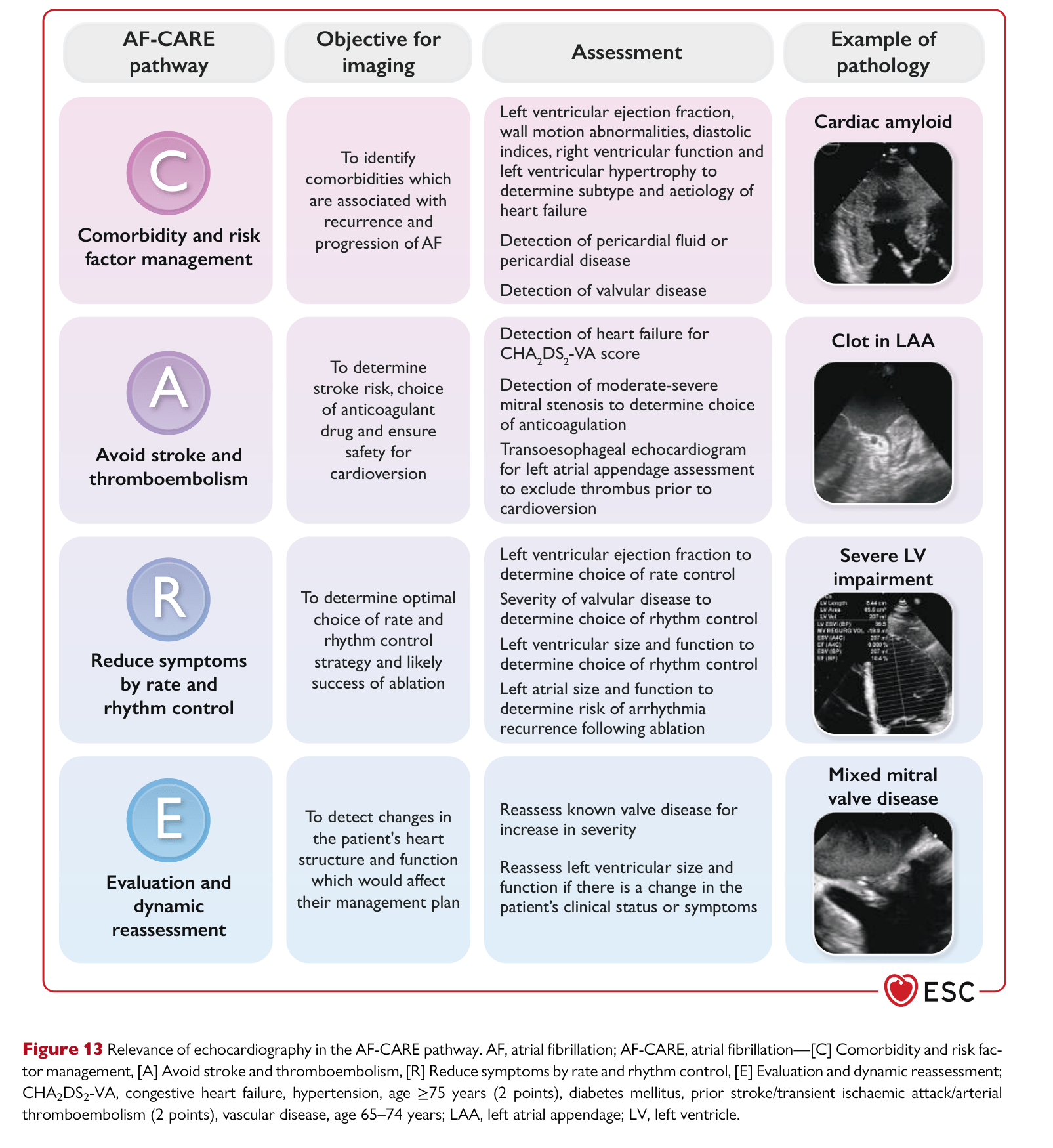
- [E] 是 2024 版的「新字母」:不是單純的「追蹤門診」,而是每 6 個月 + 後續至少每年系統性 reassess 心律、症狀、共病、心臟結構、藥物順從性、出血/血栓風險。echocardiography 在 AF-CARE 每一階段都有角色(Fig 13)。
- 特殊族群最關鍵的 3 個更新:(1) ESUS 無 documented AF 不要 empiric OAC(III A,NAVIGATE-ESUS + RE-SPECT ESUS 雙陰性);(2) Post-op AF 並非「過渡性」,OAC 升為 IIa B,amiodarone 手術全期預防 I A;(3) Trigger-induced AF 也是 AF,elevated risk 者長期 OAC IIa C。
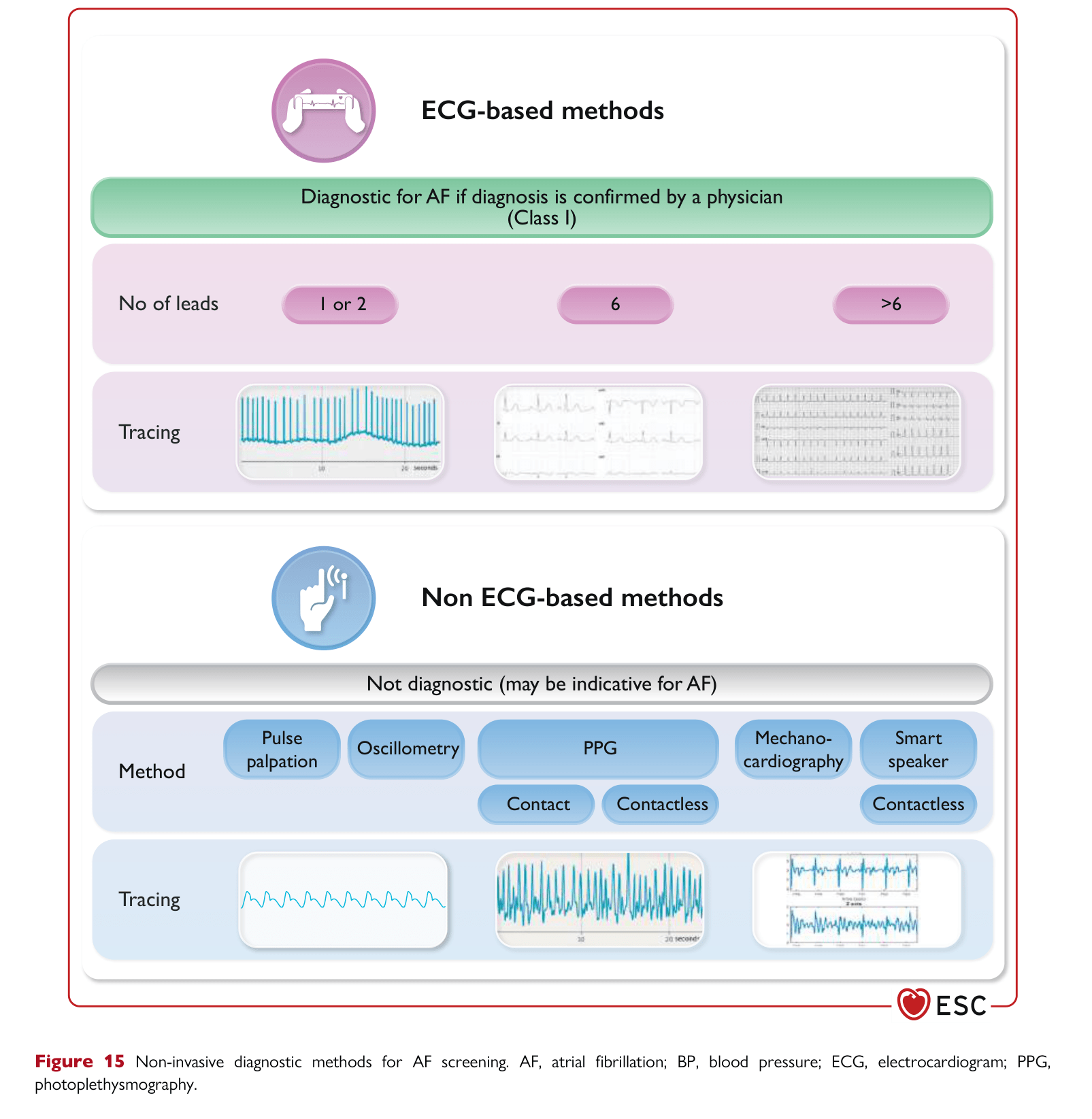
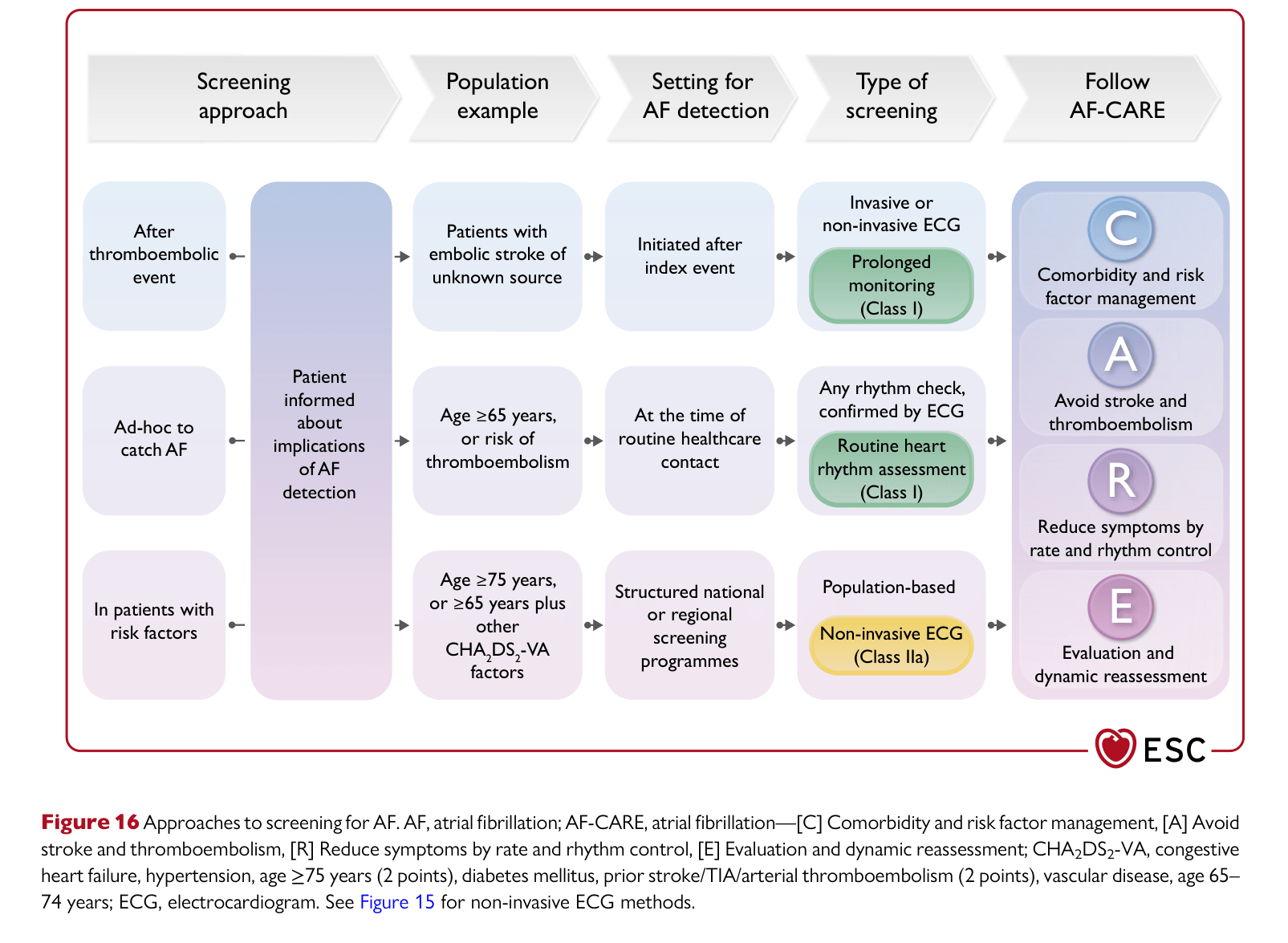
- 篩檢策略大轉向:機會性篩 ≥65 升為 prolonged screening 給 ≥75y 或 ≥65y + CHA2DS2-VA 因子者 IIa B(STROKESTOP);但純設備陽性不能直接抗凝—必須由醫師判讀 ECG 才能確診(I B)。
📐 §8 [E] Evaluation and Dynamic Reassessment
動態 reassessment 的標準頻率與內容
| 時間點 | 必檢項目 |
|---|---|
| 診斷後 6 個月 | 症狀(mEHRA score)、HR control、AF burden、共病進展、藥物耐受、INR/腎肝功能、出血/血栓事件 |
| 之後每年至少 1 次(或 based on clinical need) | 同上 + cardiac imaging(依需要)+ 重新計算 CHA2DS2-VA(年紀+1、新共病) |
| 重大臨床變化時 | 急性事件後(中風、出血、HF 住院)、AF 型態轉變、新發共病、開始/停止重要藥物 |
關鍵 recommendation
| 建議 | COR/LOE |
|---|---|
| Re-evaluate AF episodes on AF admissions Regular re-evaluation 6 months after presentation, and then at least annually or based on clinical need | I C |
| Assess area and existing risk factors and comorbidities (即年度共病評估) | I |
| Stratify risk for stroke and thromboembolism | I |
| Check impact of AF symptoms and after treatment | I |
| Assess and manage modifiable bleeding risk factors | I |
| Common OAC despite rhythm control if risk of thromboembolism | I |
| Evaluating quality of care 並改善 institutions / practitioners | IIa B(新加) |
🖼️ Figure 13 — Echocardiography 在 AF-CARE 每一階段的角色
來源:2024 ESC Guidelines for the management of atrial fibrillation (Eur Heart J, doi:10.1093/eurheartj/ehae176) — 個人教學使用,原始版權屬 ESC/EACTS。
🧭 圖表逐步解析:Figure 13
這張圖在回答什麼問題:Echo 不是「一次性檢查」,在 AF-CARE 每個字母都該回頭做。圖把四列 [C][A][R][E] 對應的 imaging 目標、評估內容、典型病理列出。
逐步走完(依字母列):
容易踩雷的地方:
📐 §9 特殊臨床情境總覽
2024 版把特殊族群整合成 §9 的 14 個小節,下表整理重點 recommendations:
§9.1 Unstable AF patients
| 建議 | COR/LOE |
|---|---|
| Haemodynamic instability → emergency electrical cardioversion | I C |
| IV amiodarone for rate control when no other option(HFrEF / refractory) | IIa C |
§9.2 AF + ACS / CCS / PCI
詳見第 III 篇 Figure 14。重點:DOAC + clopidogrel 為主流;TAT 限縮(<1 週 ACS / 1 個月 ACS high-risk);stable CCS >1 年 OAC only(III B 加抗血小板)。
| 建議 | COR/LOE |
|---|---|
| Stable AF + chronic coronary/vascular >12 m:抗血小板 stop(單 OAC only) | III B(新加) |
§9.3 AF + Vascular disease
跟 §9.2 邏輯類似。PAD / aortic disease 患者長期 OAC + lifestyle modification。COMPASS regimen(rivaroxaban 2.5 mg BID + ASA)在無 AF 的 PAD 是建議,但有 AF 不要這樣組合—OAC 就足夠。
§9.4 AF + Acute Stroke / ICH — 抗凝重啟的時機
| 情境 | 建議 | COR/LOE |
|---|---|---|
| Acute ischaemic stroke:thrombolysis / thrombectomy per stroke guideline | 建議 | I |
| Acute ischaemic stroke 後 → DOAC 重啟(依梗塞大小 timing 1-2 週) | 建議 | B |
| ICH 後 → 多學科評估、必要時延遲重啟(4-8 週 depending on cause) | 建議 | C |
| ESUS(embolic stroke of unknown source)無 documented AF → empiric OAC 不建議 | 禁止 | III A |
ESUS 的故事:NAVIGATE-ESUS(NEJM 2018)測 rivaroxaban、RE-SPECT ESUS(NEJM 2019)測 dabigatran,兩個都對 stroke recurrence 無顯著降低,但出血增加。指引明確:沒找到 AF 就不要 empiric 抗凝,要先做 prolonged monitoring(implantable loop recorder >30 天)找 AF。
§9.5 Trigger-induced AF
過去常認為「術後 AF、敗血症期間 AF、急性疾病期間 AF」是「短暫不重要」。新證據:
- Post-sepsis AF:5 年中風風險與一般 AF 接近。
- Triggers 包括:infection、surgery、pulmonary embolism、hyperthyroidism、acute MI、alcohol binge。
| 建議 | COR/LOE |
|---|---|
| Trigger-induced AF + elevated thromboembolic risk → long-term OAC 應該考慮 | IIa C(新加) |
§9.6 Post-operative AF
| 建議 | COR/LOE |
|---|---|
| Cardiac surgery 手術全期 amiodarone 預防 POAF | I A(新加) |
| Concomitant posterior pericardiotomy 預防 POAF | IIa B(新加) |
| Cardiac & non-cardiac surgery POAF + elevated risk → long-term OAC 應該考慮 | IIa B(升 IIb → IIa) |
posterior pericardiotomy:在 cardiac surgery 結束關胸前,從心包後壁切一小口讓滲液不會壓迫心房。PALACS 試驗(JAMA Cardiol 2021)顯示 POAF 從 32% 降到 17%(NNT 7)。
§9.7 ESUS
見 §9.4。重點重申:無 documented AF 不要 empiric OAC III A。要做 prolonged monitoring 找 AF。
§9.8 AF + Pregnancy
| 建議 | COR/LOE |
|---|---|
| Unstable AF → cardioversion safe in pregnancy | C |
| Rate control:β-1 selective(metoprolol、bisoprolol);digoxin 也可 | C |
| Atenolol:不建議(IUGR) | III C |
| OAC:VKA 在 5-6 月後(warfarin teratogenic in 1st trimester);LMWH 在第一孕期 + 接近分娩;DOAC 一律不要 | C |
| DOAC:禁忌(穿胎盤、缺乏安全資料) | III C |
§9.9-9.11 CHD、Endocrine、Cardiomyopathies
- CHD(成人先天性心臟病):AF 風險高,OAC 多採低分數啟動;rhythm control 困難(解剖變異多);通常需 multidisciplinary 評估 ablation。
- Endocrine disorders:hyperthyroidism → 控甲狀腺後 50-70% 自發轉復;treatment 甲狀腺為先。
- HCM:不看分數一律 OAC I B。catheter ablation 在 HCM 可行但成功率略低。
- Cardiac amyloidosis:不看分數一律 OAC I B。注意 LAA thrombus 即使有 OAC 仍可能存在(cardioversion 前 TOE)。
§9.12 AF + Cancer
癌症與 AF 雙重影響:
- 癌症本身(特別 lung、haematologic、GI)增加 AF 風險。
- 化療藥物(ibrutinib、tyrosine kinase inhibitor、anthracycline、5-FU、cisplatin)促 AF。
- OAC 選擇:避開與化療互動(多數化療經 P-gp/CYP3A4 → DOAC 互動);血小板低時暫停。
- LMWH 在 thrombocytopenia 較好調整劑量。
§9.13 AF in Older / Multimorbid / Frail Patients
| 建議 | COR/LOE |
|---|---|
| Frail / dementia → 個別化評估 OAC 益害 (個案化決策) | C |
| 跌倒風險 → 不是 OAC 禁忌(需 ≥295 次跌倒/年才超越益處) | — |
| Polypharmacy → 注意 DOAC 互動(見 Fig 9) | — |
§9.14 Atrial Flutter
| 建議 | COR/LOE |
|---|---|
| Atrial flutter + elevated thromboembolic risk → OAC 建議 | I B(新加 — 與 AF 相同看待) |
| Cavotricuspid isthmus ablation 為 typical flutter 一線治療 | I A |
📐 §10 Screening & Prevention
§10.1-10.2 流行病學與篩檢工具
AF 全球盛行率正在 doubling(2010 → 2060)。Lifetime risk 已從 1/5 升到 1/3(歐美 ≥55 歲)。台灣 ≥65y 盛行率約 5-6%。早期診斷的重要性:
- ~25% AF 是 asymptomatic(silent AF);中風可能是第一個臨床表現。
- 30-50% cryptogenic stroke 與 silent AF 相關。
- Early detection → early OAC → 中風預防。
🖼️ Figure 15 — Non-invasive Diagnostic Methods for AF Screening
來源:2024 ESC Guidelines for the management of atrial fibrillation (Eur Heart J, doi:10.1093/eurheartj/ehae176) — 個人教學使用,原始版權屬 ESC/EACTS。
🧭 圖表逐步解析:Figure 15
這張圖在回答什麼問題:篩 AF 的工具光譜,從正式 ECG 到消費級穿戴裝置,分類與每類的特性。
逐步走完(兩大區塊):
容易踩雷的地方:
🖼️ Figure 16 — Approaches to Screening for AF
來源:2024 ESC Guidelines for the management of atrial fibrillation (Eur Heart J, doi:10.1093/eurheartj/ehae176) — 個人教學使用,原始版權屬 ESC/EACTS。
🧭 圖表逐步解析:Figure 16
這張圖在回答什麼問題:不同臨床情境(中風後、機會性、高風險族群、有風險因子)下,AF 篩檢策略有什麼差異?
逐步走完(5 欄 5 種情境):
具體建議分層:
| 建議 | COR/LOE |
|---|---|
| ECG(12-lead or single/multiple leads)+ 醫師判讀 → AF 確診 | I B(新加) |
| ≥75y 或 ≥65y + CHA2DS2-VA 因子 → prolonged non-invasive ECG screening | IIa B(新加) |
| ≥65y opportunistic ECG/pulse check | 延續 |
| ESUS → ILR 監測尋找 silent AF | B |
關鍵試驗 STROKESTOP(Lancet 2021):瑞典 75-76 歲 28,768 人隨機分 prolonged screening(2 週 intermittent ECG)vs 對照組,5 年 ischaemic stroke + systemic embolism + bleeding + 死亡 composite HR 0.96(borderline),但 AF detection rate +5% 顯著高,OAC 啟動率上升。LOOP 試驗(Lancet 2021):6,004 名 ≥70y + risk factor 用 ILR vs usual care,3 年 AF detection 31.8% vs 12.2%(OR 3.17),但 stroke 沒顯著降低(HR 0.80, p=0.11)。
意涵:篩出 AF 後一定要進入完整 AF-CARE 處理才有臨床意義;單純 detection 沒有降低 stroke 的證據。所以圖 16 第 5 欄強調 “Follow AF-CARE”。
容易踩雷的地方:
📋 §9 重點 Recommendations 整理
| 族群 | 主要建議 | COR/LOE | 新增/升降 |
|---|---|---|---|
| Acute unstable AF | Emergency cardioversion | I C | 延續 |
| ACS stable >12 m | OAC only(不加 antiplatelet) | III B | 新加 |
| ESUS 無 AF | 不 empiric OAC | III A | 新加 |
| Trigger-induced AF + elevated risk | 長期 OAC 應考慮 | IIa C | 新加 |
| Cardiac surgery 手術全期 AF 預防 | Amiodarone | I A | 新加 |
| Cardiac surgery 手術全期 AF 預防 | Posterior pericardiotomy | IIa B | 新加 |
| Post-op AF + elevated risk | 長期 OAC 應考慮 | IIa B | 升 IIb → IIa |
| Pregnancy | VKA after 1st trimester;DOAC 禁忌 | C / III C | 延續 |
| HCM | OAC 不看分數 | I B | 明確化 |
| Cardiac amyloidosis | OAC 不看分數 | I B | 明確化 |
| Cancer + AF | 個別化 OAC(化療互動考量) | C | 明確化 |
| Frail elderly | 個別化(跌倒不是禁忌) | C | 明確化 |
| Atrial flutter + elevated risk | OAC(與 AF 相同看待) | I B | 明確化 |
- [E] 動態 reassessment 不是「追蹤門診」,是每 6 個月 + 後續至少每年系統性 reassess 心律、症狀、共病、心臟結構、藥物、出血/血栓風險。
- Echo 在 AF-CARE 每階段都有角色(Fig 13):[C] 找驅動因子(含 cardiac amyloid)、[A] cardioversion 前 TOE LAA、[R] ablation 前 LA size/function、[E] 年度 reassess。
- 特殊族群 3 大關鍵:ESUS 無 AF 不要 empiric OAC(III A)、Post-op AF 升 IIa B + amiodarone I A + posterior pericardiotomy IIa B、Trigger-induced AF + 高風險者長期 OAC IIa C。
- HCM 與 cardiac amyloidosis 一律 OAC 不看分數(I B);atrial flutter 等同 AF 處理(I B)。
- Pregnancy:DOAC 禁忌;VKA 在 5-6 月後;atenolol 禁忌(IUGR)。
- 篩檢 3 大新立場:(1) ≥75y 或 ≥65y + CHA2DS2-VA 因子 → prolonged screening IIa B;(2) 必須醫師判讀 ECG 才確診(I B)—wearable 是 trigger 不是 conclusion;(3) Subclinical AF (AHRE) 抗凝是 IIb B 個別評估。
📖 References
- Van Gelder IC, Rienstra M, Bunting KV, et al. 2024 ESC Guidelines for the management of atrial fibrillation. Eur Heart J 2024;45(36):3314–3414. doi:10.1093/eurheartj/ehae176
- Hart RG, Sharma M, Mundl H, et al. Rivaroxaban for Stroke Prevention after Embolic Stroke of Undetermined Source (NAVIGATE-ESUS). N Engl J Med 2018;378:2191–2201. doi:10.1056/NEJMoa1802686
- Diener HC, Sacco RL, Easton JD, et al. Dabigatran for Prevention of Stroke after Embolic Stroke of Undetermined Source (RE-SPECT ESUS). N Engl J Med 2019;380:1906–1917. doi:10.1056/NEJMoa1813959
- Svennberg E, Friberg L, Frykman V, et al. Clinical outcomes in systematic screening for atrial fibrillation (STROKESTOP). Lancet 2021;398:1498–1506. doi:10.1016/S0140-6736(21)01637-8
- Svendsen JH, Diederichsen SZ, Højberg S, et al. Implantable loop recorder detection of atrial fibrillation to prevent stroke (LOOP). Lancet 2021;398:1507–1516. doi:10.1016/S0140-6736(21)01698-6
- Perez MV, Mahaffey KW, Hedlin H, et al. Large-Scale Assessment of a Smartwatch to Identify Atrial Fibrillation (Apple Heart Study). N Engl J Med 2019;381:1909–1917. doi:10.1056/NEJMoa1901183
- Gaudino M, Sanna T, Ballman KV, et al. Posterior left pericardiotomy for the prevention of atrial fibrillation after cardiac surgery (PALACS). Lancet 2021;398:2075–2083. doi:10.1016/S0140-6736(21)02490-9
- Kirchhof P, Toennis T, Goette A, et al. Anticoagulation with Edoxaban in Patients with Atrial High-Rate Episodes (NOAH-AFNET 6). N Engl J Med 2023;389:1167–1179. doi:10.1056/NEJMoa2303062
- Healey JS, Lopes RD, Granger CB, et al. Apixaban for Stroke Prevention in Subclinical Atrial Fibrillation (ARTESiA). N Engl J Med 2024;390:107–117. doi:10.1056/NEJMoa2310234
- Bezzina CR, Lahrouchi N, Priori SG. Genetics of sudden cardiac death. Circ Res 2015;116:1919–1936(特殊心肌病背景參考).
- Garner DT, Calkins H, et al. Postoperative atrial fibrillation: time for action. Eur Heart J 2023(POAF 思路綜述).
本文以教學為目的整理 2024 ESC Guidelines for the management of atrial fibrillation;所有原文 Figure 之版權屬 ESC/EACTS。商業使用請洽 ESC 取得授權。